Why Colombia’s New Deals With Washington Are Smaller Than Billed
Key Facts
Colombia’s new right-wing president wants to repair relations with Washington after years of clashes under his leftist predecessor. On 8 September the two governments signed two memoranda in Barranquilla, and they are narrower than the rhetoric around them.
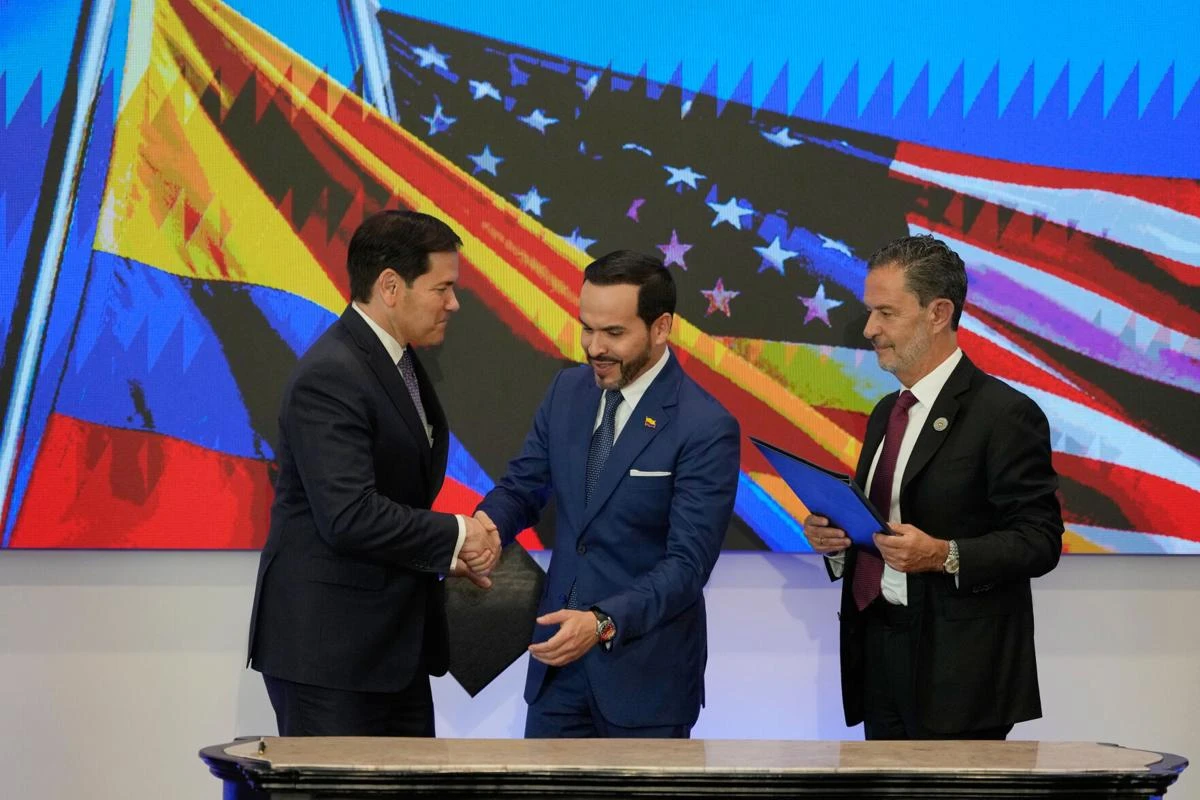
US Secretary of State Marco Rubio and Colombian Foreign Minister Omar Bula Escobar signed them in the Caribbean port city. President Abelardo De la Espriella, a right-wing lawyer in office since 7 August, called the package the Barranquilla Accords.
Why This Matters
Colombia was designated a major non-NATO ally of the United States in 2022, a status reserved for close military partners. That relationship soured under Gustavo Petro, the leftist president who governed until August 2026.
In January 2025, Petro turned back US military deportation flights, and Washington imposed emergency 25% tariffs before Colombia backed down. In September 2025, the State Department said it would revoke Petro’s visa after he criticised US policy in New York.
In October 2025, the US Treasury sanctioned Petro himself, alleging involvement in narcotics trafficking. His government condemned the sanctions as an act of aggression and called them politically motivated.
De la Espriella won a runoff on 21 June 2026 with 49.66% of the vote, against 48.70% for leftist senator Iván Cepeda. It was the narrowest margin ever recorded in a Colombian presidential election, which leaves him with a divided country.
Donald Trump endorsed him during the campaign, and he has promised to align Colombian foreign policy closely with Washington. The Barranquilla meeting is an early public test of what that alignment delivers in practice.
The minerals paper also matters beyond Colombia, because China dominates the processing of most critical minerals. The International Energy Agency says China leads refining in 19 of 20 energy minerals, with about 70% average share.
What Was Signed
Rubio and Bula Escobar signed two documents at the Batallón Paraíso, a military base in Barranquilla, on Colombia’s Caribbean coast. De la Espriella attended as a witness of honour but did not sign either document himself, a detail missing from most coverage.
The first is a framework on securing supply in the mining and processing of critical minerals and rare earths. It commits both governments to identify and finance projects within six months.
The tools named include guarantees, loans, equity and offtake arrangements. The State Department’s fact sheet also lists price-floor mechanisms, faster permitting, geological mapping and national-security reviews of asset sales.
Offtake arrangements are advance agreements to buy a mine’s future output, which help projects raise finance. The second is a memorandum on strategic civil nuclear cooperation.
It covers advanced and small modular reactors, research reactors, radioisotopes and nuclear medicine. Colombia’s electricity comes mostly from large hydropower dams, so nuclear power would be a long-term diversification rather than a quick fix.
What Was Not Signed
Both documents are memoranda of understanding. In plain terms, they set out intentions and do not create enforceable obligations.
Post-earthquake reconstruction was discussed at length. Nothing about it was signed, and no dollar figure was committed.
What exists on reconstruction is a study. The United States will look at whether to take part, once Colombia produces a detailed recovery plan.
Security and anti-narcotics cooperation were also discussed rather than signed. The same applies to trade and tariffs.
Anyone reading that the two countries signed a package on reconstruction and security has read too much into it. The signed part is real, but it covers future projects rather than money already on the table.
The Name Is Colombian, Not American
De la Espriella told reporters a roadmap had emerged that the two sides were calling the Barranquilla Accords. He grouped it under three headings: rebuild the country, recover the economy and shield the hemisphere.
The State Department has not used the phrase. Its own release describes arrangements on critical minerals and civil nuclear cooperation.
So the name is a Colombian political coinage. It is a useful label, but it is not a treaty title.
The Earthquake Behind the Agenda
A magnitude 7.4 earthquake struck on 10 August, with its epicentre at San José del Palmar in Chocó, a Pacific-coast department. It was Colombia’s strongest since 1979, at a depth of about 96 kilometres.
The official toll published on 7 September was 331 dead and 4,505 injured, with 111 still missing. Some 466,709 people were affected across 16 departments, Colombia’s equivalent of states.
More than 36,000 homes were destroyed. Early figures were far lower, at 132 and then 289 dead.
Anyone citing those numbers is working from stale reports. That is why the new government wants foreign money for rebuilding, and why the lack of a signed pledge matters.
The Question About a Military Base
Asked whether the United States would open a military base in Colombia, Rubio did not rule it out. The best-attested version of his answer is that Colombia would have to ask Washington to do so.
Spanish-language renderings of the quote differ from each other, so we are not printing one as verbatim. He added that no request for US troops or a base exists at present.
Any decision would need a feasibility and cost analysis. De la Espriella separately put a proposal to Rubio called Plan Patriota Siglo XXI, or Patriot Plan for the 21st Century.
It asks for aircraft, radar, drones, helicopters, air defence and cyber capability. That is a request, not an agreed programme, and no US funding was announced.
How Rubio Framed the Petro Years
Rubio said the last four years had been an aberration between the two governments. He was talking about the relationship.
Several reports have turned that into a description of the previous Petro government itself. The wording does not support it.
His full remark called strong alliance the natural state of things for the two countries. He said that was changing again.
He also said he hoped to build a golden age in relations. The tone was restoration rather than rupture.
The Criticism at Home
De la Espriella named General Jorge Andrés Zuluaga López to head the national intelligence directorate on the same day. In 2024 the JEP, Colombia’s transitional justice court, asked prosecutors to investigate a unit he commanded in 2004 and 2005.
That unit is accused of profiling members of the Patriotic Union, a leftist party. These are referrals for investigation, not convictions.
He was also removed from an army technical directorate in 2014 over an alleged illegal interception operation. No criminal charges followed, and he denied wrongdoing.
Separately, opposition figures published defence ministry data on the president’s use of air force helicopters. The flights cost 1,117 million pesos (US$358,000) over 18 days.
Conversions use 3,116.47 pesos to the dollar, Colombia’s official rate for 9 September 2026. Of 103 flights, 64 lasted under ten minutes.
Most ran between Barranquilla’s airport and a football training ground. For critics who campaigned against him, both stories fit a wider charge that the new government ignores its own promises of austerity.
What It Means If You Invest or Do Business in Colombia
For mining investors, the minerals framework signals that US development finance may become available within six months. No specific project, mineral or amount has been named yet, so the framework is a door rather than a deal.
For energy companies, the nuclear memorandum opens talks on US reactors and fuel, but any plant would take many years. For anyone exposed to Colombian security policy, the base question and Plan Patriota are the items to watch.
What Is Not Yet Known
It is not known which mineral projects will be put forward for financing, or by whom. Colombia has not yet published the detailed recovery plan that Washington says it needs before deciding on reconstruction help.
No request for a US base or troops has been made, and none has been announced. It is not known whether Washington will fund any part of Plan Patriota Siglo XXI.
Frequently Asked Questions
Why does this matter?
It is a concrete step in rebuilding US-Colombia ties after years of clashes under Gustavo Petro. The signed papers are non-binding, however.
What did Colombia and the United States actually sign?
Two non-binding memoranda of understanding, on critical minerals and rare earths and on civil nuclear cooperation. Reconstruction and security were discussed but not signed.
Are the Barranquilla Accords a treaty?
No. The name is a Colombian political label for a roadmap, and the State Department does not use it.
Will the United States open a military base in Colombia?
Rubio did not rule it out but said Colombia would have to ask. No such request exists at the moment.
Sources: US State Department, the signing ceremony transcript, US State Department, fact sheet on the arrangements, Infobae, De la Espriella names the accords, El Tiempo, Rubio on a possible base, Semana, Plan Patriota Siglo XXI, La República, the earthquake toll, El Tiempo, profile of the new intelligence director, Infobae, the helicopter flight costs, Wikipedia, Colombia–United States relations under Petro, Wikipedia, the 2026 Colombian presidential election, Wikipedia, Abelardo de la Espriella, International Energy Agency, Global Critical Minerals Outlook 2025, Wikipedia, energy in Colombia
This article was produced by The Rio Times’ automated newsroom system. How we use AI · Report an error · Editorial responsibility: Matthias Camenzind, Editor-in-Chief