Xi Jinping to be re-elected as China’s supreme leader: 10 years of the most powerful communist dictator since Mao

China’s hyper-personalistic dictator is about to become the first communist leader this week to rule the country for more than two terms.
By the end of his third term, he will have ruled for more than 16 years, comparable only to Mao Zedong.
The 20th National Congress of the Communist Party of China will be held on Oct. 16, when Xi Jinping’s re-election as supreme leader of the world’s most populous nation will be official.
This will further consolidate his power and extend his legacy to a third five-year term, unprecedented in China since Mao Zedong.
Read also: Check out our coverage on curated alternative narratives
The Chinese Communist Party (CCP) has 90 million members who will vote on its 2,296 delegates and elect a new Central Committee composed of nearly 200 members.

They will determine the new central leadership of the Politburo and its Standing Committee, the Party’s most powerful decision-making body.
On this occasion, all indications are that Xi Jinping will be re-elected as General Secretary of the Communist Party, a post directly linked to the Chinese state, where he is the de facto head of state.
Even though no other leader since Mao’s death in 1976 has received support for second re-election at the head of the Politburo, Xi seems to be able to do so without any problems.
There is even talk at the congress that he could be given the title of Chairman of the Chinese Communist Party, a post above that of general secretary, suspended in 1982 and once held by Mao Zedong himself.
In the intraparty struggle to succeed Mao, Deng Xiaoping won the support of other Communist leaders by “discarding” the party chairman and appointing himself general secretary.
A position that was seen as inferior and not associated with absolute power but rather that of first among equals.
For the first time in 40 years, however, the Communist Party Congress will consider a proposal by Xi’s closest confidants to reinstate him as president.
It should be recalled that in 2018, “Xi Jinping Thought” was added to the Chinese Constitution, directly naming him in several articles and putting him on par with Mao.
XI JINPING – CHINA’S SUPREME LEADER
After taking office in 2012, Xi Jinping quickly consolidated his power by taking control of all vertical levels of the power structure.
He currently serves simultaneously as General Secretary of the Chinese Communist Party (CCP), Chairman of the Central Military Commission (CMC), and President of the People’s Republic of China (PRC).
As a result, he has become China’s undisputed supreme political leader.
In his ten years in office so far, one of the main pillars of his administration has been the systematic reform and modernization of defense and the armed forces.
With its planned global naval and aerospace ambitions, China is set to go head-to-head with the United States and its weakened hegemony.
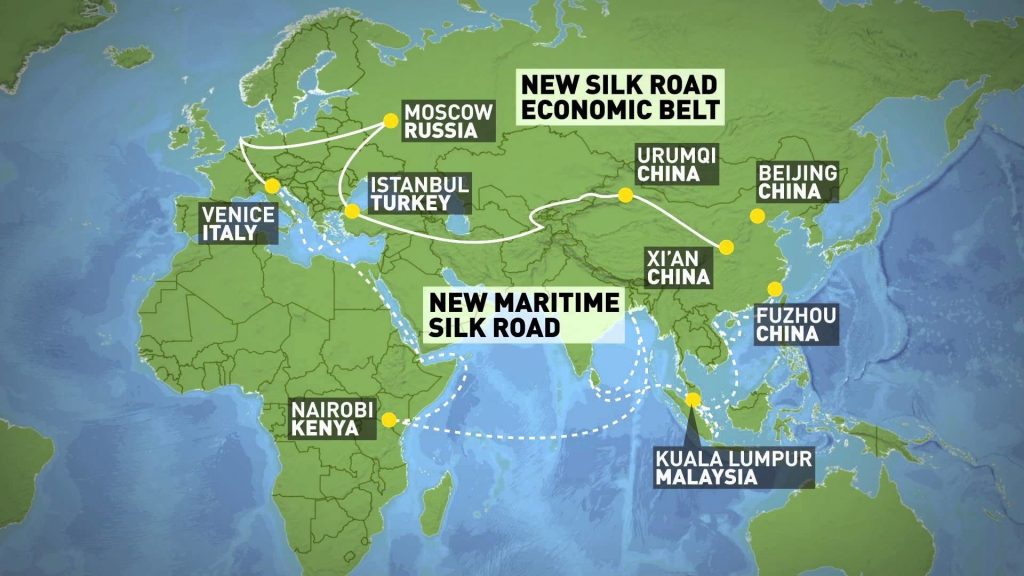
Another critical pillar of his administration has been the introduction and aggressive development of the Belt and Road Initiative (also known as the New Silk Road), which has enabled direct influence over the governments of countries in Asia, Africa, and Latin America.
Xi enabled an aggressive policy of lending money to bankrupt Third World countries.
This money was used to build transportation infrastructure such as ports, airports, railroads, etc.
However, the strategy was never financial but political, and in the last decade, China has appropriated this strategy to control major infrastructure worldwide.
FOREIGN POLICY
Xi has also taken a more aggressive stance on foreign policy than his predecessors. China has never made such great strides internationally since Mao’s death.
From 2012 to the present, China has won disputed territories against India, asserted its supremacy in the South China Sea by building artificial islands, conquered and annexed Hong Kong, and kept Taiwan on the brink of war.
The latter is one of the pillars of his regime and one of the positions that has earned him the most support domestically.
There is open talk in China that the Chinese Communist Party will rule Taiwan before the decade’s end.
As for international opposition to Xi, the creation of QUAD in 2007 by Japan’s Shinzo Abe and in 2017 by Donald Trump and Narendra Modi has not yet been strong enough to contain China’s influence in the region.
The QUAD (United States, Japan, India, and Australia) remains a nonmilitary alliance, but the size of the members’ economies and the composition and strength of their armed forces are enormous.
And if they wanted to, they could contain Xi’s expansionist ambitions.
AUCUS, which includes Australia, the United Kingdom, and the United States, operates with similar dynamics.
POLICIES OF ECONOMIC CONTROL
In addition, China has solidified its position as the world’s factory over the past decade and now concentrates nearly 20 percent of the world’s goods production on its territory.
This has been accompanied by a dumping policy developed by Xi Jinping that provides massive government subsidies for products made by Chinese companies to penetrate Western markets and eliminate local competition.
This long-term plan will make China even more indispensable in the global commodity chain.
INTERNAL CONTROL
Over the years, Xi has consolidated his hold on the Party and the Chinese people.
During his massive anti-corruption campaign, in which he removed all officials who opposed him, he forced private companies to have Party members on their boards, a Mao policy that Deng had abolished.
He also reintroduced the civilian surveillance systems relaxed after the 1989 Tiananmen protests.
But he has combined it this time with cutting-edge technology that allows the state to know where each of the millions of Chinese is, at least in the major cities.
SOCIAL CREDIT SYSTEM
He was also responsible for implementing the social credit system developed by his predecessor, Hu Jintao, which was extended to the entire country in just a decade.
Under this system, all Chinese citizens have a “score” that can go up or down depending on their loyalty to the Party.
If the score is very high, people qualify for better universities, better jobs, and even essential positions within the Party.
But if the score is very low, people cannot use public transportation, lose their jobs and place of study, and even go to jail.
PERSECUTION
Another pillar of Xi’s ten-year reign has been the alleged genocide of the Uighurs, a Muslim ethnic minority in the northern province of Xinjiang, whom the communist regime has reportedly systematically murdered in an attempt at “ethnic cleansing” and “Chinazification” that has extended to other religious groups, particularly Christians.
According to the Associated Press, Xi carried out the country’s most severe systematic suppression of Christianity since freedom of religion was added to the Chinese constitution in 1982.
In the process, “crosses have been destroyed, Bibles burned, churches closed and followers asked to sign papers renouncing their faith.”
Many priests have moved their churches underground, while others have made a pact with the regime and agreed to place images of Mao Zedong and Xi Jinping on the same level as the cross with Jesus.
CORONAVIRUS PANDEMIC
Finally, we cannot fail to mention the Covid-19 pandemic, the controversial experiments at the Wuhan Virology Laboratory, and the brutal and inhumane response to the epidemiological situation.
It has unfortunately been repeated in 2020 and 2021 in several countries with quarantines that did not exist even in the worst times of the bubonic plague in the Middle Ages.
In a new mandate, the deepening of its hyper-personalism and communist totalitarianism poses a severe threat to the rest of the world.
In the 1980s and 1990s, China, like other countries in the region, was on the verge of overturning its repressive system and liberating its politics and economy.
But when Xi took office in 2012, China returned to the height of totalitarian communism, which even Mao did not support in the final days of his regime.
Xi is expected to rule until at least 2028.
During that time, the dictator promised to end the extermination of the Uighur population, consolidate control over Hong Kong, extend his feelers to every country in the world, with particular attention to Latin America, and undoubtedly ‘bring home’ Taiwan.
Join us on Telegram: t.me/theriotimes
Editorial responsibility: Matthias Camenzind, Editor-in-Chief · Editorial standards · Report an error