Hippo Invasion: Colombia Running out of Time to Tackle Pablo Escobar’s Wildest Legacy
RIO DE JANEIRO, BRAZIL – It was hard enough to find the hippo, a massive, ornery male with a reputation for harassing local ranchers. For three long months, scientists tracked it through the Colombian countryside, staking out lakes, traipsing through brush and camping on nearby farms.
But castrating it – that was an almost herculean task. They had to inject it with a potent elephant tranquilizer before it was safe to approach. Even with the hippo immobilized, it was surprisingly difficult to locate his, ahem, parts.
“It was horrible,” recalled David Echeverri Lopez, a researcher at the regional environmental agency Cornare who led the 2013 sterilization effort. “You cannot just go on the Internet and Google, ‘how to castrate a hippopotamus?’”
After all, the creature belonged on the other side of the ocean, in the savannas and forests of sub-Saharan Africa. In the late 1980s, Colombian drug lord Pablo Escobar kept four hippos in a private menagerie at his residence in Hacienda Nápoles, 100 kilometres (62 mi) east of Medellín, Colombia.
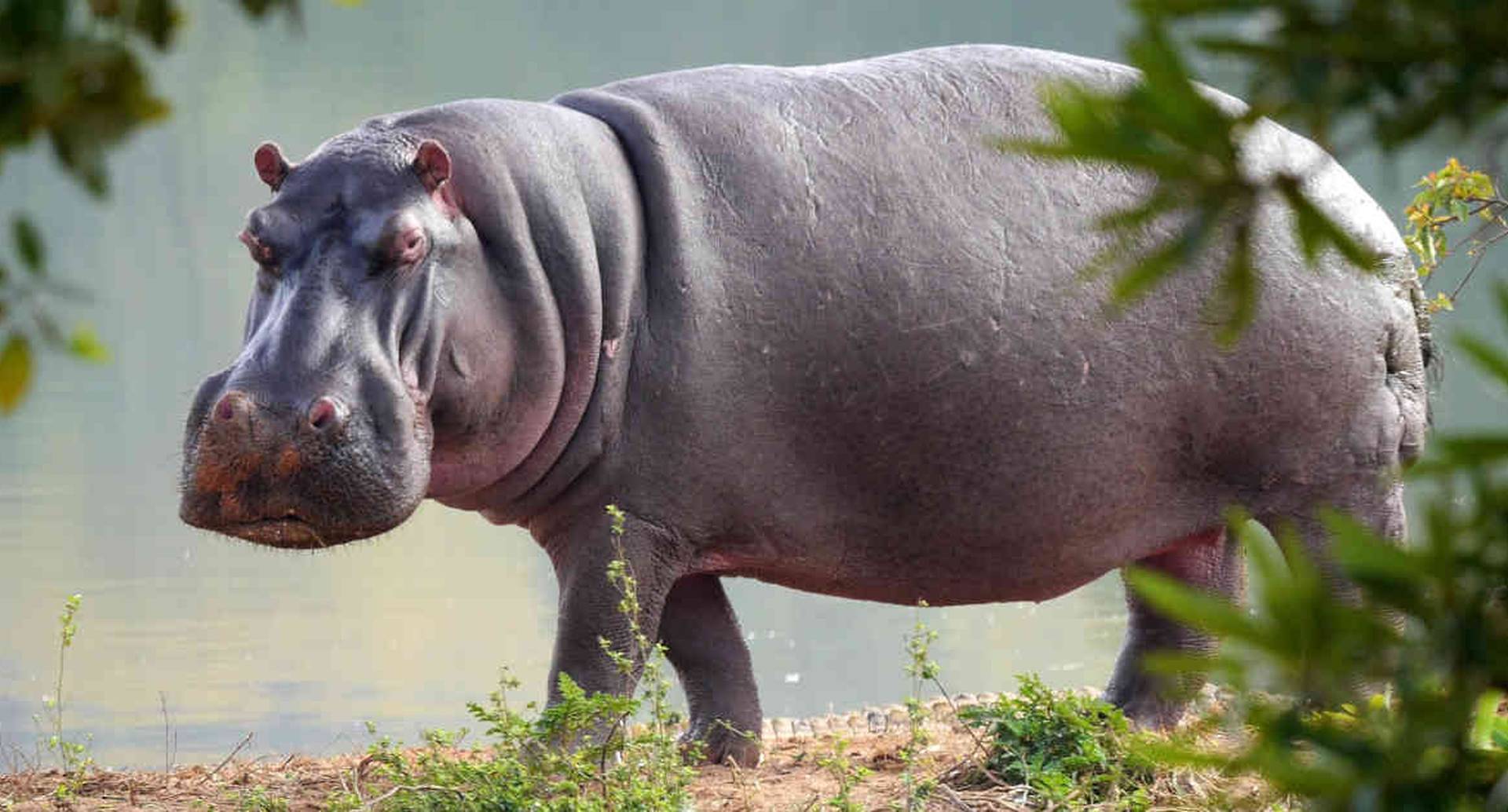
In 2020, a study showed that there was an increase in the nutrient levels and cyanobacteria in Colombian lakes inhabited by hippos. Now dozens of its wild spawn roam the wetlands north of Bogota, the largest invasive species on the planet.

Locals see the hippos as an unofficial mascot. But to scientists, they are an ecological menace, competing with native wildlife and polluting local waterways. Occasionally, they have even attacked humans.
Now a study forecasts that the invasive hippo population will swell to almost 1,500 individuals by 2040. At that point, their environmental impacts will be irreversible and their numbers impossible to control. Something needs to be done – and soon.
A 4,000-pound problem
In the beginning, there were only four hippos. How much trouble could they cause? So reasoned Colombian officials charged with dismantling Escobar’s sprawling country estate after his death in 1993. They were reluctant to approach the animals, each highly aggressive and roughly the size and weight of a four-door sedan. While most of the drug lord’s exotic animals were sent to zoos, the hippos – three females and one male – were allowed to roam.
That was the first mistake.
In their natural habitat, hippos spend the long dry season crowded into waterways that have shrunk to puddles. There, they are vulnerable to disease and predation – not to mention one another’s bad tempers.
But tropical Colombia is “hippo paradise,” Echeverri said. Rain is abundant, food is plentiful and there are no carnivores large enough to pose a threat. The animals spend five hours a day grazing on grasses and the rest of their time basking in the cool waters of the Magdalena River and surrounding lakes.
Whereas most African communities are justifiably leery of hippos – the creatures kill more people annually than any other large mammal – their Colombian neighbors are captivated by them. Gift shops in nearby Puerto Triunfo sell hippo keychains and T-shirts. At the amusement park that was built on the site of Escobar’s former pleasure palace, visitors can tour the lake where several dozen hippos now live. Occasionally, one will plod into a nearby community, looking as blasé as a shopper on his way to the grocery store.
“The hippopotamus is the town pet,” resident Claudia Patricia Camacho told the news program Noticias Caracol in 2018. “You could say that he now takes to the streets as if they were his own.”
Yet human-hippo interactions aren’t usually friendly. In 2009, after a trio of escapees from Hacienda Napoles were reported terrorizing local farms, Colombia’s environmental agency sent a team of hunters after the animals with an order to shoot on sight.
But then a photo emerged showing the soldiers posing with the carcass of one of the adults, named Pepe. Animal rights activists denounced the killing; “They could have been captured and kept in a safe place until a permanent refuge was found for them,” Marcela Ramirez, a member of the local Animal Protection Network, told Reuters at the time.
A judge issued a ruling suspending the hunt for Pepe’s mate and offspring, and it became illegal to kill hippos in the country. That’s when Echeverri launched his sterilization campaign.
After their early, exhausting effort to track an animal in the wild, the team decided to try corralling one. They piled carrots and fruit in the center of a wooden pen and waited for a hungry hippo to stroll through.
“But the corral didn’t work,” Echeverri said, speaking in Spanish over Zoom. “When he felt like he was enclosed, he jumped,” crushing the wooden barrier and escaping into the trees.
He added, “I didn’t know they could jump.”
Though male hippos have what scientists politely term “spatially dynamic testes” (their genitalia is retractable, and can hide in an opening called the inguinal canal), females’ reproductive organs proved even harder to find. “We didn’t understand the female anatomy,” Echeverri said. “We tried to do it on several occasions and were always unsuccessful.”
Eventually he found the answer: Trap the hippo in a pen. Make sure the walls are high. Don’t bother with the females. But the process remains dangerous, time consuming and costly, especially for his low-budget agency. Echeverri is able to castrate roughly one hippo per year, whereas scientists estimate that the population grows by 10% annually.
Last year, a rancher was caught by surprise while collecting water; the hippo bit his leg and threw him into the air, breaking his leg, hip and a number of ribs.
A 2020 study of hippo-inhabited lakes found that nutrients in the animals’ feces were fueling huge blooms of bacteria and algae. These in turn reduced the oxygen content of the water, making it toxic to fish.
“We saw oxygen levels that were getting to levels where you would expect to see fish start to go belly up,” said Jonathan Shurin, an ecologist at the University of California at San Diego who has worked with Echeverri to evaluate the hippos’ environmental impacts. There is concern that this will affect the region’s fishing industry.
In Africa, hippos act as ecosystem engineers, transferring nutrients from land to lakes and sculpting new channels for water as they tread across dry earth. Some researchers have suggested they could provide a similar service in their new home. They might even fill the environmental niche left by massive mammals that went extinct after the Ice Age: giant llamas, a rhino relative called Toxodon.
But Nataly Castelblanco-Martínez, a Colombian ecologist working at the University of Quintana Roo in Mexico, was skeptical of this hypothesis. Colombia’s lakes and rivers are already home to large native mammals. Giant, guinea-pig-like capybaras feed on the grasses and fruits now consumed by hippos. Threatened Amazonian manatees may be crowded out of their habitat by the aggressive newcomers.
Management of the hippo problem takes resources away from Colombia’s hundreds of endangered animals, Castelblanco-Martínez said. It also distracts officials from dealing with the roughly 400 invasive species that threaten native ecosystems.
Animal rights activists “are concerned only for the hippo,” she continued. “They are missing the whole picture: the social picture, the economic picture, and the ecological picture, too.”
Castelblanco-Martínez is the lead author on the new population study, published this month in the journal Biological Conservation. Using statistical models and climate projections, her team found that the hippos were on track to meet the ecosystem’s carrying capacity – about 1,418 animals – by 2039. Officials would have to increase the pace of sterilizations to about 30%, half of them in females, to have any effect. Even then, it would simply delay the point at which the hippos consumed all the food and space available to them.
“The only efficient strategy to deal with the invasion,” Castelblanco-Martínez and her colleagues wrote, was “extraction” of 30 hippos per year, starting right now.
There’s no obvious place to put them. Puerto Triunfo has for years sought zoos willing to take the hippos, to no avail. No African nation would risk their own hippo population by reintroducing dozens of animals with mysterious origins and unknown behaviors.
The scientists say Colombia must consider a cull.
“Nobody likes the idea of shooting a hippo. I do not like it,” Castelblanco-Martínez said. “But no other strategy is going to work.”
This is what happens, she said, when a society fails to act on a problem until it becomes too dire to ignore. Relocation might have been feasible 30 years ago, when there were only four hippos. Castration could have been effective if officials had provided sufficient resources for the program early on. Now the sole remaining option is the most painful one.
Echeverri is less certain that killing the hippos is the only way to go. “These are animals who have turned themselves into an emblem for a whole community of people,” he said. “It’s not possible to just take them away.”
He suggested it might be possible to sterilize or relocate the 50 or so hippos in the lake near Hacienda Napoles, and only cull those that have wandered farther afield. The U.S. nonprofit Animal Balance is collecting donations to help pay for this effort.
But he agreed that time is running out to act.
“I’ve worked for many years to understand the problem and find solutions, but the problem keeps happening over and over again,” Echeverri said. “The only thing that changes is the number of hippos.”
More: Latin America news in English, every day from The Rio Times.
This article was produced by The Rio Times’ automated newsroom system. How we use AI · Report an error · Editorial responsibility: Matthias Camenzind, Editor-in-Chief