Africa · Western
Key Facts
—The milestone. Apple briefly crossed $5 trillion in market value during intraday trading on Tuesday 28 July 2026.
—The peak. Shares hit $342.89, implying a market capitalisation of roughly $5.036 trillion before pulling back.
—Second ever. Only Nvidia had previously reached the $5 trillion mark, doing so earlier in 2025.
—Valuation journey. Apple added roughly $4 trillion in market value in just eight years, having first crossed $1 trillion in 2018.
—Scale comparison. At $5 trillion, Apple’s valuation exceeds the annual GDP of any single African country.
Apple briefly surpassed $5 trillion market value for the first time on Tuesday, a milestone that highlights the staggering concentration of corporate wealth in American technology platforms and its quiet implications for economies across Africa.
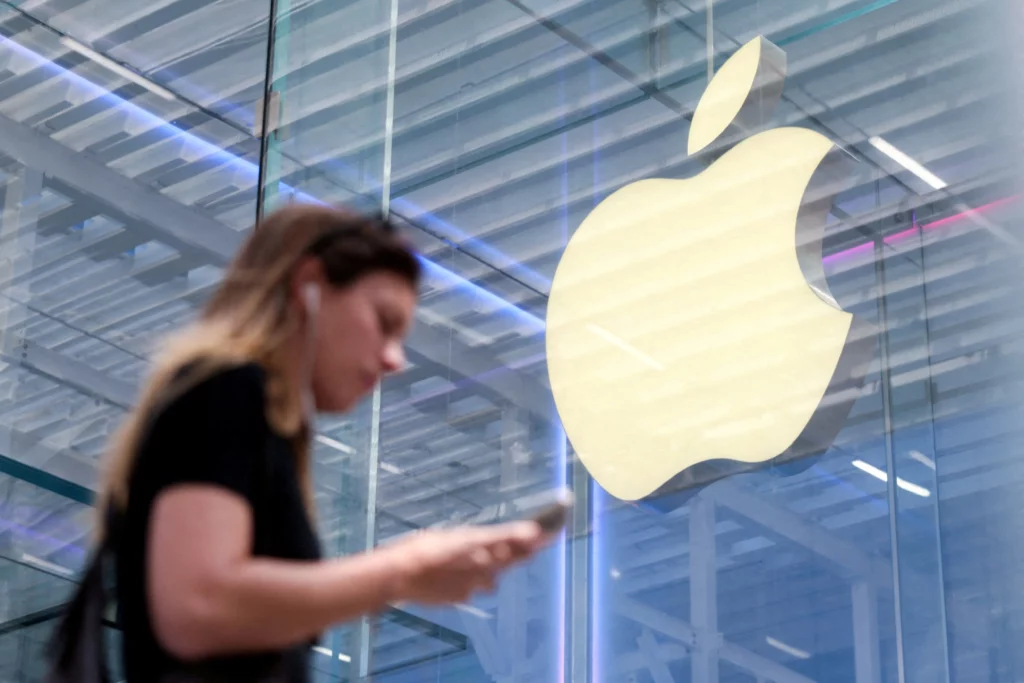
A five-trillion-dollar moment
On Tuesday 28 July 2026, Apple Inc. saw its share price touch $342.89 during the session. That intraday high translated into a market capitalisation of roughly $5.036 trillion.
The stock pulled back before the close, but the brief crossing made Apple only the second company in history to reach the $5 trillion threshold. Chipmaker Nvidia had done so first, earlier in 2025, riding a wave of artificial-intelligence investment.
The move came one day after Apple reclaimed the title of world’s most valuable publicly traded company from Nvidia. The two firms have been trading the top spot as investors reassess the AI boom.
Why investors pushed Apple past the $5 trillion mark
Analysts pointed to Apple’s role as a haven within the technology sector. A deepening sell-off in AI and semiconductor stocks sent capital rotating toward companies with more diversified revenue streams.
Apple’s business rests on a broad base of consumer hardware, software and high-margin services. That mix looks steadier to investors than pure-play chip stocks when AI sentiment wobbles.
The services segment, which includes the App Store, iCloud, Apple Music and financial products, has become a growing share of revenue. It reinforces what analysts call Apple’s platform power, a durable competitive advantage that commands premium valuations.
From billions to trillions in four decades
Apple listed on the public markets in 1980 with a valuation just under $1.8 billion. It took until 2018 to reach $1 trillion, the first American company to do so.
The pace then accelerated dramatically. Apple crossed $2 trillion in 2020, $3 trillion around 2023, $4 trillion in October 2025, and now $5 trillion in July 2026.
Put differently, the company added roughly $4 trillion in market value in just eight years. That is faster than the entire economic output of Germany or Japan in a single year.
What a $5 trillion market value means for Africa
Apple’s valuation alone now exceeds the annual GDP of any individual African nation. It is larger than the combined economies of several African regions.
This asymmetry is not merely symbolic. It reflects a structural reality in which US technology platforms control the operating systems, app stores and cloud infrastructure that African businesses and consumers rely on every day.
While Android dominates African smartphone markets by volume, iPhones remain the device of choice among urban elites, policymakers and business leaders. Key decision-making circles across the continent run on Apple hardware and US software stacks, embedding them in digital ecosystems governed from California.
The great-power contest and digital infrastructure
Apple’s milestone fits into a larger picture of US technological dominance. American firms account for roughly 62% of global equity market capitalisation when the nine largest tech stocks are included.
The global digital economy is now worth an estimated $11.5 trillion, about 15.5% of world GDP, and it has grown two and a half times faster than the broader economy over the past 15 years. US companies control roughly 70% of the global cloud-services market and more than 40% of data-centre capacity.
For African governments, this creates a dual dependency. Devices and operating systems are overwhelmingly American, while network infrastructure often involves Chinese firms such as Huawei. The continent finds itself navigating between Silicon Valley and Shenzhen, as explored in our pillar series Africa: The New Scramble.
Capital flows and the valuation gap
The depth of US capital markets allows companies like Apple to fund research, acquisitions and ecosystem expansion at a scale unmatched by African or most European firms. That advantage compounds over time.
African sovereign wealth funds and pension funds are often drawn into US mega-cap stocks like Apple as they seek liquid, dollar-denominated returns. Local exchanges struggle to match the analyst coverage, trading volumes and valuation multiples available in New York.
This pattern reinforces dependence on external capital markets. It also means that a growing share of African institutional savings is effectively financing the expansion of American platform power.
Regulation from a position of asymmetry
Apple’s scale makes it a rule-taker with respect to Brussels and Washington, but a de facto rule-maker in most developing markets. National competition authorities and telecom regulators in Africa face a firm larger than their entire economies.
Negotiations over data localisation, app-store fees and privacy standards are structurally asymmetric. African regulators often rely on coalitions through the African Union or align with European regulatory templates because they cannot independently dictate terms to a $5 trillion platform.
The European Union’s Digital Markets Act and privacy rules increasingly shape how Apple operates globally. African jurisdictions frequently adapt these norms, making Brussels an indirect regulator of digital markets across the continent.
What to watch next
The immediate question for markets is whether Apple can hold above the $5 trillion level in coming sessions. The intraday retreat suggests the milestone remains a psychological barrier as much as a financial one.
Longer term, the trajectory of US tech valuations will shape Africa’s digital future. Every trillion added in Cupertino widens the gap between those who build the platforms and those who use them.
African policymakers are increasingly focused on building local digital sovereignty through homegrown data centres, payment systems and app ecosystems. Whether those efforts can gain traction against a $5 trillion incumbent is one of the defining economic questions of the decade.
Connected Coverage
Frequently Asked Questions
When did Apple first reach a $5 trillion market value?
Apple briefly crossed the $5 trillion mark during intraday trading on Tuesday 28 July 2026. The stock hit a session high of $342.89 per share before pulling back, making it only the second company ever to reach that threshold after Nvidia.
Why did Apple’s valuation rise so quickly in 2026?
Investors treated Apple as a haven amid a sell-off in AI and semiconductor stocks. Its diversified revenue base, spanning consumer hardware and high-margin services, appeared steadier than pure-play chip companies when sentiment around artificial intelligence weakened.
How does Apple’s $5 trillion valuation compare to African economies?
Apple’s market capitalisation now exceeds the annual GDP of any single African country. The asymmetry highlights how US technology platforms operate at a scale that dwarfs the economies of the markets where they provide devices, software and digital services.
Sources
Sources: Apple Inc..
This article was produced by The Rio Times’ automated newsroom system. How we use AI · Report an error
LatAm Markets: Live Signals → — real-time movers, turnover leaders and FX across Latin America.
Read More from The Rio Times