Amazon Farmers Embrace Cocoa to Combat Deforestation
In Novo Repartimento, Pará state, a region along the Trans-Amazonian Highway reveals a diverse land mosaic.
It features indigenous territories, conservation areas, and rural settlements, including the vast Tuerê.
This area, covering 250,000 hectares, provides for 4,000 families. They balance living, farming, and preserving nature.
One can witness pastures neighboring cocoa fields there, showcasing the synergy of livestock and forestry.
The intertwining of cattle and cocoa cultivation started in the 1970s after public lands were allocated. Cattle rearing emerged as a viable venture amidst the dense forest.
Cocoa was also popular until the 1980s when disease struck the crops.
Over time, science has improved these sectors, making them key for the local economy and allowing for more eco-friendly farming.
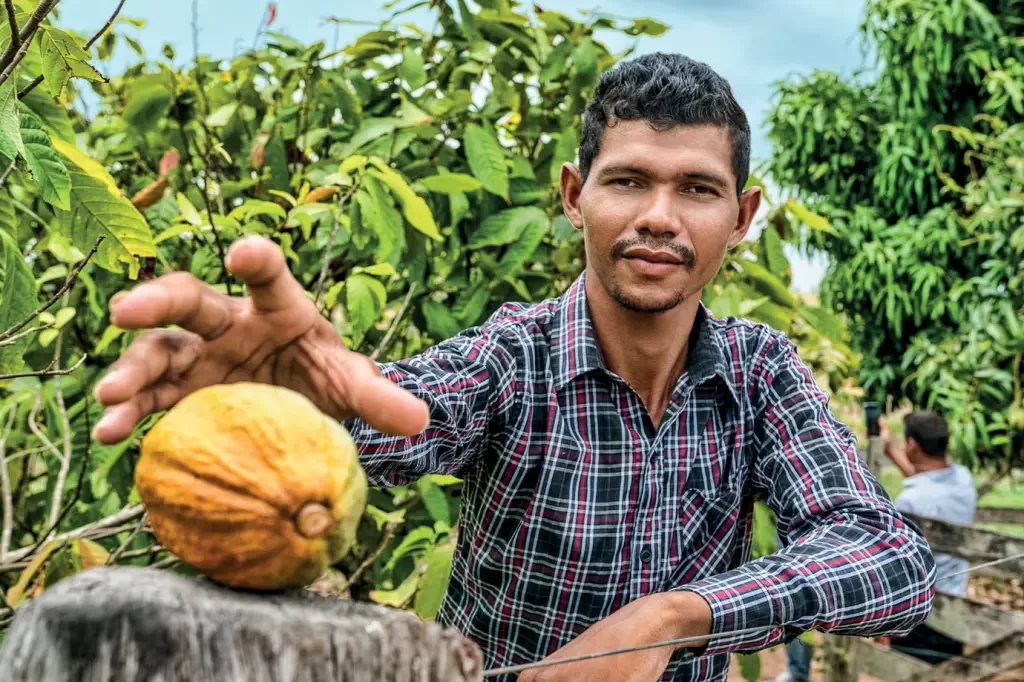
Alaion Rosa, a young rancher in Tuerê, embodies the new mindset. He aims to boost farm yields without harming the forest.
“I won’t clear more land,” he insists, calling for support to sustain cattle and cocoa as dual sources of income.
The practice of cattle farming persists as a staple. It provides quick cash from sales during tough times.
Unlike before, when barren fields were left to waste, ranchers now enhance pastures to stay productive on their lands.
Alaion joined an initiative led by Solidaridad, an NGO that promotes sustainable agriculture with a focus on reducing carbon emissions.
With funding from European nations, Solidaridad’s efforts decreased local deforestation by over half within five years.
Participants in these sustainable practices enjoyed a notable income hike.
Alaion’s own farm benefited from a six-hectare rotational cattle system, enhancing animal welfare and boosting his cocoa yield.
Paulo Lima from Solidaridad explains the efficiency gains: traditionally, extensive farming produced minimal weight gain per cow, per day.
Now, intensive methods quadruple cattle capacity per hectare, with more than double the daily weight gain.
System Transition
The transition to this system starts with a 7,500 reais investment per hectare, supported by Solidaridad with a significant contribution from the JBS Amazon Fund.
This setup aims to improve smallholder ranchers’ livelihoods without expanding into the forest.
Andrea Azevedo of the JBS Fund emphasizes the dual benefits. Their collaborative approach supports local farmers in enhancing productivity fairly, without further land clearing.
Additionally, she points out cocoa’s positive environmental impact, notably in capturing greenhouse gases, contrasting with methane from cattle.
Lima also recognizes premium cocoa’s market demand, especially when cultivated sustainably.
More: Brazil news in English, every day from The Rio Times.
This article was drafted with automated assistance and reviewed before publication. How we use AI · Report an error
Read More from The Rio Times