Who Is Irfaan Ali? Guyana’s Oil-Boom President, His Record and the Allegations
PROFILES · GUYANA
Key Facts
- —The country Guyana, an English-speaking country of under a million people on South America’s northeast coast. Since first oil in December 2019 it has become one of the world’s fastest-growing economies. It pumped about 902,000 barrels a day in the first half of 2026.
- —Who he is Mohamed Irfaan Ali, born 25 April 1980, a planner by training and a former housing minister. He has been president since 2 August 2020 and is Guyana’s first Muslim president.
- —Power base The People’s Progressive Party/Civic (PPP/C), which won 36 of 65 seats on 1 September 2025. Vice-President Bharrat Jagdeo, a former president, remains a central figure.
- —Record Oil-funded spending on roads, housing and cash grants. The 2026 budget is G$1.558 trillion (about US$7.5 billion), with the oil fund covering roughly a third.
- —Controversies Fraud charges from 2018, withdrawn in 2020 under presidential immunity and never tried. Questions over his degrees, and 2026 opposition claims about his private farm. He denies wrongdoing in each case.
- —Outlook A World Court ruling on Venezuela’s claim to Essequibo is expected between November 2026 and early 2027. It is the biggest test of his second term.
Irfaan Ali runs a country that went from no oil to about 900,000 barrels a day in under seven years. How he spends that money, and how he handles Venezuela, matters to oil markets, investors and Washington.
Irfaan Ali became Guyana’s president in August 2020, eight months after the first barrel of oil left its waters. As of 26 September 2026, he is in his second and, under the constitution, final term. His job is to turn a sudden fortune into lasting prosperity. He must also face down a larger neighbour that claims two-thirds of his country.
Early life and career
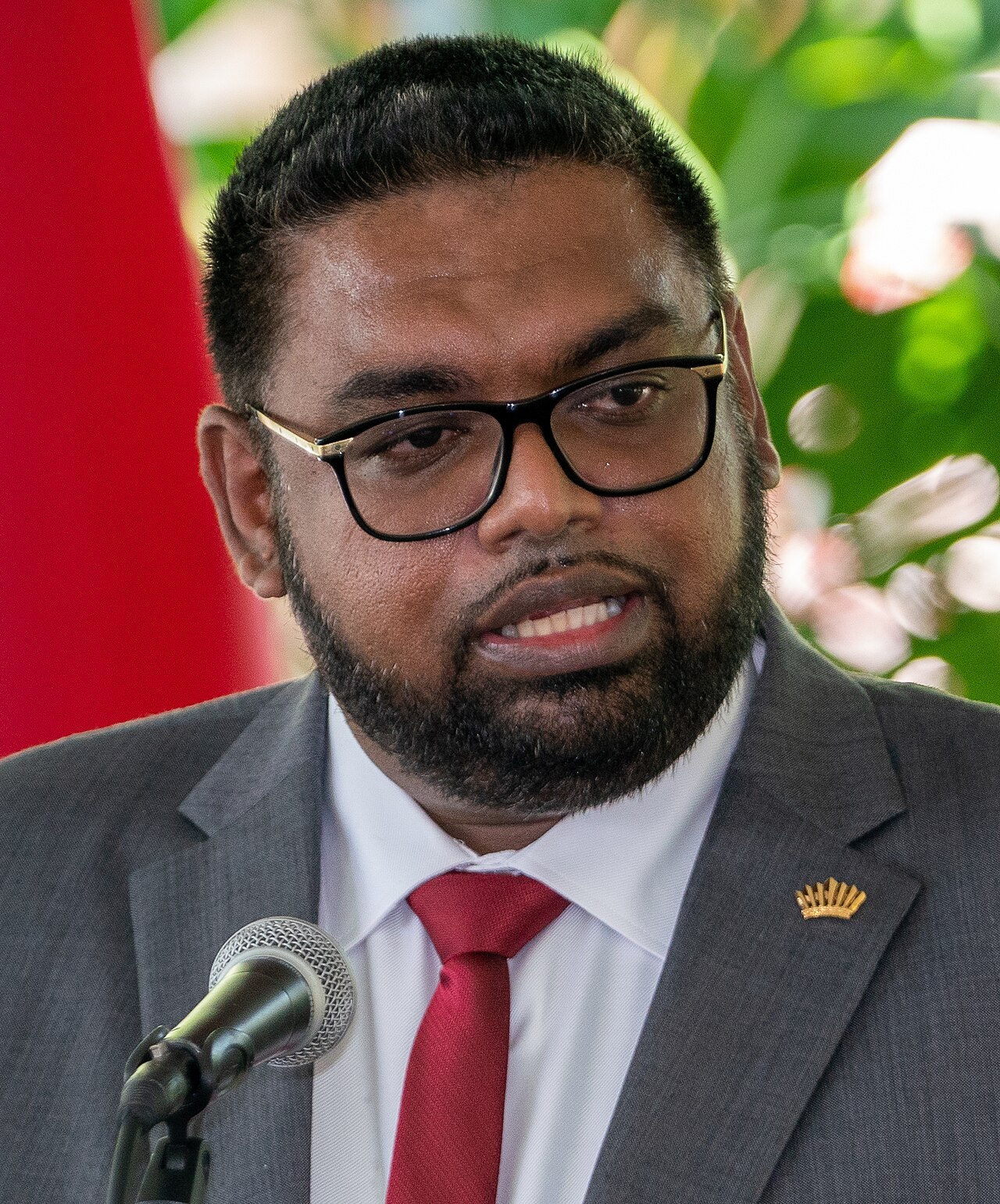
Mohamed Irfaan Ali was born on 25 April 1980 at Leonora, a village on the West Coast of Demerara. His family is Muslim and of Indian descent, and both of his parents were teachers. He is one of two sons.
He went to school at St Stanislaus College in Georgetown. His official biography lists a doctorate in urban and regional planning from the University of the West Indies. It also lists a master’s in manpower planning and a law master’s from the University of Salford. His first degree, in business management, is from the University of Sunderland.
Before politics he worked as a senior planner in the State Planning Secretariat. He then managed the Caribbean Development Bank’s project implementation unit in Guyana.
He entered the National Assembly in 2006 for the PPP/C. On 7 January 2009 he became minister of housing and water, a post he held until 20 May 2015. For part of that time he also ran tourism, industry and commerce. Housing, which in Guyana largely means allocating house lots, gave him a national profile.
Rise to power
The PPP/C lost power in May 2015 to a coalition led by David Granger. Ali moved to the opposition benches. On 19 January 2019 the party chose him as its presidential candidate. Two months earlier he had been charged with fraud, a case covered below.
In Guyana voters do not elect the president directly. They vote for party lists for the 65-seat National Assembly. The candidate at the head of the list with the most votes becomes president.
The election of 2 March 2020 turned into a five-month standoff. On 5 March a regional returning officer, Clairmont Mingo, declared figures for Region 4. They did not match the tallies held by parties and observers. Courts stopped the declaration, and a national recount ran from 6 May to 8 June.
The recount gave the PPP/C 233,336 votes and 33 seats, against 217,920 votes and 31 seats for APNU+AFC. On 24 June the Caribbean Court of Justice barred the electoral commission from using a rival set of figures. Ali was sworn in on 2 August 2020 as Guyana’s ninth executive president, with Mark Phillips as prime minister.
His second win was far less contested. At the election of 1 September 2025 the PPP/C took more than 242,000 votes and 36 seats. The Guyana Elections Commission declared the result on Saturday 6 September after a partial recount requested by APNU. In his inaugural speech he promised no new taxes and cheaper electricity.
Power base
Ali’s base is the PPP/C, one of Guyana’s two traditional parties. Guyanese politics has long followed ethnic lines. At the 2012 census about 40 percent of people were of Indian descent and 29 percent of African descent. Party support has long tracked that division.
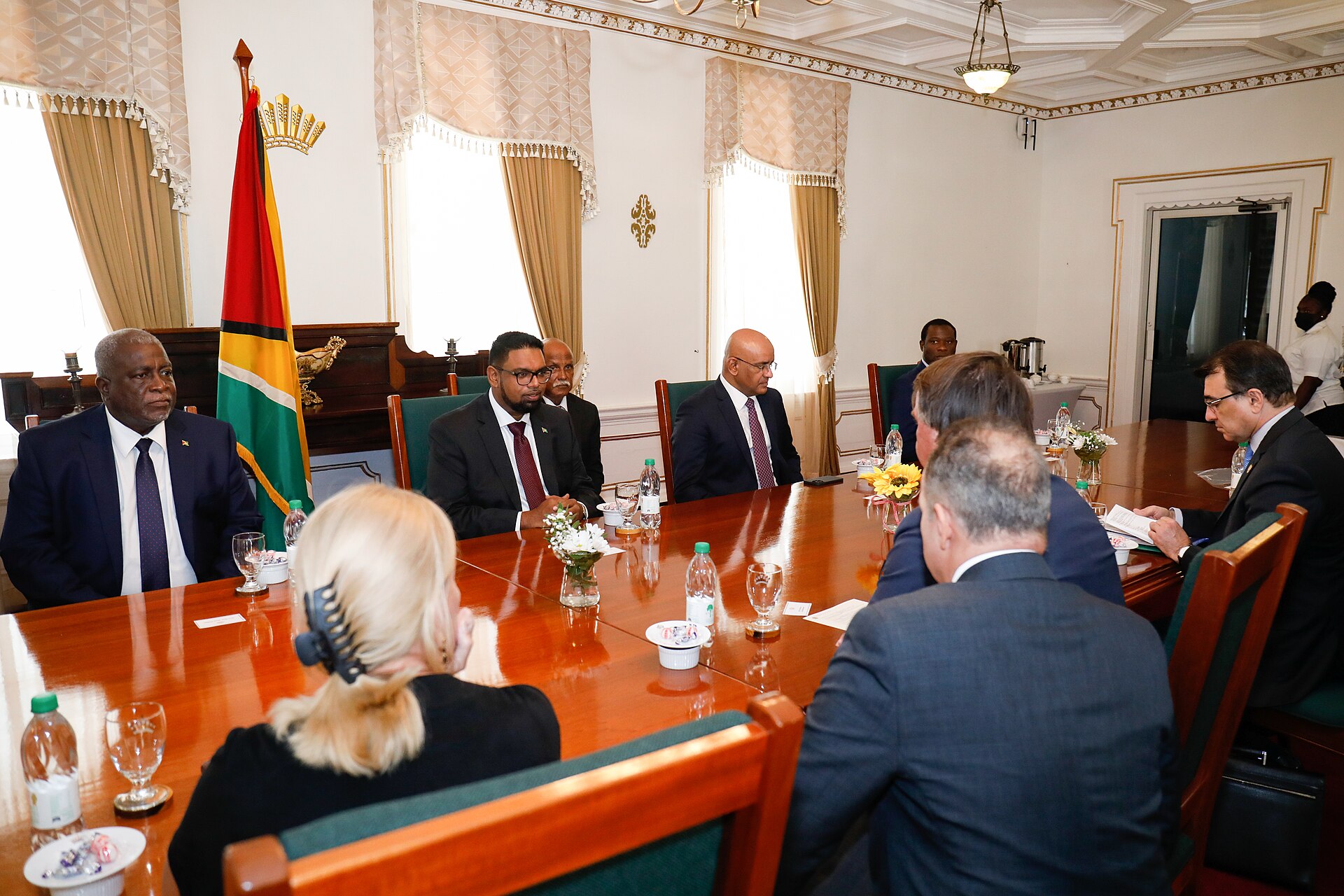
Inside the party, power is shared. Bharrat Jagdeo, a former president, was sworn in again as vice-president after the 2025 election. He remains a central figure in both the government and the party.
The 2025 result reshaped the opposition rather than weakening Ali. A new party, We Invest in Nationhood (WIN), came second with 16 seats. APNU, the historic rival, fell to 12. With 36 seats the PPP/C passes budgets and laws without coalition partners.
Record in office
Oil money and spending
Ali’s presidency coincides with the oil boom. ExxonMobil operates the offshore Stabroek Block with Chevron and CNOOC. Output averaged about 902,000 barrels a day in the first half of 2026, according to the government’s Mid-Year Report.
The World Bank puts growth at 43.8 percent in 2024 and 19.3 percent in 2025. The economy grew 33.3 percent in the first half of 2026. The government projects total petroleum revenue of US$6.50 billion for the year.
That money flows through the Natural Resource Fund, managed by the Bank of Guyana. The law governing it was passed at the end of December 2021, in a sitting the opposition tried to disrupt. The fund held US$4.29 billion at the end of June 2026.
Spending has grown fast. Senior Minister Ashni Singh presented a 2026 budget of G$1.558 trillion (about US$7.5 billion) on 26 January 2026. That was 12.7 percent more than the G$1.382 trillion (about US$6.6 billion) of 2025. The plan included US$2.6 billion of new borrowing, lifting public debt past US$10 billion for the first time, Kaieteur News reported.
The oil fund supplies about a third of the budget. The withdrawal for 2026 is about US$2.37 billion, slightly below the US$2.46 billion of 2025. It is the first year-on-year fall, because the legal ceiling follows the previous year’s deposits.
Some of the money goes straight to households. On 17 December 2025 Ali announced a cash grant of G$100,000 (about US$480) for every citizen aged 18 and over. It is paid during 2026. He said further grants would follow over the five-year term.
The ExxonMobil contract
Ali’s government inherited the 2016 production sharing agreement with the ExxonMobil consortium. Critics, including a former finance minister, want it renegotiated. Ali has refused, citing the sanctity of contract.
He has not defended the deal’s terms. “We never said it was a good deal,” he told Al Jazeera in September 2026, adding that the company “benefited more”. He promised that future agreements would not give companies the same leverage.
The state’s share is now rising anyway. Reuters reported on 31 July 2026 that ExxonMobil had recovered its initial costs. On 18 August Ali said Guyana was entitled to nearly 40 percent of production from the block.
Venezuela and Essequibo
Venezuela claims Essequibo, the land west of the Essequibo River and about two-thirds of Guyana. Guyana took the case to the International Court of Justice (ICJ), the United Nations’ top court, in 2018. It asks the judges to confirm the 1899 award that fixed the border.
The crisis peaked in Ali’s first term. On 1 December 2023 the ICJ ordered Venezuela not to change the situation on the ground. Two days later Venezuela held a referendum on creating a “Guayana Esequiba” state. On 14 December 2023 Ali and Nicolás Maduro met at Argyle, in St Vincent, and pledged not to threaten or use force.
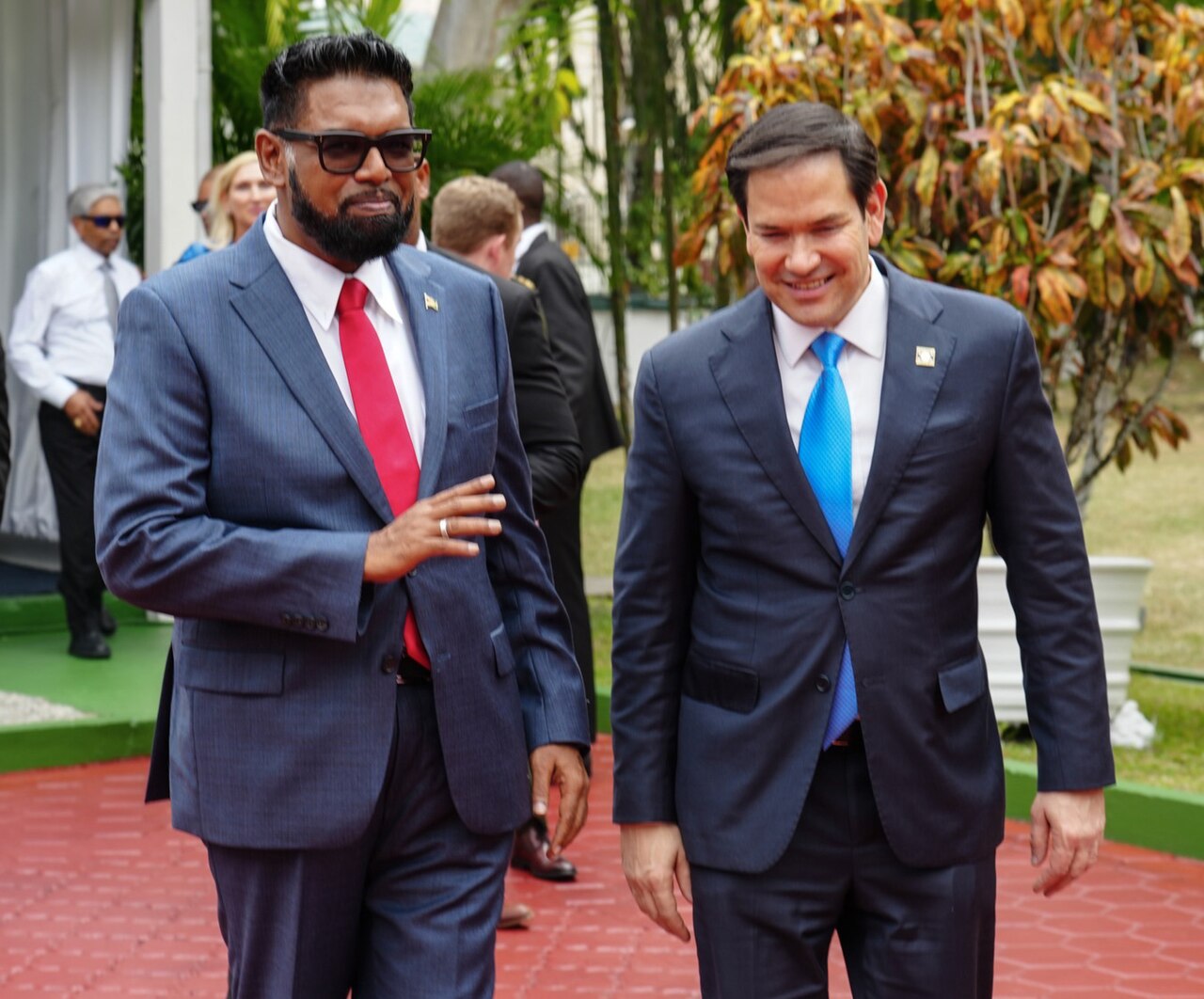
Venezuela held a vote for a governor of the claimed territory anyway, on 25 May 2025. It defied a further ICJ order of 1 May. Ali leaned on Washington. He hosted US Secretary of State Marco Rubio in Georgetown in March 2025. Guyana is also a founding member of the US-led Shield of the Americas security coalition.
The court heard the merits from 4 to 11 May 2026. US forces removed Maduro on 3 January 2026. On 12 May acting President Delcy Rodríguez said Venezuela would not respect a ruling in Guyana’s favour. At the UN on 24 September 2026, Ali urged Venezuela “to abide by the forthcoming ruling”.
Controversies
None of the allegations below has been proven in court. Each is set out with who made it, where it stands and how Ali has responded.
The Pradoville 2 fraud charges
On 28 November 2018, under the Granger government, the Special Organised Crime Unit charged Ali with 19 counts of conspiracy to defraud. Prosecutors alleged that as housing minister, between 2011 and 2015, he sold state land at Pradoville 2 at a gross undervalue.
The lots were valued at G$212.4 million (about US$1.0 million at today’s rate) and sold for G$39.8 million (about US$190,000). Prosecutors put the state’s alleged loss at more than G$174 million (about US$830,000). Buyers included former ministers and senior party figures.
Ali called the charges political victimisation. Courts declined to halt the case in 2019. After he became president, his lawyer invoked Article 182 of the constitution, which bars criminal proceedings against a sitting president. The unit withdrew the charges on 14 August 2020. The case was never tried.
His academic record
In January 2019 Kaieteur News questioned his degrees. It reported that his master’s degree from an Indian university was dated 2003, three years before his bachelor’s degree from Sunderland in 2006. It also queried the wording of his degree title.
Ali replied: “I have never presented any inaccurate academic achievements.” He said he stood by all his qualifications. No university or official body has published a finding against him.
The highway farm
On 5 July 2026 Opposition Leader Azruddin Mohamed accused Ali of “massive corruption” over a farm off the Soesdyke–Linden Highway. He estimated it at about 150 acres and a G$2.2 billion (about US$10.5 million) investment. He later raised his estimate to more than G$5 billion (about US$24 million).
Ali confirmed he owns the farm. He says it covers about 60 acres and that he bought it with loans starting in 2012. It has had no state financing, he says. He adds that all his assets are declared to the Integrity Commission, whose filings are confidential by law.
He also said he might be the victim of blackmail, citing text messages from Mohamed’s father. No formal investigation had been reported by late September 2026. Mohamed’s figures have not been independently verified.
Officials, sanctions and the ferry disaster
On 11 June 2024 the United States sanctioned Mohamed, his father and Mae Thomas, then permanent secretary at the Ministry of Labour. Washington alleged she steered contracts and permits in exchange for cash and gifts. The government sent her on leave pending an investigation.
The Mohameds were indicted in Florida in October 2025 on 11 counts, including alleged gold smuggling and fraud. They are fighting extradition, and WIN supporters call the case victimisation. The indictment, as reported, makes no allegation against Ali.
The ferry MV Barima capsized on 18 July 2026 with 179 people aboard, and at least 77 died. Ali named a five-member international commission of inquiry. APNU and WIN rejected it as unilateral. Ali has said the government has “nothing to hide”.
What to watch
The ICJ judgment. Guyana expects it between November 2026 and January 2027. Ali has said he hopes for early 2027. The court gives about two weeks’ notice, and no date has been set.
Uaru first oil. The fifth production vessel, Errea Wittu, arrived in August 2026. First oil is expected in the fourth quarter, lifting capacity above one million barrels a day.
The 2027 budget. The 2026 budget came on 26 January. The next one will show whether spending, borrowing and cash grants keep rising.
The inquiry and the farm. Watch for the Barima commission’s report and for the farm tour Ali has promised. Watch too for the Mohamed extradition case, which keeps the opposition leader’s own legal position in the news.
What this means for foreigners and investors
For oil companies and contractors, Ali offers continuity. He has repeatedly refused to reopen the ExxonMobil contract. Investors read that as a signal that signed terms will be honoured, though future licences will be tougher.
The main political risk is external. A clear ICJ ruling would reduce uncertainty over Essequibo, but only if Caracas accepts it. The sea border would need separate talks, and parts of the Stabroek Block near Venezuela remain sensitive.
Inside Guyana, power is concentrated in the presidency and the governing party. With a secure majority, policy moves fast, from infrastructure to a planned new migration policy to fill labour shortages. The flip side is thin scrutiny, which is why asset declarations and procurement draw so much attention.
For practical dealings, prices are quoted in Guyana dollars. The rate was about G$209 to the US dollar in late September 2026, the open.er-api.com mid-rate. English is the official language, and CARICOM, the Caribbean bloc, has its headquarters in Georgetown.
Connected Coverage
Guyana Explained: The Oil Boom, the Politics, the Economy and What to Watch
Guyana Urges Venezuela to Accept Coming World Court Ruling on Essequibo at UN Assembly
Is Guyana Safe for Expats? Georgetown Crime, Oil-Boom Security and Daily Reality
Guyana Plans a New Migration Policy as Its Oil Boom Runs Short of Workers
Guyana Deportee Agreement With the United States Runs Two Years and Is Worth US$7.8 Million
What Is Not Known
When the ICJ will rule, and what it will say. Guyana’s window of November 2026 to January 2027 is an estimate. The court has not announced a date.
How Venezuela would respond to a loss. Rodríguez has said Venezuela will not respect an adverse ruling. Her government is also rebuilding ties with Washington, and no one outside Caracas knows which will weigh more.
What the farm cost and how it was financed. Mohamed’s estimates and Ali’s figures differ sharply. Asset declarations to the Integrity Commission are confidential, so neither side’s account can be checked publicly.
Whether the Pradoville allegations had merit. The charges were withdrawn under presidential immunity, not decided on the evidence. Whether any future government would revisit the case after he leaves office is unknown.
Who follows Ali. The two-term limit means the PPP/C must pick a new candidate before the election due by 2030. The party has named no successor.
Sources: The Office of the President of Guyana biography. Election results from the Guyana Elections Commission. The Ministry of Finance 2026 Mid-Year Report. The International Court of Justice case record. Court reporting in the Guyana Chronicle, Stabroek News and Kaieteur News. All accessed 26 September 2026.
- Office of the President — biography of President Irfaan Ali.
- Ministry of Finance — Mid-Year Report 2026.
- International Court of Justice — Arbitral Award of 3 October 1899 (Guyana v. Venezuela).
- Guyana Chronicle — GECOM declares Ali re-elected, 7 September 2025.
- Guyana Chronicle — fraud charges against Ali withdrawn, 15 August 2020.
- Stabroek News — Ali on 19 fraud charges over Pradoville 2, 29 November 2018.
- Kaieteur News — Ali on the farm lands, 19 August 2026.
- Department of Public Information — G$100,000 cash grant announcement.
Frequently Asked Questions
Who is Irfaan Ali?
Mohamed Irfaan Ali is the president of Guyana. Born on 25 April 1980 at Leonora, he is a planner by training and was housing minister from 2009 to 2015. He took office on 2 August 2020 and won a second term at the election of 1 September 2025.
Which party does Irfaan Ali belong to?
The People’s Progressive Party/Civic (PPP/C). It won 36 of the 65 seats in the National Assembly in September 2025, a majority of its own. Vice-President Bharrat Jagdeo, a former president, is its other leading figure.
Was Irfaan Ali charged with fraud?
Yes, in November 2018 he was charged with 19 counts of conspiracy to defraud over state land sales at Pradoville 2 while he was housing minister. He called the charges political victimisation. They were withdrawn on 14 August 2020 under the constitutional immunity of a sitting president and were never tried.
What is Irfaan Ali’s position on the ExxonMobil contract?
He will not renegotiate the 2016 agreement, citing the sanctity of contract. He has admitted the company benefited more from the deal and has promised that future agreements will be tougher.
What is Irfaan Ali doing about Venezuela’s claim to Essequibo?
He is relying on the International Court of Justice, which heard the case in May 2026. Guyana expects a ruling between November 2026 and January 2027. At the UN on 24 September 2026 he urged Venezuela to abide by it.
Can Irfaan Ali run again?
No. The constitution limits presidents to two terms, and he is serving his second. The next election is due by 2030, and the PPP/C has not named a successor.
This article was produced by The Rio Times’ automated newsroom system. How we use AI · Report an error
Read More from The Rio Times