18 Nations Join US-Led Anti-Cartel Coalition in the Americas
Security: The Americas
Key Facts
—Launch. On Tuesday, August 4, 2026, U.S. Southern Command activated Joint Task Force Western Hemisphere (JTF-WHEM) at its Miami headquarters as the operational arm of the U.S.-led anti-cartel coalition.
—Members. The Americas Counter Cartel Coalition groups 18 Western Hemisphere partner nations alongside the United States, among them Chile, Ecuador, Peru, Argentina, Panama and Colombia, which joined through its president-elect.
—Origin. The coalition grew out of the “Shield of the Americas” declaration signed in Miami in March 2026, expanding from an initial group of 11 signatories.
—Mission. Members agree to share intelligence and coordinate operations against drug cartels and transnational crime; the new task force replaces the earlier Joint Task Force Southern Spear.
—Context. The move follows a contested U.S. maritime strike campaign against suspected trafficking vessels; monitoring groups say the operations have killed hundreds of people.
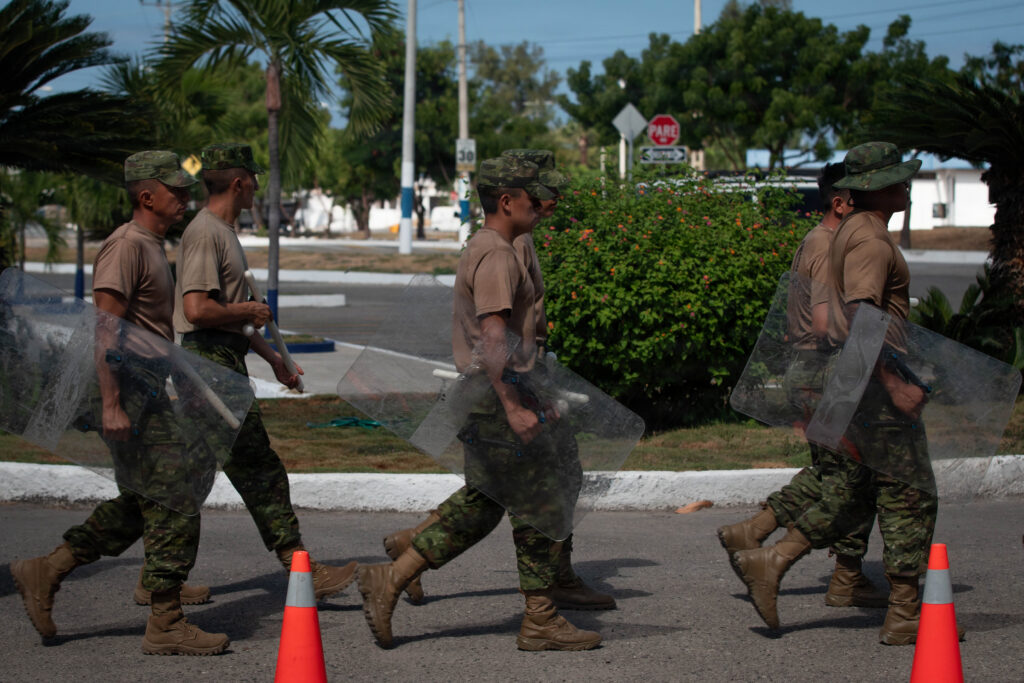
The United States has stood up a new military headquarters to steer an 18-nation anti-cartel coalition across the Americas, folding partners from Chile to Colombia into a single hemispheric campaign against drug cartels.
What Washington Announced
U.S. Southern Command (SOUTHCOM), based in Miami, activated Joint Task Force Western Hemisphere on August 4, describing it as the “operational headquarters for the execution of missions across the region.” The command said the body integrates intelligence, surveillance and reconnaissance, operational planning and multinational coordination.
SOUTHCOM commander General Francis Donovan cast the task force as the “executing arm” of the command to confront threats across the hemisphere. He said the headquarters brings together tailored military capabilities and “trusted alliances” to increase pressure on criminal organizations and strengthen the security of the United States and its partners.
According to the command, the coalition seeks to “increase operational effectiveness against threats that undermine regional security and impact the United States” and its allies, while also improving joint responses to emergencies and humanitarian crises.
The 18-Nation Coalition, Country by Country
The coalition traces back to the “Shield of the Americas” declaration signed at a March 2026 summit in Miami. The founding signatories were Argentina, Bolivia, Costa Rica, the Dominican Republic, Ecuador, El Salvador, Guyana, Honduras, Panama, Paraguay and Trinidad and Tobago, together with the United States.
After that event, the Bahamas, Belize, Chile, Guatemala, Jamaica and Peru signed on, along with Colombia’s president-elect, Abelardo de la Espriella. That expansion brought the number of partner nations to 18 alongside Washington, the figure now cited for the Americas Counter Cartel Coalition.
Colombia’s participation is notable because it was committed by the incoming administration rather than the outgoing one. President Gustavo Petro, who leaves office this week, has been openly critical of U.S. counter-narcotics strikes, while de la Espriella has aligned more closely with Washington.
From “Southern Spear” to a Standing Command
SOUTHCOM presented the new task force as a “transition” from Operation Southern Spear, a campaign launched in September 2025 that carried out strikes on boats the United States said were carrying drugs in the Caribbean and the Pacific. The earlier effort was organized around maritime interdiction.
Where Southern Spear was a temporary formation, officials have described JTF-WHEM as a purpose-built, theater-wide command covering SOUTHCOM’s full area of responsibility, which spans more than 30 countries across South America, Central America and the Caribbean.
SOUTHCOM said the new task force would be led by General Kevin Jarrard, who had overseen the U.S. response to the deadly June earthquakes in Venezuela. The command framed the change as a shift from a single campaign toward a permanent structure for regional operations.
What Members Are Signing Up For
The coalition is a political and military coordination framework rather than a binding defense treaty. In practical terms, membership commits partners to sharing intelligence, coordinating operations and taking part in joint planning against cartels and other transnational criminal networks.
For most Latin American and Caribbean members, the arrangement channels cooperation through the U.S. command structure, with the task force acting as the hub for surveillance, planning and multinational coordination. The degree of on-the-ground involvement is expected to vary widely from country to country.
For foreign readers, the initiative sits alongside existing regional bodies but is distinct from them: it is a U.S.-led coalition focused specifically on organized crime, not a formal alliance under the Organization of American States or a mutual-defense pact.
Controversy and Regional Reaction
The campaign that preceded the task force has drawn scrutiny. The Washington Office on Latin America (WOLA), a research and advocacy group, has counted strikes on more than 60 vessels and at least 221 deaths, and rights organizations have questioned the legal basis for the operations.
Reaction across the region has been mixed. Governments that signed the declaration have framed it as a way to pool resources against powerful trafficking organizations, while critics warn about sovereignty and the risks of a heavier U.S. military footprint. The Rio Times could not independently verify casualty figures cited by advocacy groups.
The rollout also unfolds against a tense backdrop in Venezuela, whose former leader Nicolás Maduro was detained and moved to the United States earlier this year to face narcoterrorism charges. Officials have tied the broader pressure campaign to that context.
Why It Matters and What Comes Next
The activation formalizes a more coordinated, U.S.-led approach to organized crime across the Western Hemisphere, giving Washington a standing command to work with partner militaries. For investors and residents, it signals sustained attention to security corridors that affect trade, migration and regional stability.
Much will depend on how the coalition operates in practice: how intelligence is shared, how operations are authorized within each country’s laws, and how governments balance cooperation with concerns about sovereignty and civilian safety.
Colombia’s formal entry, once de la Espriella takes office, will be an early test of the coalition’s reach, given the country’s central role in the regional drug trade and its shifting posture toward Washington.
Frequently Asked Questions
What is the Americas Counter Cartel Coalition?
It is a U.S.-led coalition against drug cartels and transnational organized crime that groups 18 Western Hemisphere partner nations alongside the United States. It grew out of the “Shield of the Americas” declaration signed in Miami in March 2026.
Which countries are members?
Members include Argentina, Bolivia, the Bahamas, Belize, Chile, Costa Rica, the Dominican Republic, Ecuador, El Salvador, Guatemala, Guyana, Honduras, Jamaica, Panama, Paraguay, Peru and Trinidad and Tobago, plus Colombia through its president-elect.
What is Joint Task Force Western Hemisphere?
JTF-WHEM is the U.S. Southern Command headquarters activated on August 4, 2026, to coordinate operations against cartels across the region. It replaces the earlier Joint Task Force Southern Spear and integrates the coalition’s partner nations.
Sources
El Heraldo / EFE · El Mostrador · The Spokesman-Review (AP) · AUSA · GIS Reports
Connected Coverage
Security and defense across the Americas
More Latin America coverage from The Rio Times
Sources: El Heraldo / EFE, El Mostrador, The Spokesman-Review (AP), AUSA, GIS Reports.
This article was produced by The Rio Times’ automated newsroom system. How we use AI · Report an error
Read More from The Rio Times