Uruguay Begins Flood Evacuations as River Nears 12 m

WEATHER · URUGUAY
Key Facts
- —The country Uruguay, a stable South American democracy of about 3.4 million people, shares the Uruguay River and the Salto Grande dam with Argentina.
- —Why it matters The river is rising along Uruguay’s western border, where the cities of Salto and Paysandú sit on its banks. Local officials expect a long El Niño season of high water.
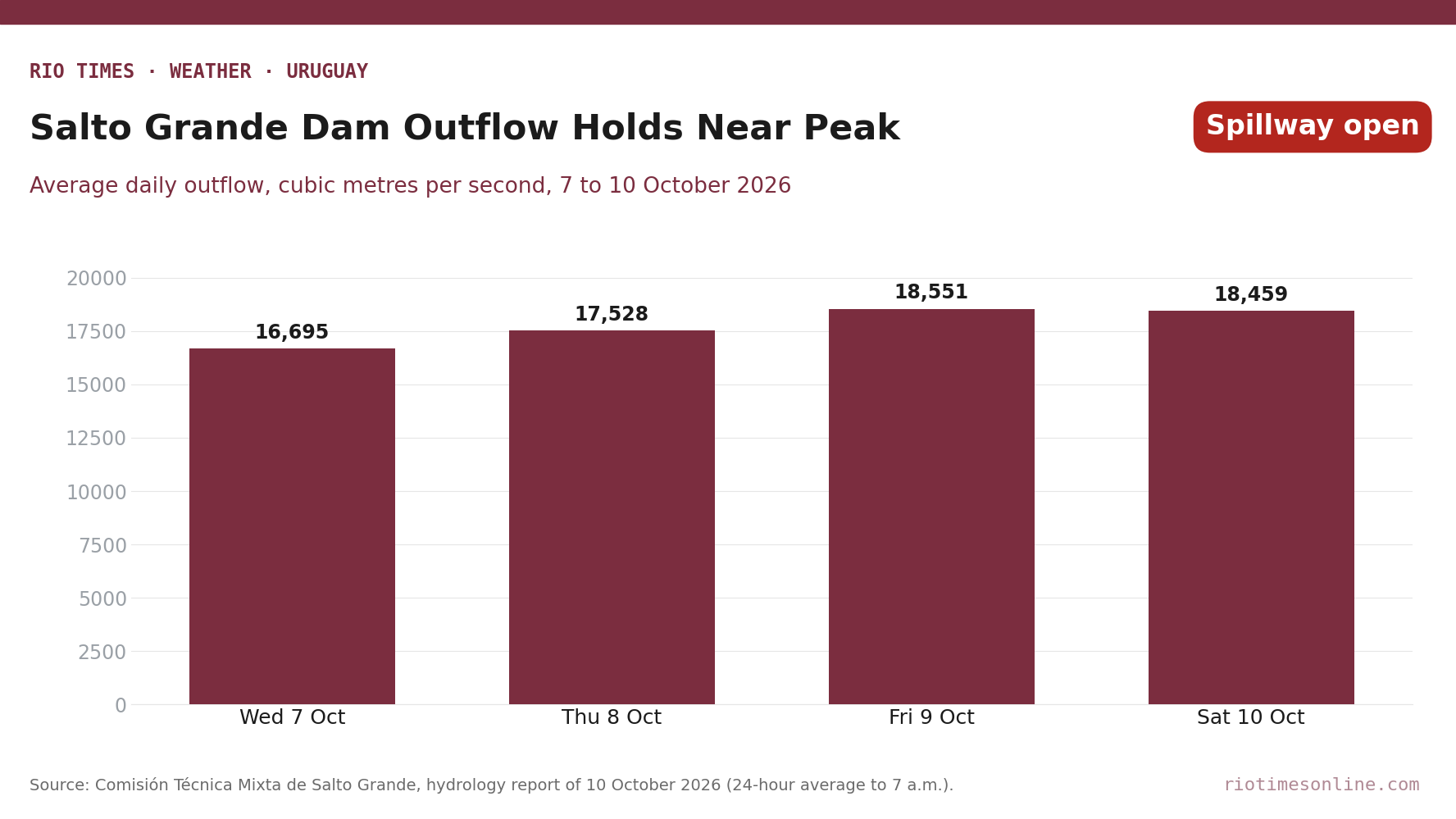
- —Why now The binational dam operator kept its spillway open on Saturday 10 October and released about 18,350 cubic metres of water per second.
- —What happened Salto has moved its first three families into an evacuation centre, local media reported on Saturday 10 October, with the river near 12 metres.
- —The numbers Salto’s emergency centre says 300 to 400 people could need help if the river reaches 13 to 14 metres. Paysandú expects a peak near 7 metres.
- —What it means for you Travellers using the Salto and Paysandú river crossings should expect closed riverside roads. Check local emergency updates before you drive.
- —Still open How high the river will finally climb depends on rain in the upper basin in southern Brazil over the coming week.
The Uruguay River flood has forced the first evacuations in the Uruguayan city of Salto, local media reported on Saturday 10 October. Three families were moved to a shelter as the river approached 12 metres at the port.
Downstream, Paysandú also began moving its first families, its mayor said. Officials in Salto warn the river could pass 13 metres in the coming days.
For US readers, the flood touches a busy border region with two road crossings into Argentina. It also lands as Paysandú prepares an open-air Mass for Pope Leo XIV, the first US-born pope.
How High the Uruguay River Flood Could Rise
The Salto Grande dam sits just upstream of both cities. It is run by the Comisión Técnica Mixta de Salto Grande (CTM), a joint Argentine and Uruguayan body.
In its daily notice for Saturday 10 October, the CTM said 17,966 cubic metres per second had flowed into the reservoir over 24 hours. At 8 a.m. it was releasing 18,352 cubic metres per second, with the spillway open.
The commission expects releases of 18,000 to 19,000 cubic metres per second until 3 p.m. on Sunday 11 October. Over that period, it says, the river should not exceed 12.20 metres at Salto or 11.90 metres at Concordia, the Argentine city opposite.
The CTM’s own gauge at Concordia shows the steady climb. It read 10.72 metres at 7 a.m. on Wednesday 7 October and 11.60 metres on Saturday morning.
The Salto daily La Prensa reported the river at 11.90 metres in front of the port on Friday afternoon, 9 October. By Saturday it said the water was close to 12 metres and covering some streets.
Aquiles Mainardi, who coordinates Salto’s departmental emergency centre (CECOED), told Radio Monte Carlo that projections show the river passing 13 metres in the coming days. He called 13 to 14 metres the critical band.
At that level, he said, 300 to 400 people could need help and a move to evacuation centres.
Who Is Responding in Salto and Paysandú
The Salto daily Diario Cambio reported that the first three families went to the Salto Uruguay sports club. The club has been converted into a shelter for about 50 to 60 people.
Workers built individual modules there to give families some privacy, the paper said. A second site, the Bernasconi space, is being prepared in case more people must leave their homes.
A social team from the Ministry of Social Development (MIDES), the national welfare ministry, is visiting at-risk neighbourhoods with emergency staff. The navy’s coast guard, the Prefectura Nacional Naval, and an army battalion are helping move families and belongings.
Several riverside roads in Salto are closed, according to the city’s traffic office as reported by La Prensa. They include the whole of Costanera Norte from Avenida Barbieri and Costanera Sur at Pascual Harriague.
In Paysandú, Mayor Nicolás Olivera told Radio Monte Carlo the river was above 6 metres and rising about one centimetre an hour. He expects a peak around 7 metres.
Olivera said the first families had already been assisted and moved. He added that projections for the number of people affected had been revised slightly downward.
He also said the Mass for the pope’s planned visit will be held in the Parque Municipal París Londres. The park was chosen because it lies outside the flood-risk area, he told the station.
What It Means for You
Salto and Paysandú are border cities linked to Argentina by road crossings, including the bridge over the Salto Grande dam. Visitors should expect detours near the riverfront and follow police signs.
Uruguayan authorities ask residents who need help, or who see a risk, to call the 911 emergency line. Salto’s CECOED also takes calls directly.
The wider picture is calmer than the images suggest. Salto officials told Diario Cambio they expect no sudden emergency in the city centre this weekend. Shelters, transport and staff are already in place.
For investors and farm traders, the episode is an early test of El Niño, which brings heavy rain to this part of South America. Our earlier analysis, El Niño Splits Latin America Into Winners and Losers, sets out who gains and who loses.
What Is Not Known
The final peak is uncertain. The CTM’s rain forecast for 11 to 17 October shows up to 112 millimetres at Itá, in the Brazilian upper basin, but almost none near Salto.
That upstream rain could push releases higher later in the week. The CTM stresses that its daily notice can change at any time for unforeseen reasons.
There is no official national total of evacuees yet. Salto’s Mainardi warned the emergency could last until March, April or May as El Niño develops. For background on who runs the country’s economy, see Uruguay Economy 2026, Who Runs It and How.
Frequently Asked Questions
Why is the Uruguay River flooding in October 2026?
Rain across the basin, which local officials link to El Niño, has raised the flow into the Salto Grande reservoir. The dam operator has opened its spillway and is releasing about 18,000 to 19,000 cubic metres of water per second.
How many people have been evacuated in Uruguay?
Salto had moved its first three families to a shelter by Saturday 10 October, and Paysandú has moved its first families too. No national total has been published yet.
Is it safe to travel to Salto and Paysandú?
Both cities are functioning, but several riverside roads are closed. Travellers should follow local police signs and check emergency updates before crossing to or from Argentina.
Sources: Comisión Técnica Mixta de Salto Grande, daily hydrology notice, flows and levels report and rain forecast, 10 October 2026; Diario Cambio, first evacuations in Salto; Radio Monte Carlo, Salto and Paysandú flood update and papal Mass venue; La Prensa (Salto), road closures.
This article was produced by The Rio Times’ automated newsroom system. How we use AI · Report an error · Editorial responsibility: Matthias Camenzind, Editor-in-Chief