Paraguay Central Bank Board: What Happens Next
Paraguay central bank board removal needs the president to act and the Senate to agree. Here is how the process works and what US investors should watch.

WHAT HAPPENS NEXT · PARAGUAY
The Paraguay central bank board faces removal demands from inside and outside the ruling party, but the law makes ousting it slow. On Wednesday 14 October, Senator Gustavo Leite urged President Santiago Peña to replace the entire board in Asunción.
Opposition senator Rafael Filizzola filed a motion the same day urging the executive to start formal removal. For US readers, the question is whether Paraguay can settle this without denting its reputation for financial stability.
Key Facts
- The country Paraguay is a landlocked South American farm and hydropower exporter, governed by President Santiago Peña of the conservative Colorado Party.
- Why it matters The Paraguay central bank board sets monetary policy and licenses every bank. Its credibility is part of the stability pitch Paraguay makes to foreign investors.
- Why now On Wednesday 14 October, ruling-party senator Gustavo Leite urged Peña to replace the whole board, and an opposition senator filed a removal motion.
- What happened Both moves rest on Article 17 of the bank’s charter law, which allows removal for poor performance only with the Senate’s prior agreement.
- The numbers The executive must send the Senate a replacement within 30 business days of any vacancy, and a successor only finishes the five-year term.
- What it means for you A drawn-out fight over the regulator could weigh on confidence in Paraguayan banks, bonds and businesses that US investors hold or deal with.
- Still open Whether Peña asks for resignations, whether the Senate votes on the motion, and what the bank’s review of ueno bank finds.
- Power Index Paraguay ranks 10th of 14 in The Rio Times Latin America Power Index, with 35.0 points (November 2026 edition).
How the Paraguay Central Bank Board Can Be Removed
The Banco Central del Paraguay (BCP) runs under Law 489 of 1995, its charter law, as rewritten by Law 6104 of 2018. Article 17 lists six ways a president or director leaves office early or on time.
They are the end of the term, resignation, poor performance, intentional criminal offences, certified physical or mental incapacity, and death. Only poor performance, under paragraph (c), requires the Senate’s prior agreement.
That means neither the Senate nor the lower house can fire the board on its own. The executive must start the case, and the Senate must then agree before any member leaves.
Members are also suspended if a judge orders them detained for an intentional crime, under Article 18. No such case has been reported against any current board member.
Three Paths From Here
The fastest route is resignation, which the law says is presented to the executive and communicated to the Senate. Leite argued on Wednesday that Peña should order a complete change of leadership himself.
The second route is a removal case for poor performance, the path Filizzola’s motion invokes. It needs both a decision by Peña and a Senate vote, so it depends on how the ruling party splits.
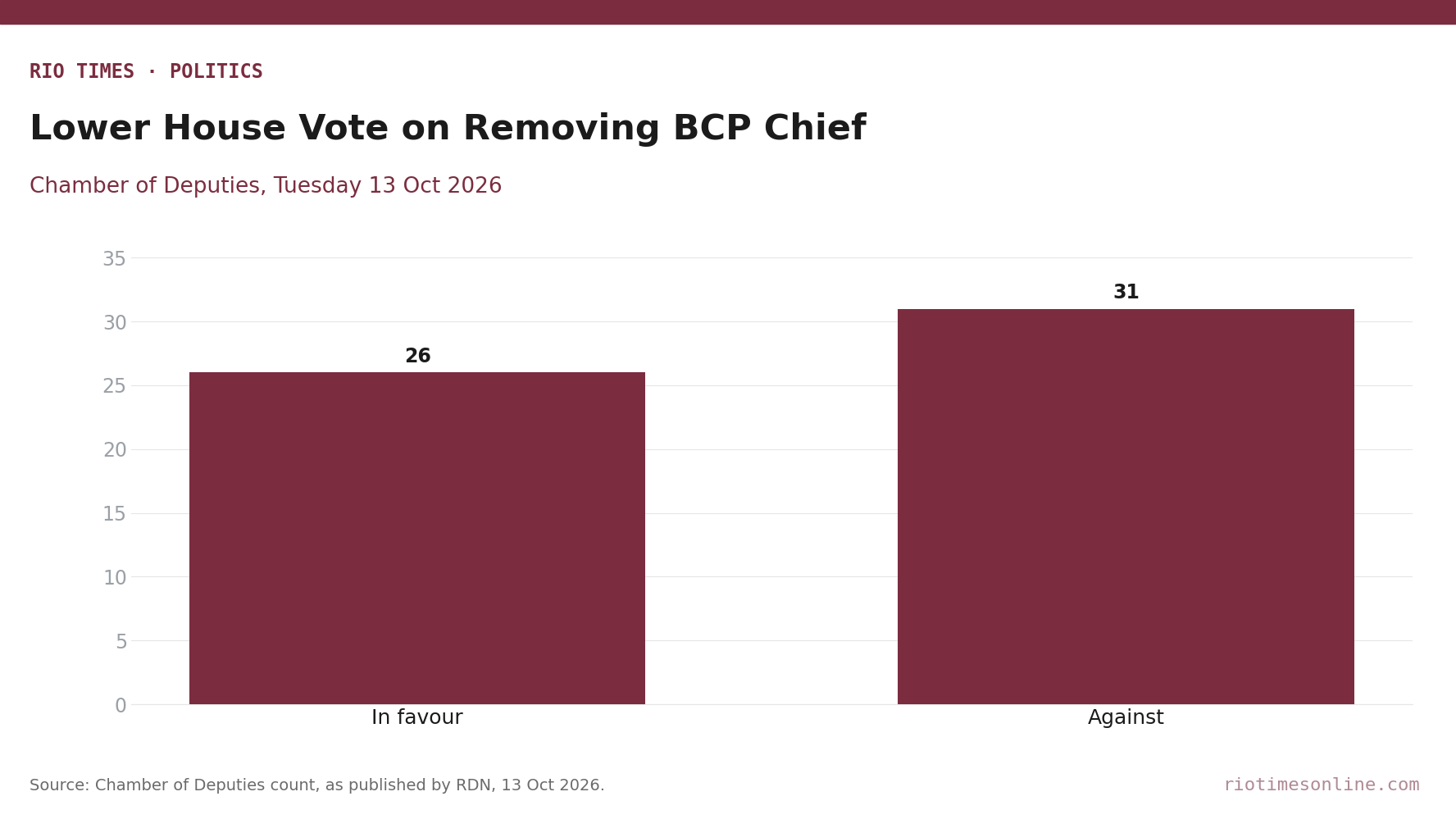
The third route is that the board stays and the pressure fades. Lawmakers aligned with Peña voted down a lower-house motion against bank president Carlos Carvallo on Tuesday 13 October, by 31 votes to 26.
Leite, a Colorado Party senator, said he remains loyal to party leader and former president Horacio Cartes. That places the dispute inside a wider fight between Cartes’s faction and Peña’s allies ahead of 2028.
The Senate Vote and the Replacement Clock
Filizzola, of the opposition Progressive Democratic Party (PDP), filed a draft declaration that urges the executive to start removing every board member. ABC Color reported that it cites Article 17(c) and needs majority support to be debated immediately.
A declaration of this kind is not binding on the president. Its value is political, because it forces senators to show whether they side with Cartes or with Peña.
If a seat falls vacant through resignation or removal, the executive has 30 business days to send the Senate a candidate. Senate agreement is again required before the new member takes office.
A replacement director does not get a fresh mandate, because the law says they only complete the five-year period already under way. The bank president’s term runs alongside the president of the republic’s, which ends in 2028.
If the bank president’s post is empty, a director elected by a board majority runs the bank until a new president is named. That rule keeps monetary policy and supervision running during any changeover.
The superintendent of banks, whom Leite also wants replaced, follows a separate rule in Article 32. The executive picks that official from a shortlist of three drawn up by the board, for a five-year term.
Why the Pressure Is Building
Leite said the BCP left eight to ten of the Senate’s 31 questions unanswered, Radio Monumental reported. He called the official reply incomplete and said it raised more doubts than certainties.
The questions concern how the bank supervised lending to related parties and the case of ueno bank, a digital lender. These are political accusations, and no court or regulator has ruled against the board.
Hoy reported Leite as saying that business leaders had implored Peña to change the board at a meeting at the presidential residence on Friday 9 October. The presidency has not confirmed that account.
Former public works minister Arnoldo Wiens said a meeting between Cartes and former president Mario Abdo Benítez discussed the BCP situation. Hoy reported that another such meeting is planned for next week.
Background on the crisis itself is in Paraguay Central Bank Board Crisis: What Is at Stake. For the wider picture, see Paraguay Explained: The Country, Its Politics, Its Economy and What to Watch and our Asunción city page.
What It Means for You
For US investors and companies in Paraguay, the BCP is the regulator behind every bank account, loan and currency transfer they use. A credible, independent board is part of why the country is seen as predictable.
So far the fight is about how the regulator handled specific cases, not about the soundness of the whole banking system. The risk is a long standoff that erodes trust in supervision as the 2028 race heats up.
Watch for a resignation request from Peña, a Senate vote on the Filizzola motion, and the outcome of the ueno review. Our Paraguay economy guide for investors sets out the wider economic backdrop.
What Is Not Known
It is not known whether Peña will ask the board to resign or open a removal case for poor performance. Revista Plus reported that Wednesday’s Senate session lost its quorum, pushing debate on Filizzola’s motion to next week.
The central bank’s full report to the Senate has not been published, so its answers cannot be checked independently. We found no public response from the bank to Leite’s latest demand by Wednesday evening.
More: Paraguay news in English, every day from The Rio Times.
Frequently Asked Questions
Can Paraguay’s Senate fire the central bank board?
No, because the charter law gives the Senate only a veto over removals for poor performance. The executive must start the case, and the Senate must then give its prior agreement.
What did Senator Rafael Filizzola propose?
He filed a draft declaration urging the executive to start removing every board member under Article 17(c). The text is not binding and needs majority support to be debated quickly.
How fast could new board members be appointed?
The executive has 30 business days after a vacancy to send the Senate a candidate. The Senate must then agree, so a full change could take weeks or months.
Who runs the bank if its president leaves?
A director elected by a majority of the board takes over until a new president is appointed. That keeps policy decisions and bank supervision running in the meantime.
Does this affect US investors?
It could, because the central bank licenses and supervises every bank in Paraguay. A prolonged fight over its leadership could weigh on confidence in the financial system.
Sources
This article was produced by The Rio Times’ automated AI newsroom. Editorial responsibility: Matthias Camenzind, Publisher and Editor-in-Chief. The Rio Times also runs Ask Rio Times, which answers from 100,000+ of our own articles, the daily Latin America Power Map, and prediction-market odds on elections and markets.. How we use AI · Report an error