Opinion: The Verbal Paradox of Being “Confined” in a Democratic Society
RIO DE JANEIRO, BRAZIL – (Opinion) Arguably the word most used by the press and people in general in the Portuguese and Spanish speaking world over the past six weeks, after coronavirus of course, has been “confinement” and all the words associated with it, such as “confined” and “deconfinement”, plus several etceteras.

But only journalist Ramón Pérez-Maura, in an article published in ABC on April 9th, with the headline “In Spain, there is no one confined”, seems to have alerted to a grave misuse of the word, applied to the reclusion that the population of Spain is still living, because of the pandemic that is ravaging the country, just as it continues to devastate much of the world.
In his text he alerted, consulting the Language Dictionary, that the verb “to confine” and its action and effect, the “confinement”, is a “punishment by which the convicted person is forced to live temporarily, in freedom, in a place different from his home”.
This is, in fact, according to the Language Dictionary. But, in any event, there is in the definition of this word an allusion to “freedom” which somehow denatures it. The truth is that in Spain, but particularly in Latin America, it was the dictatorships and not the democracies that used confinement to silence the voices of their critics, silence them for many years and, in some cases, even eliminate them.
This is the reason why a somewhat sinister and pernicious cloud hangs over the words “confined” and “confinement” which, of course, in the case of the forced seclusion people in Spain are living under the present circumstances, has no justification.
There is no doubt that in the sentence: “Don Miguel de Unamuno was confined by the Dictatorship of Primo de Rivera on the island of Fuerteventura in the Atlantic from February 1924 to July 9th of that same year, when he was pardoned” is strictly accurate, since it corresponds to historical fact.
Unamuno was an opponent of the regime which, manu militari, confined him to that remote location in order to have him silenced. This was the case of many Latin American dictatorships, which through forced seclusion somewhere remote -a desert, a jungle, an island, a village in the Andes- pushed aside and silenced troublesome adversaries and, in some cases, also made use of the distance to get rid of them.
The Peruvian dictators’ favorite place to confine their critics was the island of Frontón, in front of Lima, a sinister trajectory since many opponents and critics perished there throughout Peruvian history, where they were tortured and even murdered by our dictators.
Having said that, it is obvious that the definition of this word provided by the dictionary, which is very much in line with the old meaning of “confinement”, makes no sense in the situation experienced in Spain, since Pedro Sánchez’s government, like many other democratic governments throughout the world, intervened by establishing mandatory confinement for the entire population.
It did so by explaining the reason for the measure and by submitting it to the Cortes, i.e. the Parliament, where it was approved by a large majority, first for a period of two weeks, and then renewed several times, with the occasionally reluctant but explicit votes of opposition parties.
In other words, all legal forms have been respected in this instance, it has been done democratically, and there is no reason why this reclusion should be intended to be identical to that defined by the Dictionary. On the contrary, in a way it is precisely its antithesis.
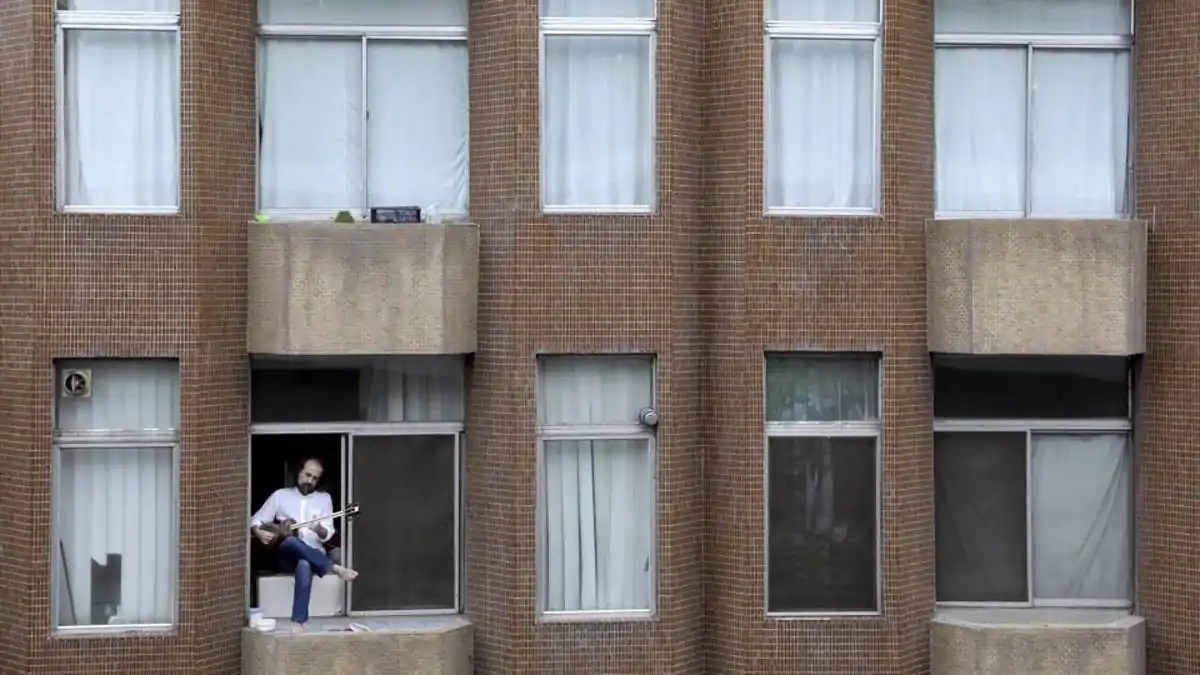
What is the solution to this contradiction? It makes no sense to start a campaign to banish the last meaning acquired by the word because of the coronavirus, for the sole reason that it would be doomed to fail miserably.
When a word is adopted by a vast multitude of speakers to express a new reality, however efficient and eloquent the campaign may be, it will fail hopelessly. The content of words is not decided by philologists and academics, but rather by the people who use them to understand and express themselves, by the people, that gigantic society which is the one that maintains languages alive and operational or lets them die.
Faced with this reality, the Institute of Lexicography of the Royal Spanish Academy proposed adding another definition besides the original one, which has been in the Dictionary since 1843, even though the Dictionary of Authorities has already attributed to the verb “to confine” the meaning of “to ban someone, giving him or her a compulsory residence” since 1743, that is, in a definition very close to that which the Dictionary would later adopt.
The Institute of Lexicography of the Royal Academy of Language proposes these two potential definitions of the word “confine”: “Temporary isolation imposed on a population for health and safety reasons”. And this other one: “Forced isolation to which a population is subjected in order to avoid the spread of an epidemic disease”.
Both are quite accurate, but the first is preferable to the second, because it establishes the temporary character of the measure which is crucial in order for the situation to be perceived as something temporary and transient, due to exceptional circumstances such as a pandemic, a large-scale terrorist action, a wave of fires and a war.
It would also be appropriate for that definition to point in some way to the legal and legitimate nature that it sustains, so that the arbitrariness with which it used to be applied in the past is excluded.
It is important to clearly differentiate “confinement” as a penalty and punishment enforced by a dictatorship against an opponent and a democratic measure, approved according to the law, which aims to protect a civilian population threatened by a sudden catastrophe that may inflict further misfortune on it unless its freedom of movement is momentarily reduced.
A final reflection on this subject, which brings useful lessons on a subject that has never been entirely clear to many people.
It is not academics and philologists who create the words used by people to communicate and understand each other; it is the speakers, both cultured and uncultured, those from the capital, the countryside and the city, who have this extraordinary faculty of renewing the language they use to understand each other, and also, of course, those who write it, journalists, authors, politicians, businessmen, workers, bankers and the endless tangle of those who use it and at the same time serve it, keeping it alive, in constant renewal.
The academics, pathologists, and dictionaries serve only to provide a certain order in what, without them, could dissolve into wild turmoil, chaos.
But it is important to always keep in mind that the power and creativity of a language lie in the popular and manifold base that uses it to understand itself, and that it is the one that gives meaning and reason to words, designating those which no longer serve oblivion, and feeding others, that it creates and adopts and configures in different ways as in this case, in strict accordance with the lived reality, which is, in the last instance, the one which gives the words their solvency and vitality and assigns them significance or buries them into oblivion.
This article was produced by The Rio Times’ automated newsroom system. How we use AI · Report an error · Editorial responsibility: Matthias Camenzind, Editor-in-Chief
Read More from The Rio Times