Bangladesh Cheers for Brazil: A World Cup Love Affair Since 1958
Opinion · World Cup 2026
More than sixteen thousand kilometres from the pitch, millions of Bangladeshis live and breathe the Seleção. Here is why a distant nation has loved Brazil since Pelé’s first World Cup, and dreamed along with its 2026 run.
For many years I have learned that football can unite people who have never shared a language, a border or a history. I am from Bangladesh, a country in South Asia more than sixteen thousand kilometres from Brazil.
And yet, when the Seleção takes the field, millions of Bengali hearts beat to the same rhythm as Brazil’s.
That is exactly what happened when Brazil beat Japan to reach the last 16 of the 2026 World Cup.
Japan opened the scoring, and for a few moments it looked as if they might write the story of the match. But there is a truth we have learned from following Brazil across generations: the Seleção’s story never ends at half-time, nor after conceding a goal.
When Gabriel Martinelli came on in the sixty-sixth minute, many believed he could change the game. In the ninety-sixth he found the net and sealed a 2-1 win, confirming what so many fans in Bangladesh have repeated for decades: Brazil never stops believing.
While Brazilians celebrated reaching the next round, Bangladesh celebrated as if the victory were its own.
A bond born of emotion, not geography
To many in Brazil this may seem curious. But outside Brazilian territory, few countries live the Seleção as intensely as Bangladesh.
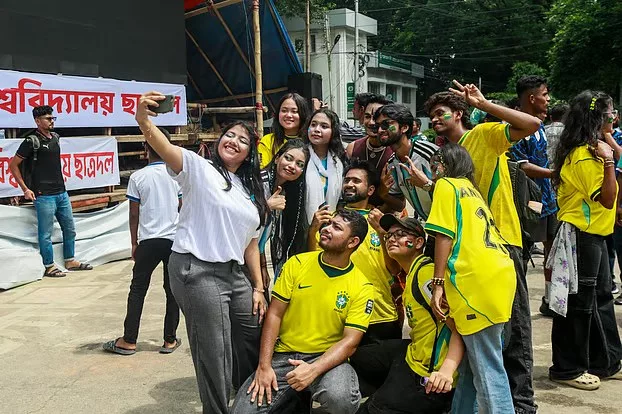
During the World Cup, streets empty when the games kick off. Green-and-yellow flags fly over houses and buildings.
Children wear the yellow shirt without ever having set foot in South America. Whole families stay up through the night to follow a match.
Our connection to Brazil was not born of geography or politics. It was born of emotion.
It all began in 1958. When Pelé enchanted the world and led Brazil to its first world title, his football crossed oceans.
Even in an age when few had access to television, the stories of that magical team reached what was then East Pakistan, today Bangladesh. Brazilian football came to represent far more than victories: it stood for joy, creativity, daring and freedom.
That passion crossed generations. Parents taught their children to love the Seleção, and those children did the same with their own.
Today Bangladesh may be the only place on earth where Brazil and Argentina share the hearts of millions with an intensity comparable to South America’s own.
But those who support Brazil in Bangladesh have never cheered only for the titles. If that were so, many would have given up after the disappointments of various World Cups.
We continue because Brazil represents an idea of football that has not disappeared: the beautiful game.
At a time when the sport often seems ruled by tactical systems and statistical calculation, Brazil keeps reminding the world that football can also be art. That is why every Brazilian comeback stirs us so deeply.
Falling is part of the game; staying down is not
When Japan scored first, social media in Bangladesh filled with worry. But there was confidence, too, because history has taught us that Brazil knows how to rise after falling.
Since 1958 the Seleção has taught a simple lesson: falling is part of the game; staying down is not.
That is exactly what we saw against Japan. More than a passage to the next round, it was a show of character.
Martinelli scored the decisive goal, but that moment stood for something larger than a result. It captured the essence of a team that never accepts that fate is settled before the final whistle.
After the win over Japan, Bangladesh lived familiar scenes once more. Flags rose in the streets, young people celebrated until dawn, and social media filled with messages for the Brazilian national team.
From Pelé to Neymar, an inheritance passed down
Down the decades, it was not only Pelé who conquered Bangladesh. There came Zico, Sócrates, Romário, Bebeto, Ronaldo, Rivaldo, Ronaldinho, Kaká, Cafu, Roberto Carlos and, more recently, Neymar.
Each Brazilian generation left its mark among us. Our young people copied Ronaldinho’s tricks on dirt pitches and tried to repeat Ronaldo’s step-overs in narrow city streets.
To this day it is common to find children playing barefoot while dreaming of one day wearing the yellow shirt, even knowing they were born on the other side of the planet.
Deep down, we admire Brazil because it taught us that football can be a celebration of the imagination. In Bangladesh, where the most popular sport is cricket, the football World Cup transforms the mood entirely.
For a month the country seems to breathe only football.
Houses are painted green and yellow, or blue and white. Giant flags stretch across whole streets.
In some towns, residents even build replicas of the World Cup trophy. It is not merely a sporting conteSt It is a collective celebration.
Now the dream continues, the dream of the Hexa
Many foreigners ask why a country so far away loves Brazil so much. The answer is simple.
Because football lets people belong to dreams that cross borders. Brazilians are born with the Seleção; we Bengalis chose it with our hearts.
And perhaps there is no greater tribute to a country than to discover that millions of people on the other side of the planet share its victories and its defeats as if they were their own. The Seleção is part of our emotional memory.
It has been there in conversations between parents and children, in the small hours in front of the television, in the tears of eliminations and the embraces of triumphs.
In Shariatpur, in Bangladesh, a group of young men made headlines by publicly vowing to stay single until Brazil wins another world title. It may sound like a curious story, but it reveals a deeper truth: here, football is not just a pastime. It is identity, community and emotion in their purest form.
For Brazil, a sixth title would mean writing another glorious chapter of its history. For Bangladesh, it would mean thanking a country that, without knowing it, has been giving whole generations joy, hope and passion since 1958.
When the world thought all was lost, Brazil was only just beginning. And in Bangladesh, millions believed it from the very first minute.
Because, for us, Brazil is never just a national team. It is a way of seeing football, an emotional inheritance passed from generation to generation, proof that a team can win hearts far beyond its borders.
Whatever happens in this World Cup, one certainty will remain: when the Seleção takes the field, there will be an entire country, on the far side of the Indian Ocean, cheering as if the yellow and the green were its colours too. That may be the greatest victory Brazilian football has ever achieved.
Background: Brazil Overhauls Tax System: A New Era for Business and Economy.
More: Brazil news in English, every day from The Rio Times.
Frequently Asked Questions
How far is Bangladesh from Brazil, and why do Bangladeshis support the Seleção?
Bangladesh is more than sixteen thousand kilometres from Brazil, yet millions of Bangladeshis support the Seleção despite sharing no common language, border, or history with the country. The bond between Bangladesh and Brazil is described as one born of emotion rather than geography.
How did Brazil beat Japan to reach the last 16 of the 2026 World Cup?
Japan opened the scoring and briefly looked like they might control the match, but Brazil ultimately won 2-1. Gabriel Martinelli came on in the sixty-sixth minute and scored in the ninety-sixth minute to seal the victory.
How did fans in Bangladesh react to Brazil's victory over Japan at the 2026 World Cup?
Bangladeshis celebrated the victory as if it were their own, mirroring the celebrations taking place in Brazil. This reaction reflects what the article describes as a deep, generational connection between Bangladesh and the Seleção.
Connected Coverage
Central Banks Fled the Dollar for Gold — Into a 29% Crash
How Ecuador Became Latin America’s Deadliest Country and a War Zone
Editorial responsibility: Matthias Camenzind, Editor-in-Chief · Editorial standards · Report an error