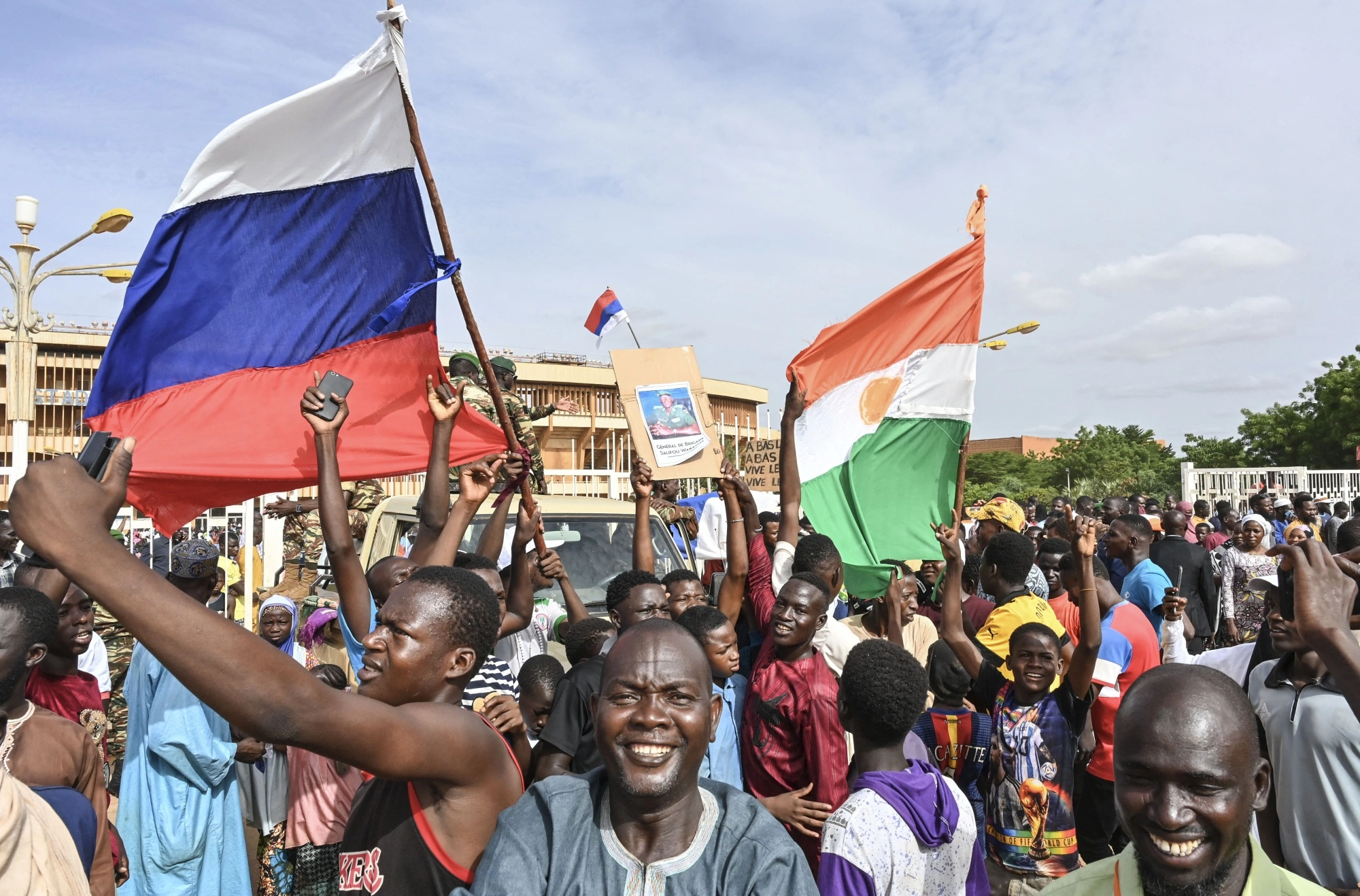
In Niamey, the capital of Niger, a significant display of Russian flags at 15 roundabouts signals shifting geopolitical winds.
This move coincides with the emergence of Russia as a visible ally in the context of Niger’s evolving international relations.
This development follows the military coup that ousted President Mohamed Bazoum in the summer of 2023.
Free daily brief — no card needed
Get every Africa story in one morning email
We build you a personalized brief around the topics you follow — free for 7 days. Love it? Your first month after that is US$1.
Russian flags, positioned alongside those of Niger, Mali, and Burkina Faso, articulate emerging bonds of friendship and burgeoning diplomatic ties between Niamey and Moscow.
This is despite Russia not being part of the Alliance of Sahel States, to which the other three countries belong.
Niamey’s New Allies: Russian Flags and Regional Realignments.
Public displays of Russian flags and an attack on the French embassy underline a rejection of former colonial influence rather than a straightforward endorsement of Russia.
Amid these events, the new military junta canceled military cooperation with the European Union and revoked permissions for EU missions.
This marks a potential pivot towards more independent defense and foreign policy orientations, possibly leaning toward Russian influence.
Niger’s Political Turmoil and Global Implications
The presence of Russian flags thus embodies more than just diplomatic camaraderie; it reflects a complex narrative of local autonomy against traditional Western influence.
This situation is further complicated by official Russian statements condemning the coup, juxtaposed against the visible public support for the new junta.
This suggests a nuanced Russian stance towards Niger’s political changes.
These developments highlight the delicate balance of power in the Sahel region, a key battleground in the fight against jihadism and a focus of international power struggles.
Niger’s political instability post-coup poses significant implications for regional security and international alliances.
In short, this situation illustrates the intricate dance of diplomacy, national sovereignty, and regional stability in Africa’s Sahel.
This article was produced by The Rio Times’ automated AI newsroom. Editorial responsibility: Matthias Camenzind, Publisher and Editor-in-Chief. The Rio Times also runs Ask Rio Times, which answers from 100,000+ of our own articles, the daily Latin America Power Map, and prediction-market odds on elections and markets.. How we use AI · Report an error