
Rio Times Markets · Mexico
Key Facts
—Who. INEGI, Mexico’s statistics agency, counts monthly sales at shops, supermarkets and online stores.
—What. Retail sales rose 1.2% in August from July, four times the 0.3% that analysts expected.
—Year on year. Sales were 3.3% above August 2025, against a forecast of 2.0%.
—Why it matters. Strong spending gives Mexico’s central bank less reason to cut its 6.50% interest rate.
—What to watch. Inflation data for early October are due on Thursday 22 October at 12:00 UTC.
—Prediction markets. Polymarket prices no Banxico change in November at 68.5%, a cut at 30.1%; Kalshi 61% and 35% (10:33 a.m. ET).
—Power Index. Mexico ranks 2nd of 14 in The Rio Times Latin America Power Index, with 71.4 points (October 2026 edition).
Mexican shoppers spent more in August than analysts expected, which gives the central bank one more reason to keep its interest rate at 6.50%.
Mexico’s retail sales rose 1.2% in August from July, four times the 0.3% that analysts expected, the statistics agency INEGI reported on Wednesday 21 October 2026. Compared with August 2025, sales were 3.3% higher, against a forecast of 2.0%.
The data matter to US readers because a stronger Mexican shopper leaves the central bank less room to cut interest rates, and rates drive the peso and Mexican bonds. They also give an early guide to household spending in Mexico.
What INEGI Reported
INEGI measures the real income of retail companies, which means their sales revenue after removing the effect of inflation. The monthly figure of 1.2% is seasonally adjusted, a method that smooths out regular calendar swings such as holidays.
The rise followed two small falls. Income fell 0.2% in June and 0.1% in July.
The yearly rate of 3.3% compares August 2026 with August 2025, and it is up from 1.8% in July. Forecasters in the RT economic calendar had expected 2.0%.
A strong month after two weak ones is good news, but it is still only one month. The forecasts quoted here are the consensus in the RT economic calendar.
Online Sales and Health Products Led
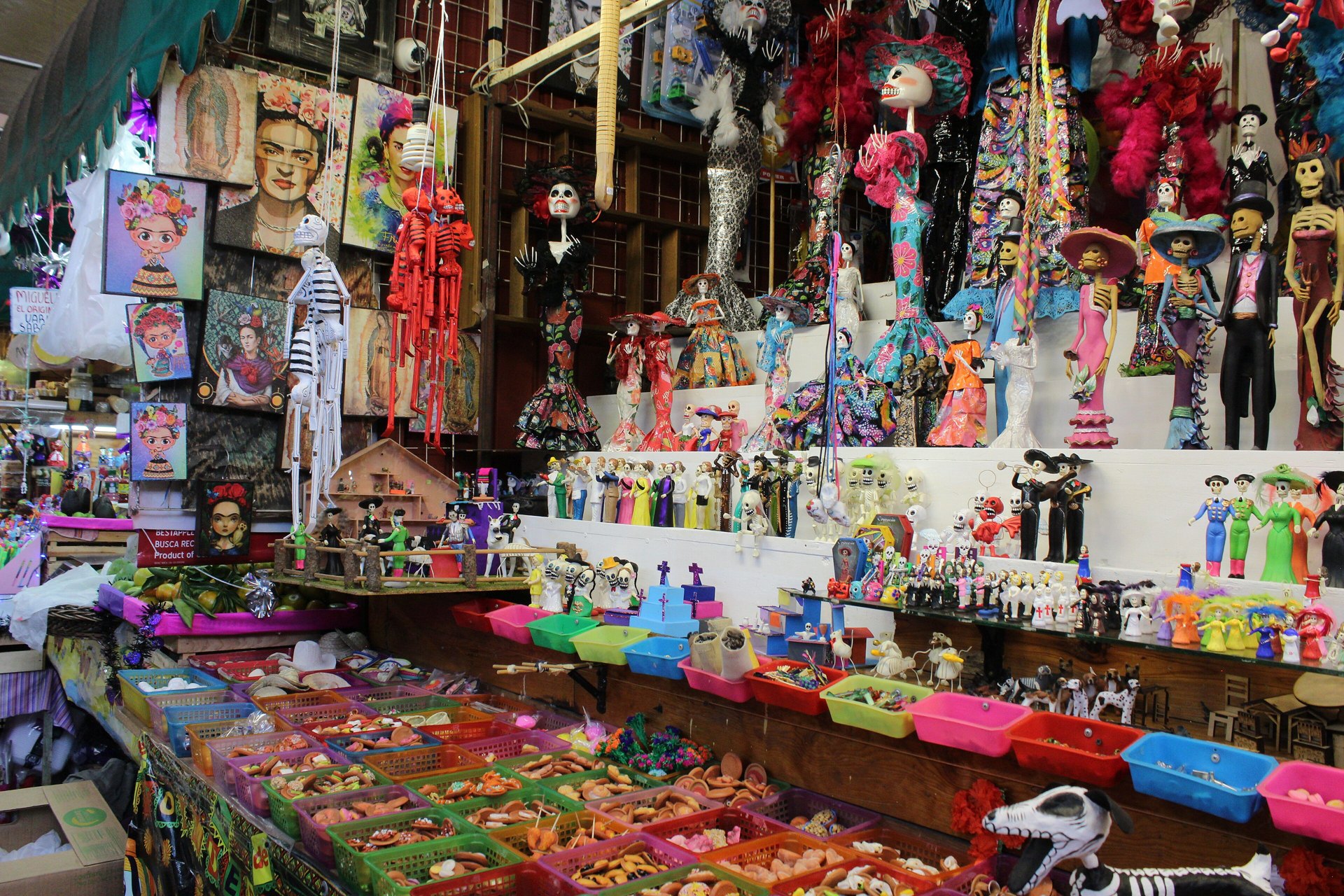
Among product groups, online, catalogue and television sales grew fastest, up 17.6% from a year earlier. Health-care products followed with 9.3%.
Hardware, paint and glass rose 8.3%, and household appliances, computers and decor rose 6.2%. Clothing, footwear and accessories gained 5.6%.
These annual rates are INEGI figures as relayed by the broker XTB and trading-data services. They show that growth was broad, not limited to one kind of shop.
In Plain English
INEGI. Mexico’s national statistics agency.
Real income. Sales revenue after removing the effect of inflation.
Seasonally adjusted. Smoothed for regular calendar swings.
Banxico. Mexico’s central bank, formally the Banco de México.
What It Means for Interest Rates
Banxico held its target interest rate at 6.50% on Thursday 24 September 2026, its third hold in a row. The minutes of that meeting, published on 8 October and reported by El Financiero, showed three of five members saying a cut could be discussed, while the others urged caution.
Strong retail sales lean against a cut, since steady demand can keep inflation from falling. Retail data are only one input, and inflation figures and US interest rates weigh more on the peso and on Banxico.
Inflation stood at 3.45% a year in September, with core inflation, which leaves out volatile prices, at 3.75%. The next reading covers the first half of October and is due on Thursday 22 October at 12:00 UTC (8:00 a.m. New York time).
The RT economic calendar shows forecasts of 3.6% for headline inflation and 3.7% for core, against 3.42% and 3.79% in the first half of September. Those are forecasts, not results.
What to Watch
Thursday 22 October, 12:00 UTC. Mexico’s inflation for the first half of October (forecast: 3.6%).
Thursday 5 November, 19:00 UTC. Banxico’s next interest-rate decision.
November. INEGI’s retail survey for September.
The Peso Weakens on the Day
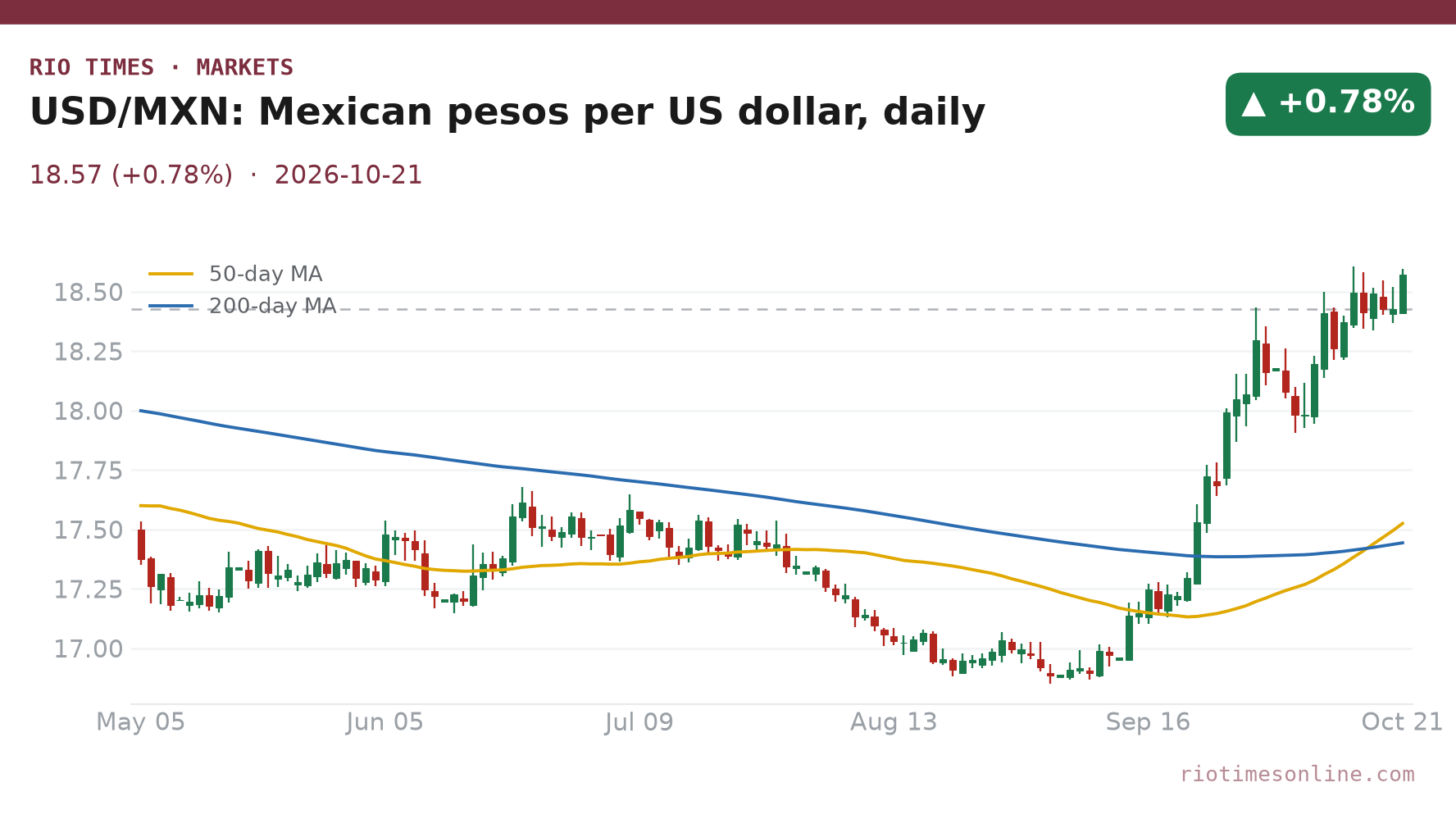
The dollar traded above 18.5 pesos on Wednesday, against 18.43 at Tuesday’s close, according to RT market data. One peso is worth about US$0.054 at that rate.
The broker XTB names the risk of higher US interest rates as the main pressure on the peso. It is not possible to separate the effect of the data from other news on the day.
What Prediction Markets Say
Polymarket is a platform where users trade contracts on real events, and its market on Banxico’s November decision has US$85,241 traded. As of 10:33 a.m. ET on 21 October 2026, traders price no change at 68.5% and a 25-basis-point (0.25 percentage point) cut at 30.1%.
Kalshi, regulated in the US by the Commodity Futures Trading Commission (CFTC), shows no change at 61% and a 25-basis-point cut at 35% (42,450 contracts traded). Each outcome is quoted separately, so Kalshi’s prices do not add up to exactly 100%, and all these prices are bets, not polls.
Why we show this: prediction markets turn real-money bets into a live probability that moves within minutes of the news, which is why investors, campaigns and newsrooms in the United States now follow them closely. We show them next to polls and official results, never instead of them.
What It Means for You
For US investors in Mexican stocks, bonds or the peso, the data point to firm consumer spending and a central bank in no hurry to cut. Companies that sell to Mexican shoppers, such as Walmart de México, which the US retailer Walmart controls, operate in a market that is still growing.
For residents and visitors, inflation of 3.45% means everyday prices are rising at a moderate pace. At about 18.5 pesos per dollar, US$100 buys roughly 1,850 pesos.
What Is Not Known
Details on retail jobs and pay in the August survey are not covered here, and it is not yet clear whether the rebound will last. The September survey, due in November, will show whether August was a turning point or a one-off.
What supports spending is inflation of 3.45%, a moderate level that does not quickly eat into household budgets. What could reverse it is a weaker peso that lifts import prices, and a central bank that stays at 6.50% for longer.
Frequently Asked Questions
How much did Mexico’s retail sales grow in August 2026?
Mexico’s retail sales rose 1.2% from July, seasonally adjusted, and 3.3% from August 2025, the statistics agency INEGI reported on 21 October 2026. Forecasters had expected 0.3% and 2.0%.
What does the retail sales figure measure?
It measures the real income of retail companies, which means their sales revenue after removing the effect of inflation. It covers retail businesses such as shops, supermarkets and online stores.
Will Banxico cut interest rates after this data?
The data lean against a cut, but retail figures are only one input. Banxico held its rate at 6.50% on 24 September 2026, and its next decision is on 5 November.
What do prediction markets say about the November rate decision?
On Polymarket, traders price no change at 68.5% and a 25-basis-point cut at 30.1%, while Kalshi shows 61% and 35%. These prices are bets, not polls.
What does this mean for the Mexican peso?
Strong spending can support the peso by reducing the chance of rate cuts. On the day, however, the peso weakened, and the broker XTB names the risk of higher US interest rates as the main pressure.
Sources
INEGI, monthly survey of commercial companies · INEGI, July bulletin · INEGI, June bulletin · Banco de México, policy announcements · El Financiero · XTB · Polymarket · Kalshi. Forecasts and earlier values from the RT economic calendar; peso rates from RT market data. This is news, not investment advice.
Connected Coverage
Mexico factory output rises 1.7% in August
Mexico consumer confidence drops to 45.1 in September
This article was produced by The Rio Times’ automated newsroom system. How we use AI · Report an error · Editorial responsibility: Matthias Camenzind, Editor-in-Chief
In depth
LatAm Markets: Live Signals → — real-time movers, turnover leaders and FX across Latin America.