Brazil’s Embraer KC-390 Could Become a Missile Truck
Brazil · Defense
Key Facts
—The partners. Brazil’s Embraer and US defense firm Anduril signed an MoU on July 21, 2026.
—The weapon. The Barracuda-500M is a subsonic cruise missile with a range of over 500 nautical miles (~926 km).
—The concept. Palletised munitions are dropped from a cargo bay, turning a transport plane into a ‘missile truck.’
—The payload. Each Barracuda-500M carries a 100-pound (approx. 45 kg) warhead for precision strikes.
—The timeline. The C-390 integration is under evaluation; the missile’s first pallet flight test was in September 2024.
The KC-390 Millennium, Embraer’s military transport workhorse, could soon double as a long-range strike platform. A new agreement signed at the Farnborough International Airshow on July 21, 2026, sets the stage for the Brazilian-made aircraft to launch palletised cruise missiles from its cargo bay.
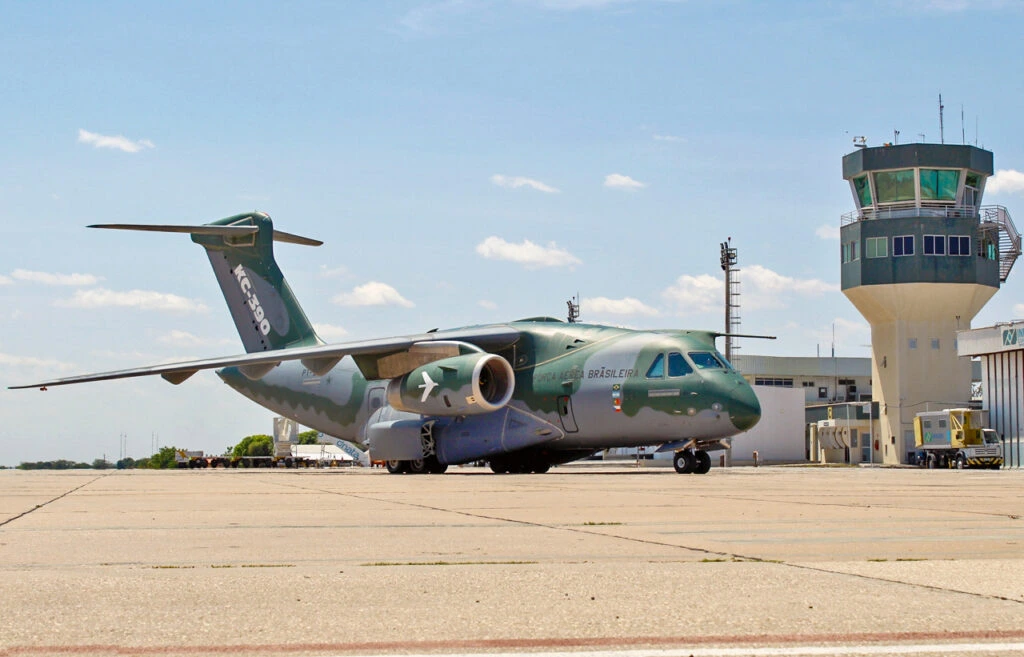
What palletised munitions actually mean
Palletised munitions are exactly what they sound like: weapons loaded onto standard wooden pallets and rolled into a cargo hold. Instead of needing external pylons or bomb bays, a transport plane simply opens its rear ramp and deploys them in mid-air.
This concept turns a logistics aircraft into a ‘missile truck.’ The pallets can carry multiple munitions, allowing a single plane to launch a swarm of affordable cruise missiles without ever entering hostile airspace.
For military planners, the appeal is clear. It bypasses the need for expensive, specialized strike aircraft and uses platforms that many air forces already own for cargo and humanitarian missions.
The technique itself is not entirely new, but pairing it with a modern, affordable cruise missile like the Barracuda-500M makes the idea practical for a wider range of countries. It effectively democratizes long-range precision firepower.
The weapon and the partnership
The missile in question is the Barracuda-500M, built by US defense technology company Anduril. It is a turbojet-powered, subsonic cruise missile that flies over 500 nautical miles (~926 km) to strike land or sea targets.
Anduril already has a framework agreement to deliver 3,000 surface-launched versions to the US Army by 2029. The new Memorandum of Understanding with Embraer focuses on an air-dropped, pallet-launched variant tailored for the KC-390.
Anduril designed the Barracuda family for scalable, lower-cost production, positioning it as an alternative to expensive legacy missiles like the Tomahawk or JASSM-ER. The company completed the first flight test of the pallet-launched version in September 2024.
For Embraer, partnering with a fast-moving US tech firm signals a strategic shift. It moves the KC-390 beyond its identity as a pure transport aircraft and into the offensive systems market, a space traditionally dominated by American and European defense giants.
Live Company IntelligenceEmbraer SA ADR — the full investor dossier
Wall Street view
Valuation & profitability
Price & risk
$59.2252-wk high
$66.87
Revenue trend · 6y
Ownership
Dividend
What changes for Brazil’s air force
For the Brazilian Air Force, which already operates the KC-390, this capability would add a completely new mission set. A single fleet could handle humanitarian airlift, troop transport, and now long-range precision strike.
It offers a lower-cost path to massed firepower. Instead of buying a separate fleet of bombers or advanced fighters, the air force could generate stand-off effects from a platform it already flies and maintains.
This flexibility is especially valuable for a country with Brazil’s vast territory and long coastline. The ability to project power quickly, using existing infrastructure and crews, strengthens national defense without requiring a massive budget increase.
The evaluation phase will determine how many missiles a single KC-390 can carry and deploy. If the numbers are significant, it could reshape how Brazil thinks about deterrence and its role in regional security.
How this reshapes Embraer’s export pitch for the KC-390
Embraer can now approach export customers with a multi-role aircraft that blends airlift with offensive punch. Nations seeking both transport and strike options on a single budget may find the math very compelling.
The palletised system also avoids permanent modifications to the aircraft. A KC-390 could fly a relief mission one day and, with a quick cargo-bay reconfiguration, train for a mass-launch strike the next.
This dual-use nature is a strong selling point for medium-sized air forces in Latin America, Africa, the Middle East, and Asia. It means a single fleet can cover missions that previously required two or three different aircraft types.
The KC-390 is already in service with Portugal and Hungary, with orders from the Netherlands, Austria, and the Czech Republic. Adding a proven strike option could accelerate decisions in competitive procurement campaigns where Embraer faces rivals like the Lockheed Martin C-130J.
Background: The rise of affordable cruise missiles
The Barracuda-500M belongs to a new generation of weapons designed to be produced quickly and cheaply. Unlike traditional cruise missiles that can cost millions of dollars each, Anduril’s approach uses commercial supply chains and modular designs to drive down unit costs.
This shift matters because it changes the economics of warfare. A country can now afford to launch salvos of precision weapons rather than hoarding a small stockpile of expensive missiles for only the most critical targets.
The US Army’s order for 3,000 surface-launched Barracuda-500Ms, with first deliveries expected in the first half of 2027, validates this high-volume philosophy. The air-launched pallet variant extends the same logic to air forces that already operate cargo planes.
For context, the Barracuda family includes smaller Barracuda-100 and 250 variants, but the 500M is the long-range strike model. Its 100-pound warhead is designed for precision rather than massive destruction, targeting command posts, radar sites, or ships with minimal collateral damage.
What this means for expats, investors, and regional stability
For foreign investors watching Brazil’s aerospace sector, the Anduril deal reinforces Embraer‘s ability to compete globally in defense technology. The company’s stock (traded on Brazil’s B3 exchange as EMBR3) often reacts to major contract news, and a successful integration could open a new revenue stream.
Expats and business travelers in Latin America should see this as a sign of Brazil’s deepening defense ties with the United States. Such partnerships often lead to technology transfers and joint training exercises that can stabilize regional security dynamics.
Tourists are unlikely to notice any direct impact, but a stronger, more versatile Brazilian Air Force contributes to the country’s ability to respond to natural disasters and humanitarian crises. The same KC-390 that could carry missiles can also deliver emergency supplies to flood-stricken communities.
From a geopolitical perspective, the palletised munition concept could level the playing field for smaller nations. It reduces dependence on expensive fighter jets for strike missions, potentially altering defense procurement strategies across Latin America and beyond.
More: Brazil news in English, every day from The Rio Times.
Frequently Asked Questions
What is a palletised munition?
It is a weapon system loaded onto a standard cargo pallet and launched from a transport aircraft’s rear ramp, turning the plane into a weapons carrier without structural changes. The pallets can carry multiple missiles and be deployed in rapid succession, enabling a single cargo plane to launch a swarm of precision weapons while staying far from enemy defenses.
How far can the Barracuda-500M fly?
The Barracuda-500M has a range of over 500 nautical miles (about 926 km), allowing the launch aircraft to stay safely outside enemy air defenses. This stand-off distance is critical for the KC-390, which is a transport aircraft not designed to survive in contested airspace.
Is the KC-390 already firing these missiles?
Not yet. The July 2026 agreement is an evaluation phase to study integration.
The missile itself completed its first pallet-launched flight test in September 2024, but engineers must still verify that the KC-390 can safely deploy the weapon and that the missile can transition from cargo-bay release to stable flight.
Connected Coverage
Sources: Embraer; Anduril.
This article was produced by The Rio Times’ automated newsroom system. How we use AI · Report an error · Editorial responsibility: Matthias Camenzind, Editor-in-Chief
Read More from The Rio Times