Isolated, Bolsonaro Weeps and Seeks Support Among Military Against Crisis
RIO DE JANEIRO, BRAZIL – Politically isolated, President Jair Bolsonaro has demonstrated emotional fragility in the handling of the coronavirus crisis and sought refuge in the military sector in an attempt to regain control of the government.
On at least one recent occasion, he wept before government members in the Planalto Palace who were not part of his inner circle. He complained that he is suffering constant criticism and points to external opponents, with particular emphasis on governors João Doria (São Paulo) and Wilson Witzel (Rio de Janeiro).

Bolsonaro and the state chiefs have been engaged in a power struggle, with the President advocating only partial isolation measures for groups vulnerable to Covid-19, while the others have embraced the WHO’s full quarantine recommendations.
The President lacks unanimous internal support. Government ministers, starting with Luiz Henrique Mandetta, Minister of Health, but also the popular Sérgio Moro, advocate social isolation. The Minister of Economy, Paulo Guedes, said he would rather remain at home “as a citizen”.
As a result, Bolsonaro turned to his original background, the military, whose wing in the government had been strengthened earlier this year after being sidelined by the so-called ideological core centered on the President’s sons.
He restored his Chief of Staff, General Walter Braga Netto, in an attempt to unify the speech on the crisis. He did so under suspicious eyes, given that the final word is typically his and his sons.
The result, in any event, was disastrous from the public perspective. In a press conference on Monday, March 30th, Braga Netto behaved like a Mandetta guardian and even speculated on his resignation.
Leaders in Congress, starting with the heads of both Houses, were horrified by the scene – a reaction that enjoys some partisan solidarity, since Mandetta is a member of the Democrats political party, as are Rodrigo Maia (Chamber) and Davi Alcolumbre (Senate).
In an exchange of calls and messages during Tuesday morning, March 31st, politicians were intrigued by the symbolism of Braga Netto’s action.
This was because, also the day before, a Twitter post by the former Army commander, Eduardo Villas Bôas, had drawn a great deal of attention.
In it, the man to whom Bolsonaro once said he owed the 2018 election advocated his “brave stance” in the crisis, just when the President was under a hail of criticism for having visited the street market around Brasília on Sunday.
Also on Monday, the Ministry of Defense released the agenda concerning the 56th anniversary of the 1964 coup, referring to the military action as a “milestone for democracy”.
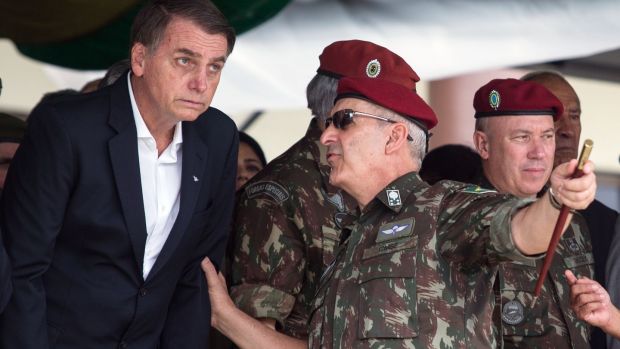
The cabinet Minister, General Fernando Azevedo, is regarded as a moderate negotiator. Nowadays, he is the link between the active military under his command, the military wing in which Braga Netto is a former subordinate, and the Judiciary, in which he acted alongside the President of the Supreme Court, Dias Toffoli.
On March 31st, the vice-president, General Hamilton Mourão, also praised the 1964 coup on Twitter, although leaving a hashtag saying that it belonged “to history”. The vice-president had already dissociated himself from the President by advocating social isolation.
Party leaders wondered if there was any connection between the events involving the uniformed leaders.
What can be said at this point is that there is concern over the risk of social instability due to the economic impacts of the pandemic, in addition to what was already perceived as the threat of the military being used in the dispute between the President and the states.
Combined with all this, there is concern that Bolsonaro’s belligerence will raise the crisis to another level, since he no longer relies on support in Congress, nor on the good will of the Supreme Court since he endorsed an action calling for the closure of these institutions.
This distinguishes him from the Hungarian premier Viktor Orbán, for one, who acquired quasi-dictatorial powers in the midst of the health emergency, with overwhelming backing in Hungary’s parliament and supreme court.
The military’s image is associated with the President and his rise to power. As he is deemed uncontrollable, guided by his core famil , damage control for the class itself would remain.
A general very close to Villas Bôas emphasizes another aspect. Although very respected and influential, the former commander no longer represents the active duty forces and plays a symbolic role in the military wing used by the government.
Consequently, his speech may only be yet another record of loyalty at a difficult time, where the erosion of emotional stability is the subject of talks within the military, as well as the known concern with radicalization in the streets.
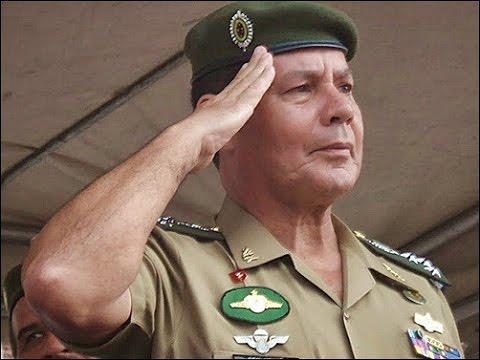
In relation to 1964, the military were unanimous in further emphasizing the benign aspect of the agenda, which insists on the constitutional submission of the Armed Forces to civilian authority.
A number of politicians have already noticed a message regarding the readiness of the military in case the situation deteriorates.
A centrist party president joked nervously that a coup would not even be required, it would be enough to see Bolsonaro on leave for the military to effectively return to power.
For a politician with intense activity among the uniformed men, one must look at history. The concept of authority over civil power is in the Brazilian military DNA, according to successive interventions and coups.
The erosion of the public powers’ credibility after the redemocratization, a period in which the military was placed virtually under public gag, culminated with the election of a retired Army captain.
The release of powers would be inevitable, argues the politician, because over the years the officers have always seen their 1964 version under-represented after leaving power in 1985.
When Azevedo took over, he agreed with the commanders that everything concerning the activity for an external public would fall under his responsibility, while others would control internal demands. Signing the note, underwritten by the three Powers, is one way to accomplish this and still report to the generalship.
The greatest risk, this politician believes, is the return of the notion of authority, and what Bolsonaro’s role in this arrangement might be.
Source: Folha
More: Brazil news in English, every day from The Rio Times.
This article was produced by The Rio Times’ automated newsroom system. How we use AI · Report an error · Editorial responsibility: Matthias Camenzind, Editor-in-Chief