Honduras Energy Justice Law Takes Effect, Freezing a 0.64% Power Tariff Rise
ECONOMY · HONDURAS
Key Facts
- —The country Honduras, a Central American country of about 10 million people, where the state utility ENEE supplies most homes and firms.
- —What happened The Energy Justice Law (Decree 198-2026) was published in La Gaceta, the official gazette, on 30 September 2026 and is now in force.
- —The numbers The regulator CREE approved an average 0.64% tariff rise for October to December 2026. Under the law, it will not reach customers’ bills.
- —What it means for you The price per kilowatt-hour on your last bill cannot rise for six months. Bills still rise if you use more power.
- —Still open How much the government will pay to absorb deferred increases, and how those amounts and any interest will be recovered later.
The Honduras Energy Justice Law took effect after its publication in La Gaceta, the official gazette, on Wednesday 30 September 2026. Its first test came the same day, when the electricity regulator announced a new quarterly tariff.
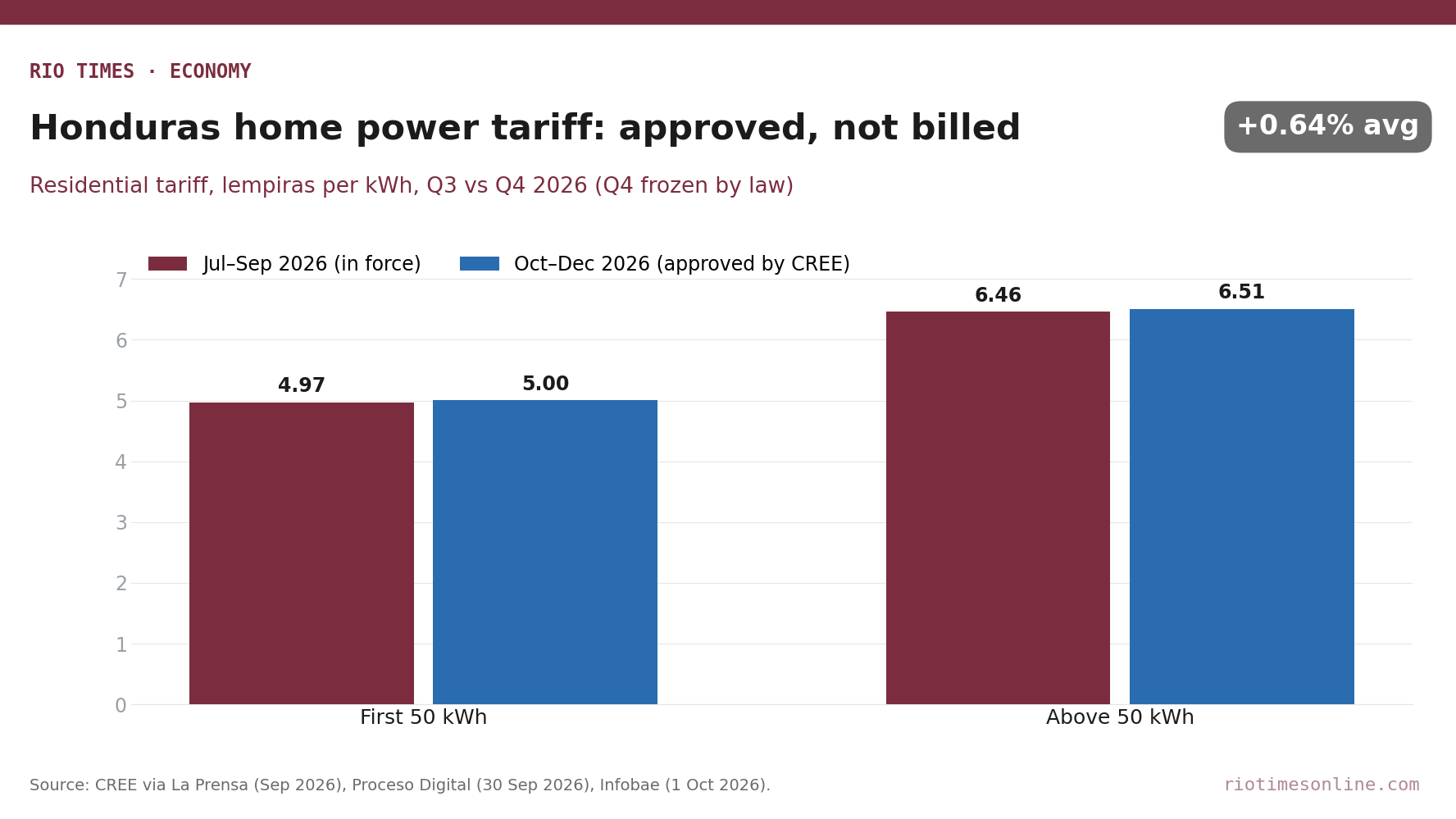
The Electric Energy Regulatory Commission (CREE) set an average rise of 0.64% for October to December, Proceso Digital and Infobae reported. Because the law freezes tariffs for six months, customers will not pay it for now.

From signature to law in force
President Nasry Asfura signed the reform on 29 September, as The Rio Times reported in Honduras Electricity Tariff Frozen for Six Months as Asfura Signs Law. Publication in the gazette was the last step before it could apply.
Tu Nota reported that the text appeared as Decree 198-2026, the Energy Justice Law Applied to the Consumer. El Heraldo confirmed on 30 September that the freeze is now in force.
A rise approved on paper only
CREE reviews the tariff of the National Electric Energy Company (ENEE), the state utility, every three months. Its new schedule took effect on 1 October.
For homes, the first 50 kilowatt-hours now cost 5.0031 lempiras each (about US$0.19), against 4.9706 before. Each further kilowatt-hour costs 6.5102 lempiras (about US$0.24), up from 6.4580.
Héctor Corrales, CREE’s president commissioner, said Article 1 bans any increase in ENEE’s applied tariff during the freeze. The law does allow the tariff to fall if costs drop, he told Infobae.
The small size of the October adjustment eases pressure on the freeze. For July to September, CREE had lifted the average tariff 12.48%.
Who pays, and when
The cost does not disappear. Corrales said the state must absorb the increase, while the deferred amounts are carried into later periods and may accrue interest.
“In this period no tariff rise is passed on; the government will absorb it,” ENEE manager Guillermo Peña Panting told El Heraldo. He said this would require a fiscal effort and must be handled “with total responsibility”.
Congress can extend the freeze by a further six months. CREE will keep issuing quarterly tariffs, so the gap between approved and billed prices will stay visible.
What else the law sets in motion
The Honduras Energy Justice Law splits ENEE into a state parent company and three subsidiaries for generation, transmission and distribution. Each starts with share capital of 150 million lempiras (about US$5.6 million), Tu Nota reported.
Dams, transmission lines and substations remain state property. The law also gives the system and market operator technical autonomy and strengthens the independence of CREE.
For households, prices per kilowatt-hour should hold until about the end of March 2027. For investors, the test is whether the restructuring cuts losses faster than the freeze adds to costs.
What Is Not Yet Known
The government has not published an estimate of what absorbing the deferred increases will cost. It has also not said how or when the deferred amounts and any interest will reach customers.
The timetable for setting up the three subsidiaries has not been announced. CREE’s next quarterly tariff, due for January 2027, will show whether the gap widens.
Amounts in lempiras are converted at 26.85 per US dollar, the rate on 1 October 2026.
Sources: El Heraldo, 30 Sep 2026; Proceso Digital, 30 Sep 2026; Infobae, 1 Oct 2026; Tu Nota, 30 Sep 2026; La Prensa (Q3 tariff figures, via The Rio Times, 30 Sep 2026); exchange rate: open.er-api.com, 1 Oct 2026.
LatAm Markets: Live Signals → — real-time movers, turnover leaders and FX across Latin America.
Read More from The Rio Times