
HEALTH · GHANA
Key Facts
- —The country Ghana is a stable West African democracy and a close US security and trade partner. The Upper West Region lies in its far north-west, on the Burkina Faso border.
- —Why it matters Yellow fever is a mosquito-borne virus that can kill. A vaccine prevents it, and Ghana already requires proof of vaccination from every arriving traveller aged nine months or older.
- —Why now Laboratory tests in Dakar, Senegal, confirmed three cases. All three patients died, and the Ministry of Health declared an outbreak on Friday 9 October.
- —What happened The declaration covers affected districts of the Upper West Region. Officials first saw suspected cases with fever, jaundice and bleeding on 9 September in Sissala West and Wa West.
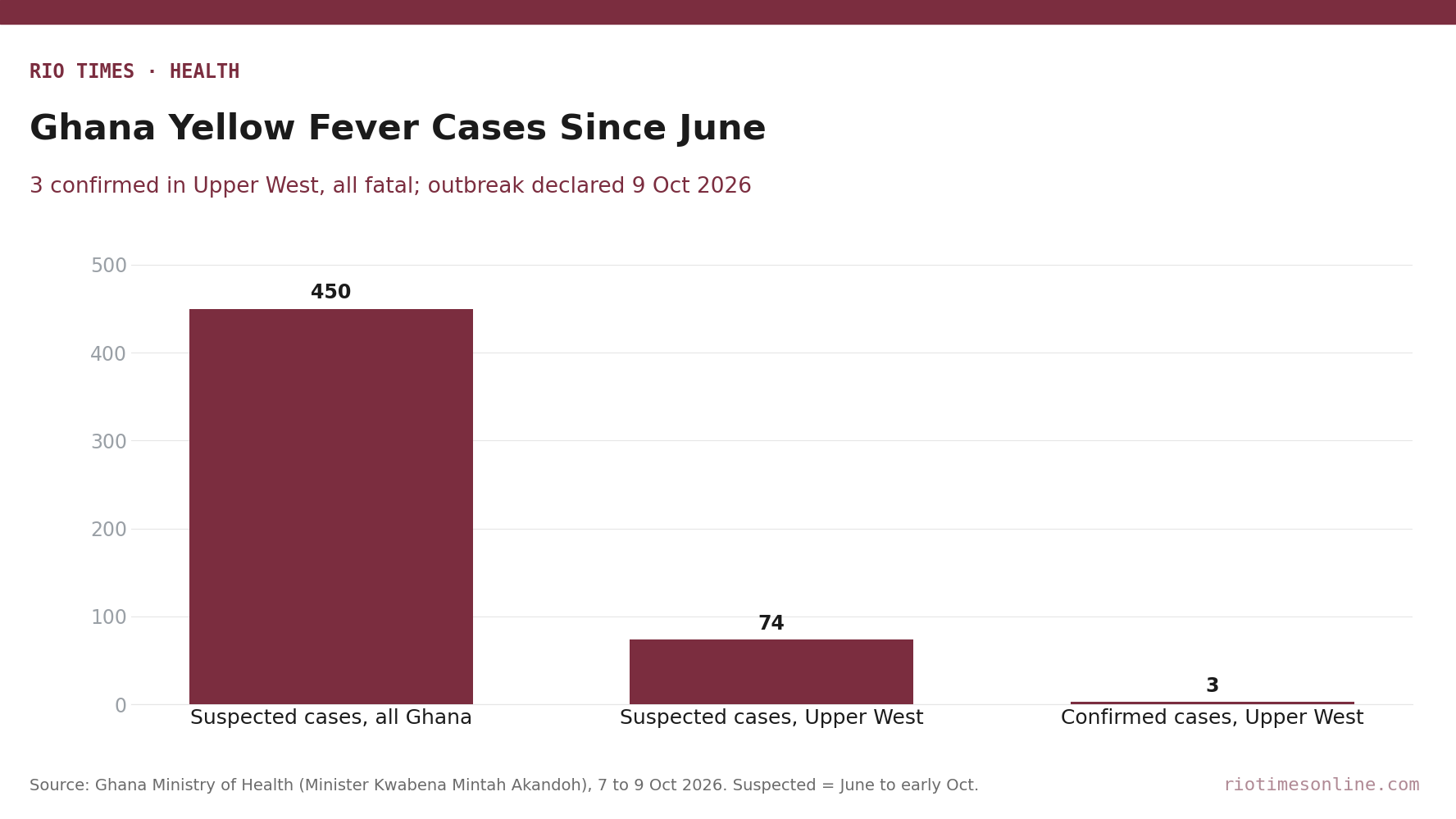
- —The numbers 3 confirmed cases, all fatal. 74 suspected cases in Upper West and about 450 suspected nationwide between June and September, according to Health Minister Kwabena Mintah Akandoh.
- —What it means for US readers Nothing changes at the border: the vaccination certificate was already mandatory. Travellers to northern Ghana should confirm their shot and avoid mosquito bites.
- —Still open How many suspected cases test positive, whether reported deaths in Sissala East are confirmed, and when the vaccination campaign starts.
Ghana has declared a yellow fever outbreak in its Upper West Region after laboratory tests confirmed three cases, all of them fatal. The Ministry of Health announced the Ghana yellow fever outbreak on Friday 9 October. It acted with the Ghana Health Service and the World Health Organization (WHO).
The affected districts lie in the country’s far north-west, on the border with Burkina Faso. For foreign visitors the practical rule is unchanged. Every arriving traveller aged nine months or older must already show proof of yellow fever vaccination.
Health Minister Kwabena Mintah Akandoh serves in President John Mahama’s government. He made the declaration under the International Health Regulations (2005) and Ghana’s Public Health Act, 2012 (Act 851). He has also urged calm.
He told a health sector meeting in Accra this week that the outbreak was “not out of hand,” according to the Ghanaian Times. “Let us go slow on pressing the panic buttons,” he said.
How the Cases Were Found
According to the ministry statement, reported by the Daily Graphic, health facilities began seeing suspected cases on 9 September 2026. The patients came from Sissala West and Wa West, two districts of the Upper West Region.
They arrived with fever, jaundice (yellowing of the skin and eyes) and bleeding. Samples were tested first in Ghana and then sent to a WHO-accredited laboratory in Dakar, Senegal.
The Ghana News Agency named that laboratory as the Institut Pasteur de Dakar. It confirmed three cases. The ministry said all three patients died “despite aggressive management by health staff.”
Mr Akandoh said the three confirmed cases came from about 450 suspected cases recorded across Ghana between June and September. Of those, 74 were in the Upper West Region. A suspected case is a patient whose symptoms fit the disease before any laboratory test.
Local reports suggest the toll may be higher. On 7 October CitiNewsroom reported seven deaths in the Sissala East Municipality. The local health directorate said it was monitoring the outbreak. The ministry has not confirmed those deaths as yellow fever, and the figures have not been reconciled.
What the Government Is Doing
The Ghana Health Service, the agency that runs public hospitals and clinics, has activated national and regional public health emergency operations centres. Rapid response teams are in affected communities, looking for cases, tracking surveillance data and informing residents.
The ministry statement says a targeted emergency vaccination campaign will run this month. It covers affected and at-risk districts, including Wa West, Sissala West and Sissala East. At a press conference in Accra on Friday, the minister said the campaign would start next week. It will target people aged nine months to 60 years, the Ghana News Agency reported.
District hospitals have set aside isolation areas for suspected and confirmed cases. Laboratories have received reagents to detect and confirm cases, the minister said earlier in the week.
The ministry asked residents to clear stagnant water around homes and to sleep under treated bed nets. It also advised using repellents and sleeping under nets during the day, and warned against self-medication.
Yellow fever does not pass directly from person to person. It spreads through the bites of infected mosquitoes, according to the WHO, and a single vaccine dose gives most people lifelong protection.
What It Means for US Readers
For US travellers the Ghana yellow fever outbreak does not change the entry rule. The US Centers for Disease Control and Prevention (CDC) says Ghana requires yellow fever vaccination from all arrivals aged nine months or older. The CDC also recommends the vaccine for that same group.
When we checked on 10 October, the CDC’s Ghana page listed no yellow fever travel health notice. Its only notice was a global Level 1 alert on measles.
Most visitors fly into Accra, on the coast, hundreds of kilometres from the affected districts. Aid workers, researchers and missionaries in the north face more exposure and should check their certificates before travelling.
The wider point is stability. Ghana detected the cases through its own surveillance, confirmed them abroad within about a month and moved quickly to vaccinate. That is the response international health rules are designed to produce.
For more context on the government in charge, see our explainer Ghana Politics Explained, Who Holds Power in 2026. For how another African country treats the vaccination card, read Uganda Confirms No Yellow Fever Card for Entry.
What Is Not Known
In the Ghana yellow fever outbreak, officials have not said how many of the 450 suspected cases have been tested. They have also not said whether any confirmed case came from outside Sissala West and Wa West.
It is not clear whether the seven deaths reported in Sissala East were yellow fever. The exact start date and vaccine supply for the emergency campaign have not been published.
The ministry has not said whether neighbouring Burkina Faso has been alerted to any cross-border cases. We will report confirmed figures as the Ghana Health Service releases them.
Frequently Asked Questions
Why did Ghana declare a yellow fever outbreak?
Laboratory tests at a WHO-accredited laboratory in Dakar confirmed three yellow fever cases in the Upper West Region. All three patients died. The Ministry of Health declared the Ghana yellow fever outbreak on Friday 9 October 2026.
Which parts of Ghana are affected?
The declaration covers affected districts of the Upper West Region. Suspected cases were first reported in Sissala West and Wa West, and Sissala East is also in the vaccination plan.
Do US travellers need a yellow fever vaccine for Ghana?
Yes. According to the CDC, Ghana requires proof of yellow fever vaccination for all arriving travellers aged nine months or older. That rule was in place before the outbreak.
Can yellow fever spread from person to person?
No. Yellow fever spreads through the bites of infected mosquitoes, not through contact between people, according to the WHO and Ghana’s Health Minister.
What is Ghana doing to stop the outbreak?
The Ghana Health Service has activated emergency operations centres, deployed rapid response teams and isolated suspected cases. A targeted emergency vaccination campaign is planned this month in affected and at-risk districts.
Sources: Ghana Ministry of Health statement of 9 October 2026, as published by the Daily Graphic, Health Ministry declares Yellow Fever outbreak in Upper West Region; Ghana News Agency, Health Minister confirms three yellow fever cases in Upper West; Ghanaian Times, Yellow fever outbreak in Upper West: 3 cases confirmed, 74 suspected; CitiNewsroom, 450 suspected yellow fever cases recorded from June to September and Sissala East on alert as Yellow Fever outbreak kills 7; US CDC, Ghana traveller health page.
This article was produced by The Rio Times’ automated newsroom system. How we use AI · Report an error · Editorial responsibility: Matthias Camenzind, Editor-in-Chief
Part of our ongoing coverage
Africa: The New Scramble — the great-power contest over the continent.