Florida Farmers Trade Oranges for Real Estate
Florida’s farmers have grappled with pests, frost, and storms devastating their orange orchards for nearly two decades.
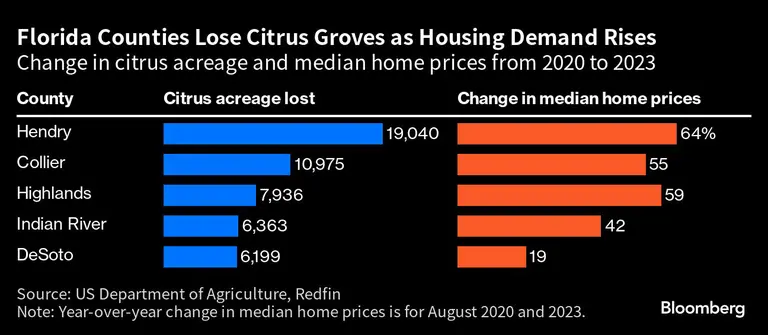
Many farmers have decided they’ve had enough. A booming real estate market is now making it more lucrative for them to sell their land rather than continue farming.
According to a preliminary report by the U.S. Department of Agriculture (USDA), the amount of land dedicated to orange farming in Florida has dropped by over half since 2000.
This year, only around 121,400 acres remain. Trevor Murphy, a third-generation farmer in Florida’s Highlands County, recently sold some of his less productive land.
That land will now become a vacation home for a buyer from Miami.
For years, Florida’s economy has been changing, moving away from its agricultural roots. Factors include climate fluctuations and changing consumer tastes.
Disease has also played a role. An incurable bacterial disease known as “greening” has accelerated the decline of the state’s citrus sector.
The disease has led to a 75% drop in Florida’s citrus production since 2005. As a result, the number of citrus farmers has decreased by 62% between 2002 and 2017.
Replacing diseased trees takes years, making land sales a tempting option for struggling farmers.
Florida is Growing
Drew Poston, a commercial real estate broker in Southeast Florida, says half of the properties he sells were once orange orchards.
They are mostly being converted into single-family homes. For instance, a 19-acre former orchard in Fort Pierce recently sold for over $6 million.
It will soon become a residential area with 165 plots.
Florida’s population is growing, making it a hot real estate market. This surge in demand has led to a shift in property development from coastal areas like Miami to inland locations.
According to Daryl Fairweather, chief economist at Redfin, former orchards offer a cheaper, more convenient option for building new homes.
In summary, as Florida’s economy evolves and its real estate market booms, many farmers find it more profitable to sell their land for housing development rather than continue with orange farming.
This trend has significant implications for the state’s once-dominant citrus industry.
With information from Bloomberg Linea
More: Brazil news in English, every day from The Rio Times.
This article was drafted with automated assistance and reviewed before publication. How we use AI · Report an error
Read More from The Rio Times