Expectations of the South American left for the upcoming meeting of presidents
In a dialogue with Sputnik, leaders of the South American left expressed their high expectations for the meeting of presidents to be held on May 30 in Brazil, especially for the possibility of promoting regional unity and reactivating the integration process.
“The big issue is that there is a will to overcome disunity and begin to build a new space, and we hope that the retreat convened by [Brazilian] President [Luiz Inácio] Lula da Silva, opens a path where the leaders, beyond their political differences, can go in the same direction,” said Carlos Ominami, former Chilean Minister of Economy and Trade, to Sputnik in the framework of the event called Montevideo Colloquium for South American Integration.
In a joint statement after the end of the colloquium, leaders of the South American left assured that they hope that the meeting of presidents in Brasília “will effectively set in motion a process of reactivation of regional integration as a clear demonstration of commitment to the interests, social and environmental wealth, and the plural cultural protagonism of the societies of our region”.
“We will await the results of the May 30 meeting.”
“From now on, we commit our greatest effort to continue collaborating in constructing a united, solidary, emancipated, proactive, and strengthened South America in the world”, they added.
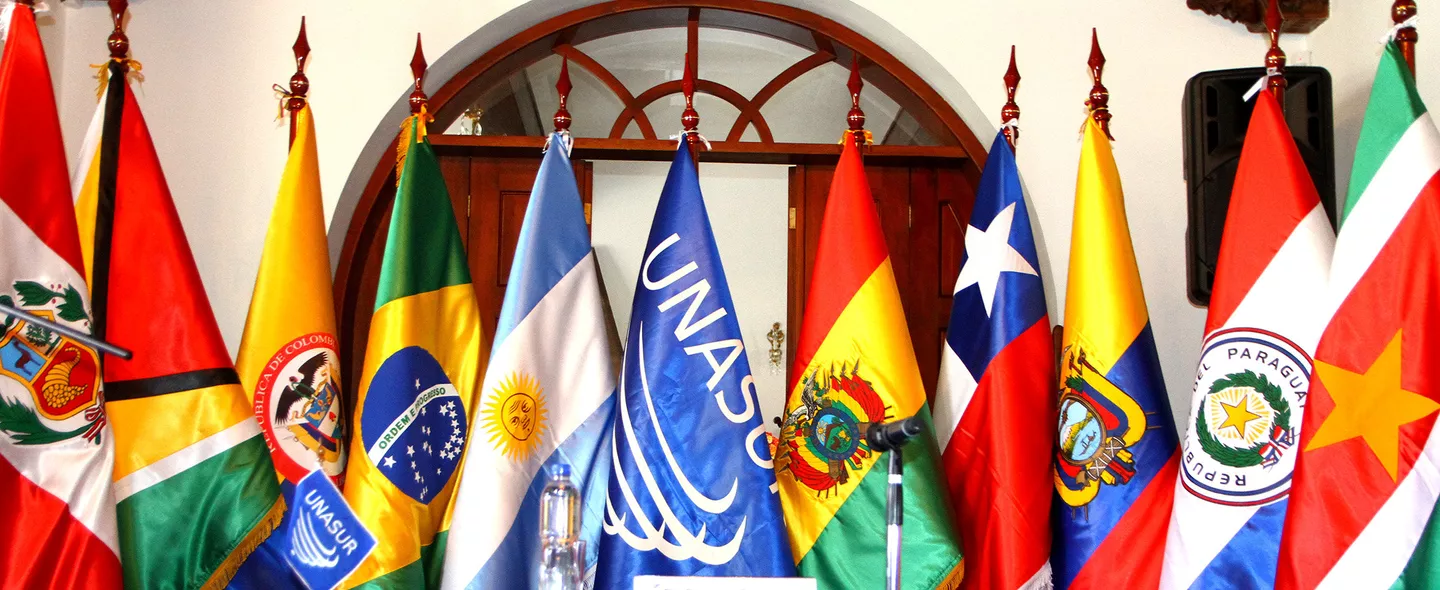
The meeting of presidents in Brasilia was called by Lula and is aimed at relaunching the Union of South American Nations (Unasur).
ANNUAL MEETING OF PRESIDENTS
Similarly, former Uruguayan foreign minister and vice-president Rodolfo Nin Novoa informed Sputnik that South American governments should establish an annual meeting of presidents in Brasília to deal with the region’s most important problems.
“I would hope [from the meeting in Brasília] that at least a certain consensus would be reached to have a regular meeting of the presidents, that they meet once a year and the foreign ministers once every six months to have a prepositive and problem-solving agenda that can give better living conditions to the peoples,” Nin Novoa said.
Ominami considered that the presidents would not have much time to “go into details”, but they should express their “pluralistic interest”.
“What is fundamental is that we can build instances that the governments in office do not condition. From the most practical point of view, a high-level meeting is built so that in 120 days, we have a proposal on Unasur, which recovers the positive things of the previous period and opens the way to the indispensable changes”, he added.
He considered that “we must get out of this black period of disintegration and divisions, with a situation of marginalization of Latin America in the global context. Today we are absent from all major debates. Our voice is not heard”.
Nin Novoa pointed out that the presidents of South America do not have a forum to discuss, put forward ideas, and plan joint actions related to the environment, an issue he considered “fundamental” and which is “very much threatened by extractivist threats that endanger the planetary balance”.
“Today, very few problems are of a national order; they are global, regional, the problem affects several countries (…) Latin America has a deeper recession than the one suffered worldwide.”
“There has been an increase of almost 50 million poor people; can’t something be done jointly? I believe that the countries have a better chance of getting out of this situation together”, he added.
BRAZIL’S ROLE
Brazil’s president will have to convince that Unasur is not a “club of leftist friends” during the retreat of South American leaders to be held in Brasilia on May 30, said Guillaume Long, former foreign minister of Ecuador and researcher at the Center for Economics and Policy Research, on Saturday.
“Lula must convince the countries, especially the conservative ones, that Unasur is not an ideological project nor a club of leftist friends.”
“This idea is very much installed in the media and the continental right wing. He has to talk a lot about pluralism, with open arms”, said Long during the event being held on Friday and Saturday called Coloquio Montevideo por la Integración Sudamericana (Montevideo Colloquium for South American Integration).
Long affirmed that Lula “has to have the firmness to say that Unasur is going to be reactivated because some countries will say that another space has to be created”.
“Unasur was abandoned in 2017 due to the political change in the region. (…) Clearly, with the return of Brazil and Argentina, the panorama changes.”
“They are the largest economies in the region and give the possibility to relaunch the organization.”
“With the return of Brazil and Argentina, we are talking about seven countries in Unasur. But five countries are missing”, he added.
He said President Lula’s challenge is to get Uruguay, Paraguay, Chile, Colombia, and Ecuador to join Unasur.
“It is difficult to recreate the conditions we had in 2008. Lula has to convince that this is convenient in a world that will be of blocs, multipolar.”
“We already have a tool to avoid going back ten years, which is the constitutive treaty of Unasur”, he affirmed.
For his part, Brazil’s presidential advisor for International Affairs, Celso Amorim, said that the government wants to promote a joint declaration on integration during the meeting between presidents.
“It is the first time there is a meeting [of presidents], which is very important. There will be a declaration mentioning the importance of integration and discussing issues such as infrastructure, defense, trade, and setting specific goals,” Amorim assured.
He stressed that it is not yet known if the declaration will reference Unasur since there is a country that has “resistances”.
He indicated that during the meeting, there would be ministerial meetings in several areas, especially defense, health, infrastructure, and trade.
“Brazil will bet during the meeting on political pluralism. It doesn’t matter if you are left or right.”
“The presidents must have an occasion to discuss the big issues (…) They have to feel that there is a South American T-shirt”, he reflected.
The event in the Uruguayan capital, organized by the Novos Paradigmas Institute and the Chile 21 Foundation, featured three round tables on integration: the first was discussed from the business point of view and scientific-technical cooperation, the second on the world of work and the third on a new political institutionality; later there will be a final declaration.
Unasur was founded in 2008 to increase cultural, social, and commercial exchange in the south of Latin America and from that region with other regions.
Initially, it was formed by Argentina, Bolivia, Brazil, Colombia, Chile, Ecuador, Guyana, Paraguay, Peru, Suriname, Uruguay, and Venezuela.
However, the bloc has been in crisis since 2018 due to political differences among its member countries and has been paralyzed since April 2019.
With information from Sputnik
News Latin America, English news Latin America, South America politics
More: Latin America news in English, every day from The Rio Times.
Read More from The Rio Times