Dominican Fuel Subsidy of US$25 Million Holds Prices
ECONOMY · DOMINICAN REPUBLIC
Key Facts
- —The country The Dominican Republic shares the Caribbean island of Hispaniola with Haiti. Its government sets fuel prices every Friday for the week that follows.
- —What happened On 2 October the trade ministry said it will spend RD$1.49 billion (about US$25 million) to keep petrol, diesel and gas prices unchanged from 3 to 9 October.
- —The numbers Fuel support in 2026 is nearing RD$37 billion (about US$621 million), the ministry said on 2 October. Diario Libre reports that RD$13.5 billion (about US$227 million) was budgeted.
- —What it means for you Regular petrol stays at RD$317.50 (about US$5.33) a gallon and regular diesel at RD$270.80 (about US$4.54) until 9 October. Fuel oil prices rise.
- —Still open How long the freeze lasts. The finance minister warned this week that the 2026 bill could reach RD$50 billion (about US$839 million), Diario Libre reported.
The Dominican Republic fuel subsidy will cost RD$1.49 billion (about US$25 million) this week to keep pump prices unchanged. The Ministry of Industry, Commerce and SMEs (MICM), which sets fuel prices each Friday, announced the freeze on 2 October.
It covers 3 to 9 October and brings fuel support this year close to RD$37 billion (about US$621 million), the ministry said. All conversions here use 59.59 pesos per US dollar, the rate at the close on 2 October.
What stays frozen and what moves
Premium petrol stays at RD$353.10 (about US$5.93) a gallon and regular petrol at RD$317.50 (about US$5.33). Optimum diesel holds at RD$306.10 (about US$5.14) and regular diesel at RD$270.80 (about US$4.54).
Liquefied petroleum gas (LPG) stays at RD$135.20 (about US$2.27) a gallon and natural gas at RD$43.97 (about US$0.74) per cubic metre. The prices come from the ministry’s notice and match those reported by El Nacional.
Not every product is frozen. Jet fuel falls RD$3.34 (about US$0.06) to RD$333.65 (about US$5.60) a gallon.
Kerosene falls RD$3.60 (about US$0.06) to RD$380.10 (about US$6.38) a gallon. Fuel oil No. 6 rises RD$4.04 (about US$0.07) to RD$180.76 (about US$3.03).
Fuel oil with 1% sulphur rises RD$2.36 (about US$0.04) to RD$212.75 (about US$3.57) a gallon.
The freeze follows two weeks of rising petrol prices, El Nacional noted. On 25 September the ministry raised petrol by RD$2 to RD$3 (about US$0.03 to US$0.05) a gallon.
Diesel rose RD$3 to RD$4 (about US$0.05 to US$0.07) a gallon that week.
How much the state pays per gallon
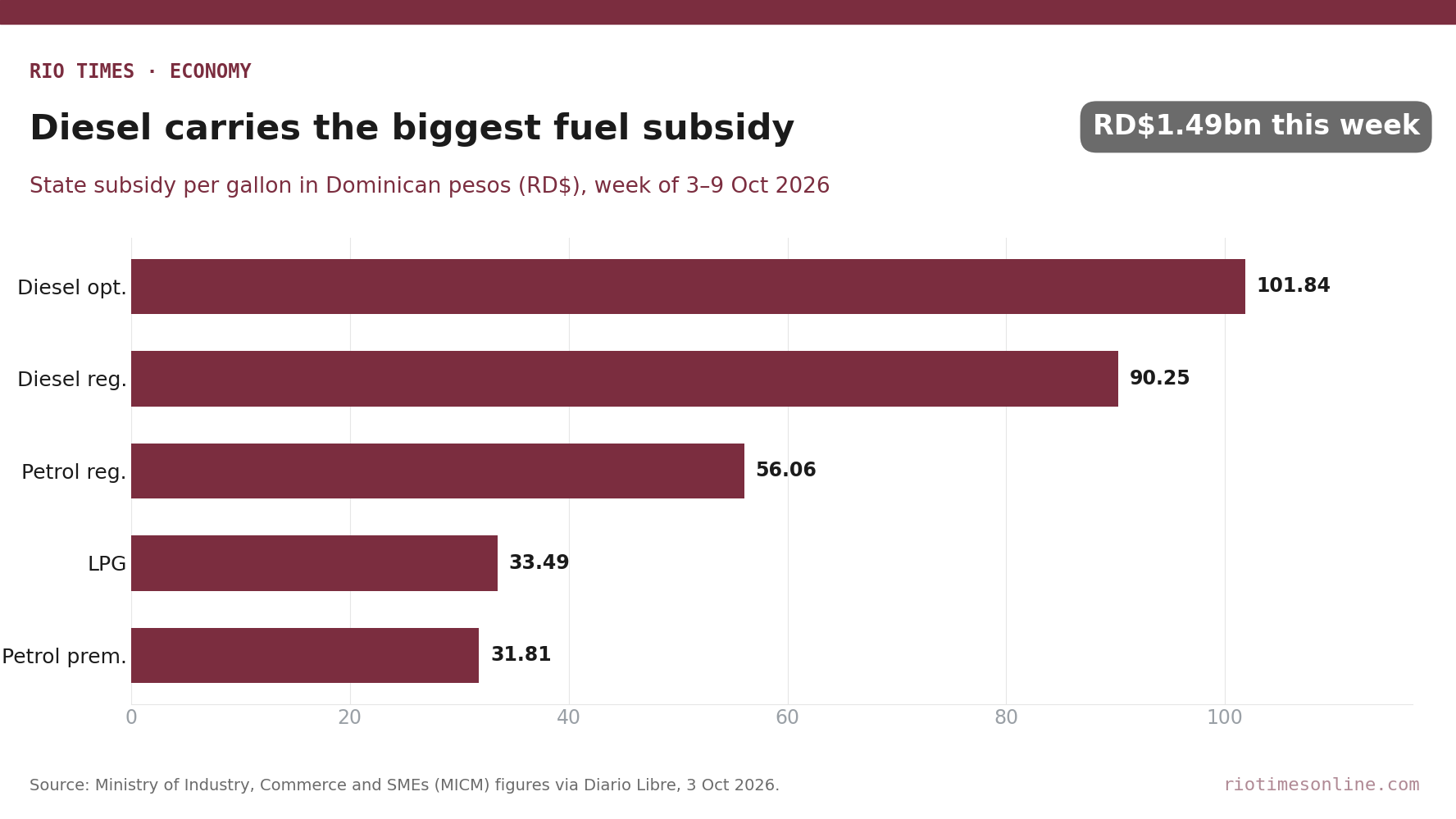
The subsidy is the gap between the price implied by international references and the price drivers pay. Ministry figures cited by Diario Libre put it at RD$101.84 (about US$1.71) a gallon for optimum diesel.
Regular diesel carries RD$90.25 (about US$1.51), regular petrol RD$56.06 (about US$0.94), LPG RD$33.49 (about US$0.56) and premium petrol RD$31.81 (about US$0.53). Without support, regular diesel would cost about RD$361 (about US$6.06) a gallon, a Rio Times calculation.
Why diesel costs so much more
Diesel has climbed faster than crude oil. Finance Minister Magín Díaz presented data on 29 September showing US crude up 68% since January. Diesel was up 130%, Diario Libre reported.
The ministry’s reference price for optimum diesel rose from about US$91 a barrel in January to US$202 by late September. It peaked near US$221 on 15 September.
The ministry also points to slower US refining. US refineries ran at 92.5% of capacity in the week to 25 September, against 98% in late August, according to official US data it cites.
The cost to the budget
The 2026 budget set aside RD$13.5 billion (about US$227 million) for fuel subsidies, according to Diario Libre. Díaz warned this week that the bill could reach RD$50 billion (about US$839 million) if world prices hold.
That would be about 270% above the original plan. The power subsidy had already used 92.8% of its 2026 allocation by 25 September, as reported in Dominican Electricity Subsidy Hits US$1.47 Billion.
The government says the aim is to stop world price swings from passing in full to transport, distribution and household budgets. The trade-off is fiscal. Debt interest has passed education spending, as covered in Dominican Republic Debt Interest Passes Education Spending by 18 September.
What Is Not Yet Known
The ministry has not said how long the freeze on petrol and diesel will last. Its next weekly price notice is expected on Friday 9 October.
It is also unclear how the Dominican Republic fuel subsidy overrun will be financed. Nor is it known whether the RD$13.5 billion allocation will be formally raised. Diario Libre said the pressure on public accounts will grow if refined product prices stay at current levels.
Sources: Ministry of Industry, Commerce and SMEs (MICM), price notices of 2 October 2026 and 25 September 2026; Diario Libre, 3 October 2026; El Nacional, 2 October 2026.
Editorial responsibility: Matthias Camenzind, Editor-in-Chief · Editorial standards · Report an error
LatAm Markets: Live Signals → — real-time movers, turnover leaders and FX across Latin America.