Death of Indigenous Elders in Pandemic Could Extinguish Whole Languages
RIO DE JANEIRO, BRAZIL – Almost a month after the death of 71-year-old indigenous leader Aritana Yawalapiti by Covid-19, his eldest son Tapi Yawalapiti recounts his daily conversations with his father.
One of the most important and respected leaders of the peoples of the Xingu Indigenous Territory, Aritana, had Yawalapiti and Kamayurá ancestry and spoke ten languages, of at least three different macrolanguages.

“When my father spoke to me in Yawalapiti, I understood everything and replied in Kamayurá, the language of my grandmother, my father’s mother,” explains Tapi in Portuguese, one of the five languages he speaks.
When his father died, Tapi was studying the Yawalapiti language with Aritana. His passing was a hard blow to this language’s survival, which is ‘in critical danger’ of vanishing, according to UNESCO.
“Losing my Uncle Aritana is losing 98 percent of our language,” Watatakalu Yawalapiti, Aritana’s niece, said in a statement after her uncle died. Tapi explains that there are still some other Yawalapiti speakers alive, two older uncles, but that his father had a deeper, more technical knowledge, which he tried to pass on to the younger ones.
Yawalapiti is not the only endangered language.
Brazil has at least 190 languages that run the same risk, according to the UNESCO Map of Languages in Danger. The death of several indigenous elders due to the pandemic adds to this situation.
Uncontrolled, the Covid-19 epidemic threatens to destroy, along with the lives of thousands, whole cultures of certain peoples, leading to what indigenous representatives call “true ethnic extermination”.
“The elders disappearing are the living libraries of all this traditional knowledge of language, customs, dances, music. This knowledge is preserved in the elders, and it is through them that it reaches the young and reproduces,” explains Angel Corbera Mori, professor of linguistics at the State University of Campinas (UNICAMP) and an expert in Amerindian languages.
The loss of indigenous elders is occurring all over the country. In the Xingu alone, Covid-19 has killed the elder Juca Kamayurá, the leader Jamiko Nafukuá and Mamy Kalapalo, chief of the Kuluene village.
Among the Kokama, in the Amazon, at least 37 died of Covid-19 symptoms, according to the Association of Kokama Indians Living in the Municipality of Manaus (AKIM), most of them elderly.
In Alter do Chão, Pará, the disease took Lusia dos Santos Borari’s life, 87, still early into the pandemic in March. In Roraima, the 75-year-old Bernaldina José Pedro died in June, an elder of the Macuxi people who lived in the Raposa Serra do Sol Indigenous Land.
In a suit brought to the Supreme Court (STF), the Brazil’s Indigenous People Articulation (APIB) said that public power’s “flaws and omissions” in fighting the novel coronavirus epidemic among Brazil’s indigenous peoples are leading to a “true genocide”.
According to the organization, these populations record a 9.6 percent virus lethality rate, while among the general population, the rate stands at four percent, according to the Ministry of Health.
The APIB also says that the government is not only failing but actively endangering the indigenous peoples. Several researchers have already alerted to the risk of the pandemic decimating these populations in the country.
The government denies that there is negligence, but has battled in the courts to avoid having to comply with the APIB’s petitions.
However, the STF unanimously ruled that the government should take measures to guarantee the fight against the pandemic and meet specific measures requested by the organization, such as the creation of a health barrier and the removal of invaders from indigenous lands.
Irreparable loss
Bernaldina José Pedro, 75 years old, was a guardian of traditional customs and the Macuxi language. She had just returned to her home in the Maturuca community in the Raposa Serra do Sol Indigenous Territory in Roraima when she died of Covid-19 in late June after an 11-day battle with the disease.
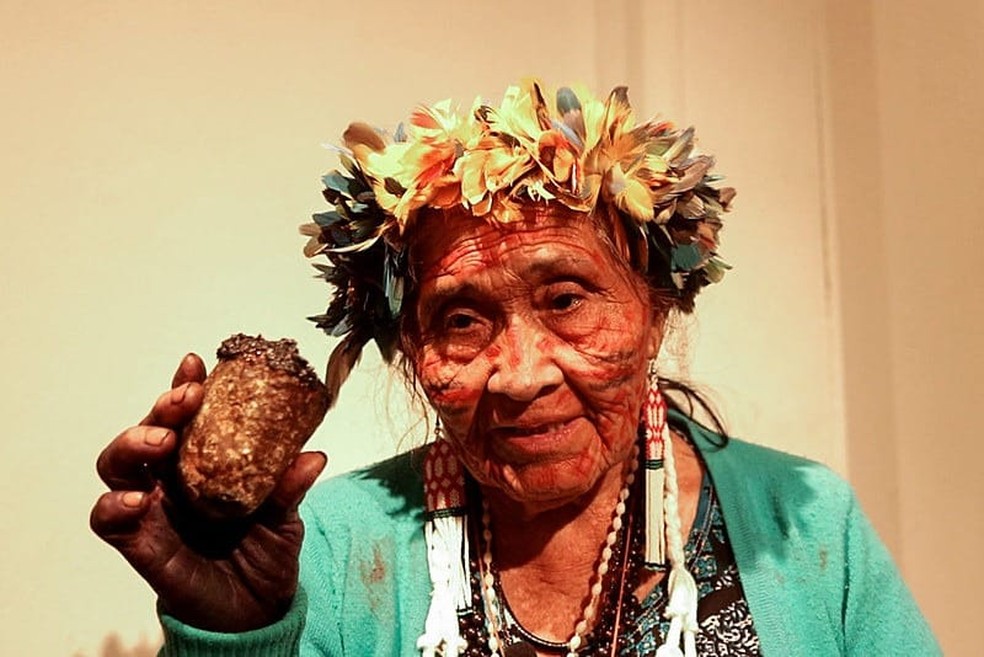
She contracted the coronavirus in the community shortly after returning from a season in her adopted son’s studio (also in Roraima) the Macuxi artist Jaider Esbell, who was learning to speak Macuxi with his mother.
This language is not endangered because it has many speakers and has even been systematized in dictionaries, but much traditional knowledge left with Bernaldina.
“She knew a complete vocabulary, a huge variety of structures,” says Jaider. “It’s an irreparable loss.”
He was a Macuxi apprentice, a work that involved many practices. “She spent some time making clay pots, translating the songs with me, naming the materials, the elements (in her mother tongue). Unfortunately, this process was interrupted,” he laments.
“Although my language is safe, it is always difficult to maintain it, because there is an illusion in Brazil of a standard language (Portuguese), of a ‘national’ language, and children are learning only Portuguese and having less contact with their mother tongue,” says Jaider, who intends to build a memorial for Bernaldina.
He says he will be continuing the activities that she has always wanted to preserve, such as braids, songs, medicines, clay pots, cultural activities.
Jairder says that his mother’s community in Roraima suffered greatly with the pandemic, particularly in the beginning. “We had a very difficult wave, we lost many teachers and elders,” he says.
Gathering a people
Amid the most recent struggle for their right to health to be guaranteed, the Yawalapiti continue their decades-long battle to preserve their people, who have been close to extinction.
“Our history is very long, my people were almost extinct,” tells Tapi. “Many have died and there are only six or seven people left, pre-adolescents, who have gone to live in other villages.”
The last village disappeared, and the remaining Yawalapiti grew up among other peoples, speaking other languages on a daily basis.
“They spent a long time living far away and ended up having no more contact. So, my people were there, but they were scattered”, tells Tapi.
With the arrival in the 1940’s of the brothers Orlando and Claudio Villas Bôas, backwoodsmen who fought for the delimitation of indigenous lands in the Xingu, also came their alert that threats such as prospecting and deforestation were increasingly close.
Indigenous leaders then focused on the importance of preserving their people and had help from the Villas Bôas brothers in this task.
Paru, Tapi’s grandfather and Aritana’s father, was one of the leaders in charge of reuniting the scattered Yawalapiti and reactivating the old village.
Today, Tapi works to complete his master’s degree at the University of Brasília, for which he studied and reported the Yawalapiti language along with his father. His dissertation defense would have been in May but was deferred to November because of the pandemic. “This project will be a great memory of my father,” he says.
In addition to being the chief of the Tuatuari village, Aritana was an advocate of indigenous territory, an activist for the Xingu peoples’ rights, and a guardian of culture for the Kamayurá and Yawalapiti – and even for other peoples who were not part of his ancestry.
“My father was regarded as a general leader in the Xingu,” says Tapi, who is now tasked with taking on the role of ethnic leader and defender of the Xingu that was his father’s.
“The Xingu is in mourning, but I got a lot of support, many people saying ‘you will now undertake your father’s role’. It’s a huge responsibility,” he says.
“Our culture is very strong – the youths dance, paint, they are singing the songs, but our mother tongue is weakened,” he says.
He plans to produce a textbook to teach the language to children and youths of his people -many of them speak languages like kamayurá.
Linguist Angel Corbera Mori explains that the criteria for determining how much a language is endangered is how fluently it is spoken by younger generations and used in everyday life.
“The preservation of language is an essential part of culture, without speakers it vanishes, and with it many central aspects disappear”.
The unauthorized access of religious missionaries to the territories, who aim to convert the indigenous and lead the youth to be less interested in traditional culture, is pointed out by him as one of the main threats to the preservation of indigenous cultures.
However, Mori points out that at present concerns are much greater. “Today, the threat is to the speakers themselves. The concern at the moment is about life.”
More: Brazil news in English, every day from The Rio Times.
Source: BBC
This article was produced by The Rio Times’ automated AI newsroom. Editorial responsibility: Matthias Camenzind, Publisher and Editor-in-Chief. The Rio Times also runs Ask Rio Times, which answers from 100,000+ of our own articles, the daily Latin America Power Map, and prediction-market odds on elections and markets.. How we use AI · Report an error
Brazil runoff, Sunday, October 25: Brazil runoff: date, poll closing times and when results start. Latest: Brazil runoff polls, Flávio 51%, Lula 49%.