Analysis: Why Do We Behave As If Quarantine for Covid-19 Is Over?
RIO DE JANEIRO, BRAZIL – Last Wednesday, July 1st, Brazil passed the 60,000 deaths mark by the novel coronavirus. This is a far higher figure than the 5,000 deaths that prompted President Jair Bolsonaro to issue his “So what?” comment that earned him worldwide repercussions. Now, in a much worse context, it seems that “So what?” is coming from the population itself.
After almost four months of quarantine, a new sense of relaxation begins to take hold of people. In Rio, the reopening of bars and restaurants on Thursday, July 2nd, led hundreds to the streets, in settings that show serenity and very few masks. The number of denunciations of crowding now stands at over 20,000.

Some even propose social bubbles, in an illusion of responsibility.
The current pandemic figures in the world place Brazil second, in absolute numbers, in terms of both deaths and infections. In the count of deaths per million people, the country is ranked 15th. Why, despite this scenario, have Brazilians been relaxing quarantine?
For the infectologist Luana Araujo, professor at Johns Hopkins University, the answer lies in scientific illiteracy. “There is a difficulty in understanding basic scientific concepts and understanding that science is meant to protect, not to complicate,” she says. “When they see science as an enemy to ordinary life, they make room for the misrepresentation of knowledge.”
According to Araujo, the lack of knowledge and denialism also contribute to sustaining a notion that is more comfortable for people: that all is well and that the pandemic is a fabrication.
The scientist even developed a website to clarify concepts and explain them concisely. “It’s a huge strain,” she says. “To talk about a vaccine, for instance, you have to explain what the immune system is. Only then can I discuss whether the vaccine will work and where we stand.”
Fear is overcome
In a text published in March, psychiatrist Daniel Martins de Barros had already predicted a change in behavior. “My assumption was that the curve would keep rising and that people would still leave home,” he says.
A member of the USP (University of São Paulo) Medical School’s Clínicas Hospital, Barros believes that, in general, people’s fear of the pandemic was not infection by the virus or transmitting it, but rather chaos in the healthcare system. “Once the fear of ICUs collapsing, of shortages of ventilators, was overcome, people felt reassured.”
In his view, the reopening of bars also had an impact on the decision to break quarantine. “Bars are not expendable in life, but they are a more superficial activity. The reflection is that if even the bars are open, then life is back to normal,” he points out.
The psychiatrist also recalls that, since the outbreak of the pandemic in Brazil, reports were unclear: there were contradictions and ambiguity about what was or was not allowed, leading to a context of greater uncertainty and insecurity.
Ideal world
For Luana Araujo, isolation is like pregnancy. There is no partiality: either you are isolated or you are not. “There is no scientific evidence for a certain level of exposure. From the moment you expose yourself, you are exposed. All that remains is to try to reduce the chances of contamination with wearing masks, hygiene, and distance.”
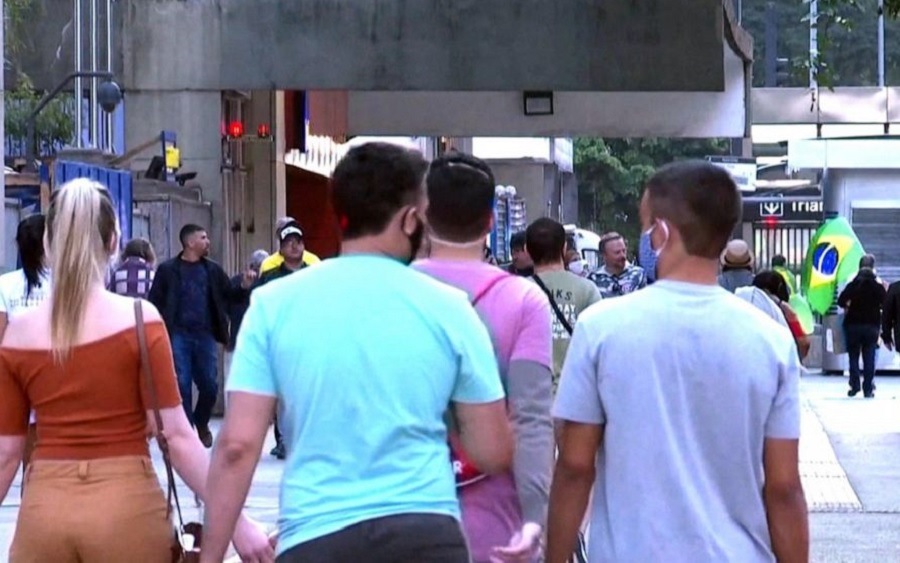
The infectologist says that in an ideal world, those who are able to work from home should stay isolated. Those who need to return to some degree of normality should be aware that they are at risk, and that they ultimately expose the people they live with too.
She stresses the fact that Brazil is a continental-size country, with different socioeconomic level locations, and where the healthcare system responds unequally. This impacts the displacement of the death toll, which has lately been impacting the Midwest region most heavily.
“Furthermore, we have a challenge in terms of commitment: Brazilians don’t seem to have a commitment to society, but rather to themselves,” says Araujo. “In general, people think they’re smart for dodging the rules – but this ‘pseudo-smartness’ endangers everyone.”
Source: Exame
More: Brazil news in English, every day from The Rio Times.
This article was produced by The Rio Times’ automated newsroom system. How we use AI · Report an error · Editorial responsibility: Matthias Camenzind, Editor-in-Chief