LGBTIQ+ Pride in Bolivia: a view from the indigenous and queer perspective
By Roxana Baspineiro
RIO DE JANEIRO, BRAZIL – “For us, the fagot is a political statement that has to do with the redefinition of the insult, it is a political statement in the sense that the fag, the fagot, the maraco, all these insults that at some point are pejorative, are hurtful, they displace you, they assassinate you, you have to reverse the meaning, you have to resemantize it and you have to assume it politically,” says Edgar Soliz Guzmán, activist and member of the Maricas Bolivia Movement.
The word ‘gay’ was installed in Bolivia in the 90s, it came with neoliberalism and the NGOs brought it. “What was there before gay?” asks Soliz. There was the “maricón, fagot, mariposon, marulo, chisu, mujercito, trava, a series of pejorative insults of popular ardor.”
But there is also the understanding of the queer from the Indian, the cholo, and other derogatory adjectives with which the bodies that carry the Aymara and Quechua identities, ancestral cultures present in the Andean region, are denigrated.
Read also: Check out our coverage on Bolivia
“At some point in my life, that Indian that I hated in my face, in my person, in my life, at some point I began to politicize that racially and also of it, of the Indian, an exercise in resistance,” Soliz reports.
Every June 28, the International LGBTIQ+ Pride Day is celebrated, which commemorates the so-called Stonewall riot of 1969 in the United States, a series of demonstrations against police violence that was frequently exercised against the LGBTIQ+ population, mostly racialized.
This revolt is perhaps best known as the driving force that forged the movement for the rights of sexual and gender diversity in the northern country and also became a milestone throughout the world.
However, while on this day or throughout the month of June different activities are organized to reaffirm and make visible the feeling of pride in sexual and gender identities and orientations —historically excluded and violated by a heteronormative and patriarchal system— in other parts of the world, such as Bolivia, on the contrary, the criticisms are woven around the Eurocentric and Western gaze with which the experiences of these populations are narrated, specifically those of the Global South.
In some way, a hegemonic knowledge is imposed that annuls other ways of understanding subjectivities and sexuality itself, for example, the Aymaras and Quechuas way. Some academics and activists who advocate a proposal from the Indian, the indigenous and the decolonial would say a neocolonial form.
In the Andean vision prevails the essentialist idea of a dualistic model that reduces the understanding of relationships to those of complementarity (female-male), leaving out other ways of relating beyond the binary.
Although it is not a question of devaluing the struggles of the north, which are just as essential, it is important to recognize, according to Soliz, that just as a series of imaginaries were imposed through colonization and a type of “universal and absolute truth” was built in colonized societies, the norms around desire and feelings were also imposed and dictated through a dominant heterosexual model.
Therefore, if the logic that prevails over the bodies of sex-gender people is intrinsic to Western thought, then how are these identities being thought of in contexts such as rurality, knowing that they have naturalized the heterosexual norm.
But, in addition, how these realities are being made visible, which beyond belonging to diversities, are also fighting for the dignity of their Indian and indigenous identities.
In turn, they also do not fit into an urban LGBTIQ+ movement that, as they say, tends to end up reproducing globalized, racist, and classist logic.

THE RURAL ENVIRONMENT AND THE BODIES THAT TRANSGRESS THE “NORM”
In the Andean vision, the essentialist idea of a dualistic cosmogonic model prevails, represented in the chachawarmi concept, which reduces the understanding of relationships to those of complementarity (female-male), leaving out other ways of relating beyond the binary.
This, according to experts, responds to a legacy left by the colonial evangelizing discourse, which contradicts the extensive literature and records that show the existence of gender-sex identities in the Andean world.
“The (Spanish) invasion used the pretext of civilization to erase and deny the fact of civilization also of the Indians and indigenous people. And of course, this went hand in hand with religious indoctrination, the installation of the Catholic faith, and in that exercise, of course, the heterogeneity in pre-Hispanic cultures was erased”, says Soliz, also producer and host of the radio program “Nación Marica”.
A kind of utopia as he calls it, the program serves as a meeting point to reflect on issues related to colonialism, racism, and classism with people who are also “resisting from their Indian face, from their raciality, from their political enunciation as indigenous people, but also as fagots, as machorras or as travas”.
“If we go into the present day of the Aymara-Quechua Andean world, of course, there is a strong presence of that obligatory heterosexuality that until today has been assumed as an almost natural order,” Soliz comments, which triggers a series of social sanctions and mechanisms of control and discipline, including experiences of exile.
“In the Aymara-Quechua Andean world, of course, there is a strong presence of that obligatory heterosexuality that until today has been assumed as an almost natural order”
Between 2019 and 2020, Nación Marica carried out a project in some rural regions in the city of La Paz, the capital, to find out if there were LGBTIQ+ people in these territories, which also have a high presence of evangelical and Christian churches.
The surprise was discovering a high level of denial, invisibility and with it a lot of violence, homophobia, and transphobia, which can explain the evolution of migration as a means of escape.
Part of this reality, according to the member of Nación Marica, has to do with the constant invisibility and even nullity of LGBTIQ+ people in rural areas. A situation that is also reinforced in the media.
“There is an absolute denial in the rural part,” says Soliz about the neglect and little attention to these populations, in regions that are also totally disconnected from celebrations such as June 28 or other dynamics that occur almost exclusively in urban spaces.
“We know some testimonies of people who have had to leave their town because there was harassment of asking for accounts. Why are you effeminate, why don’t you play soccer, why haven’t you gone to the barracks, why, why (…) So in the indigenous issue, it’s not only the family, in the community one has to be accountable, even of their sexuality, to the indigenous authorities, to the political authorities, to the family”, Soliz maintains.
A different reality from that of the city, where, for example, processes such as “coming out of the closet” take place in a more intimate, individual, or family environment, and do not necessarily imply a community or collective issue.
“People today are also migrating from their community because of their sexuality because one knows that they will not be able to be or recognize themselves as homosexual, lesbian or trans in their community, that sooner or later they will be the object of discrimination”
“Today people migrate from their indigenous community for business, study opportunities, money, etc. But also today people are migrating because of their sexuality because one knows that they will not be able to be or recognize themselves as homosexual, lesbian or trans in their community, that sooner or later they will be the object of discrimination.”
Soliz takes advantage of and shares his personal experience in which, as a result of psychological violence and his family’s constant questioning about his homosexuality, he was forced to migrate to the city.
“Of course, what remained for me was exile, it was migration,” he says, referring to the struggles that Aymara and Quechua dissidents endure against a dominant system that conveniently embraces the LGBTIQ+ cause every June 28 and at the same time is exclusive. with those bodies that carry identities that move away from what is established as the Indians and indigenous people.
“For us, an element of resistance is calling ourselves Indians, Aymaras, Quechuas, as well as fagots in the city, in urbanity, whether you like it or not, that also opens up a reflection in the rural space, in the community space,” he says about of the importance of enunciating from the place of the Indian, because in the face of all oppression “as Indians they subjected us, as Indians we will liberate ourselves”, he says in allusion to the famous phrase of one of the most important intellectuals of Bolivian Indianist thought, Fausto Reinaga.
“We believe that if we name ourselves (first) as mestizos, if we name ourselves as indigenous or as cholos, in some way we are erasing or denying or displacing what is Indian. So for us, the Indian is ahead,” Soliz adds.
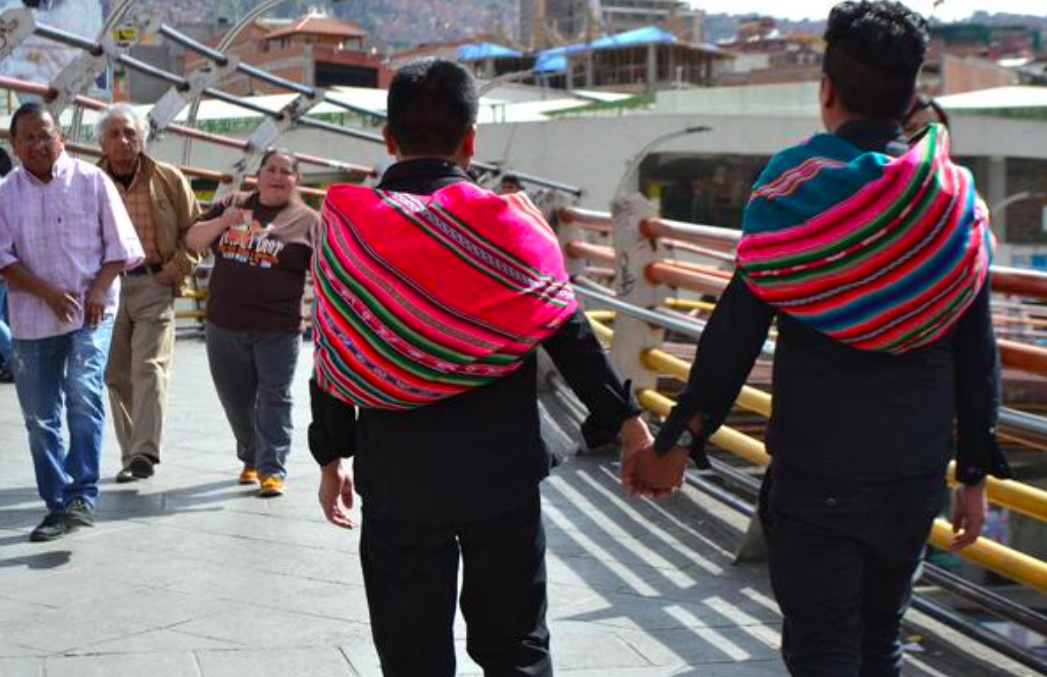
THE CITIES, DIVERSITIES AND THE NULLITY OF THE INDIAN
“This figure of uprooting of their Indian, indigenous, Aymara, Quechua identity and in this migration exercise this subject has to face the racism of the cities, not only of the cities but also of an urban LGBTIQ+ environment that is built precisely for the white subject and for the urban subject and there the Indian body, of course, is singled out, is discriminated against and is the object of racism”, says the activist.
Although the harshness that characterizes the ties in the cities has meant that the discussions around gender-based diversities have not been able to transcend rural borders, models such as neoliberalism have also forged a type of LGBTIQ+ urban struggle that is more connected to global interests than with the locals and that lends itself to the ambitions of a capitalist market.
“I feel that this capitalist cooptation of the market and the trivialization of this struggle is the product of neoliberalism and capitalism, which does not see the political subject who claims their rights or who fights against patriarchy and homophobia, but instead sees a potential client,” Soliz highlights.
“For us, an element of resistance is calling ourselves Indians, Aymaras, Quechuas, as well as queers in the city, in urbanity, whether you like it or not, that also opens up a reflection in the rural space, in the space of the community”
“In Spain, in Mexico, there are exclusive areas for gays, in quotes, but in reality, they are exclusive areas for white gays, upper-middle-class, with purchasing power and young people. And all those who do not fall into that category are excluded from those areas,” comments Soliz referring to the dynamics of capitalist modernity where not only products are commercialized but also desires feelings, struggles, and identities. An example is the convenient marketing applied by companies to project a more inclusive and pro-rights image of LGBTIQ+ people, known as pinkwashing, which emerges precisely on dates such as June 28.
In addition to this, in Bolivia and in Latin America in general, there is a type of habitus that gravitates around the gay and white subject in which all the interest of the market is centered, making invisible the plurality of orientations and sex-gender identities. This has led to proposing, from a counter-hegemonic perspective, the idea of plurality as a fundamental guideline to dignify the realities of these people as diverse bodies without the hierarchical imposition of any kind, nor the classist and racist gaze that they denounce prevails within the urban LGBTIQ+ environment.
“I think there are many layers of discrimination in the Indian body, in the Aymara body, in the Quechua body, especially in racialized bodies, in those brown bodies with Indian ethnic features, who even have difficulties with language, because there is a very characteristic of people who migrate from the countryside to the city, because their native language is Aymara or Quechua, so Spanish, of course, since it is not the mother tongue, will be half Spanish. And that subject is the racialized one and is the object of discrimination”, he stresses.
“There are many layers of discrimination in the Indian body, in the Aymara body, in the Quechua body, especially in racialized bodies whose native language is Aymara or Quechua”
Despite the fact that today in Bolivia there is greater openness in the cities to reflect on the Indian, in some cases using the discourse that every family has or has had a mother or grandmother of Quechua or Aymara origin, racism in the South American country continues to be one of the main problems, despite being one of the countries with the highest density of indigenous population in the region.
“We cannot climb into the white, urban, city gay ghetto when those from below are having a hard time. So class consciousness, Indian, indigenous, and Chola identity is very important to build a kind of struggle and local resistance (…) For us, sexual orientation is secondary, the first thing is the Indian, the indigenous struggle and racism accordingly,” says Soliz.
THE LGBTIQ+ URBAN MOVEMENT AND PRIDE MONTH
“Here in Bolivia, it is called the long month of sexual and gender diversity. We have a very critical position in this regard, which has to do with our decolonial Indian proposal, with respect to the perspective of the global North”, says Soliz regarding the discrepancy with the representations that are built on the diversities in urban spaces.
One of the questions of the counter-hegemonic resistance to LGBTIQ+ urban activism has been, without a doubt, to homogenize and naturalize the demands of this population from the cities, which has been seen as an attempt to whiten identities and reproduce racism and that have served to marginalize other subjectivities and corporalities such as the Indians, queers, the cholos or the travas.
“The starting point is to question why a history of the global North, such as the Stonewall revolt, should read reality as alien as the Bolivian one. “Do we not have our own history, our own origin?”
In turn, the starting point is to question why a history of the global North, such as the Stonewall revolt, should read reality as alien as the Bolivian one. “Do we not have our own history, our own origin, and of course, this has a lot to do with a kind of neo-colonialism around LGBTIQ+?” says Soliz.
In this sense, cities, already privileged environments in which LGBTIQ+ activism has concentrated, with the attention of the media and social networks, have also been high-risk territories for dissident groups, especially for those through which pinkwashing does not benefit.
“Why do we celebrate June 28 if in this part of the world that is now Latin America, the origin of non-hegemonic sexualities precedes the Spanish invasion? And the same thing happens in the United States, there are the Berdache Indians, the double-spirited Indians of the Indian communities,” Soliz points out, referring to other narratives that challenge the official and universal narrative that today has focused on Stonewall.
More: Bolivia news in English, every day from The Rio Times.
Editorial responsibility: Matthias Camenzind, Editor-in-Chief · Editorial standards · Report an error