Bolivia takes the lead with a lithium research center: Should Peru follow suit?
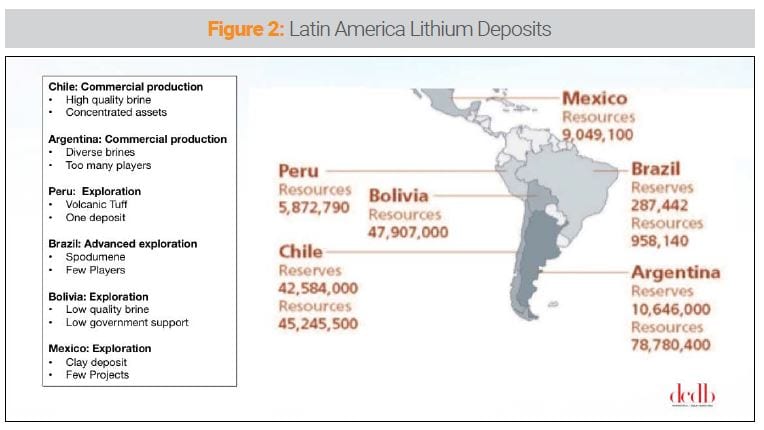
RIO DE JANEIRO, BRAZIL – The advances in Peru in relation to lithium are few compared to the progress made by Argentina, Chile, and Bolivia in 2021; especially in the latter country, which leads to the exploitation of this mineral with a reserve estimated at more than 21 million tons and is now taking advantage with the implementation of a research center for the industrialization of lithium.
“The first thing we are going to do is to develop Bolivian science and technology for the exploitation and industrialization of our lithium to benefit ourselves,” said Bolivian President Luis Arce at the time. Should the Peruvian government replicate this strategy?

In Peru, only three events have marked the lithium agenda this year in a context in which demand for the mineral is rising due to the global energy transition (electric vehicles):
- The sale of the Falchani lithium project and the Macusani uranium project, located in Puno and operated at the time by Macusani Yellowcake, to the Canadian company American Lithium.
- The enactment of the Law declaring the promotion and encouragement of lithium and uranium industrialization in Peru to be of national interest.
- And the warning from the Ministry of Energy and Mines (Minem) regarding the “difficulties” to exploiting lithium in Puno due to the uranium.
No progress, although at least five areas with high potential for lithium exploration and exploitation have been identified on Peruvian territory, such as Salar Salinas in Arequipa, Laguna Loriscota in Puno, Salar Chilicolpa and Salar Laguna Blanca in Tacna, and volcanic rocks in Puno, the region where “more progress” has been made since Macusani’s discovery in 2018.
WAY FORWARD
Puno demonstrates the most significant progress for the future exploitation of lithium in Peru. Still, the presence of uranium is the main challenge, as its extraction – in a non-specialized way – could generate serious radioactivity problems that would affect the population, warned the Minem, although without delving into alternatives.
“The critical importance must be given to the exploration and exploitation of lithium at a time when the manufacture of batteries in the world generates enough demand. We need the State to provide or relax the regulations so that an exploration project can move forward,” Dante Salas, director of the Regional Directorate of Energy and Mines of Puno, told Gestión.
According to data from the Directorate, the Puno region processed 678 mining petitions this year, with a significant number related to lithium. In 2021, a potential zone was released, “which generated many requests that are still under evaluation because it is freely renounceable and therefore an auction will be necessary”.
But creating a research and planning center that evaluates the mining potential in the whole territory, with resources to participate in mining exploration should be the objective of a country like Peru that is highly mining, refers the former Minister of Energy and Mines, Carlo Herrera Descalzi.
“Not only Bolivia is doing it, but also developed countries such as Canada,” he noted.
“We can aim at strengthening the Geological, Mining and Metallurgical Institute (Ingemmet) that includes alliances with the country’s universities so that qualified people, not linked to Minem, can carry out research on how to improve the profitability of lithium exploitation in the country, on how to reduce the levels of impurities in mining exports, among others, and that these results are shared with the companies under reasonable conditions”, he noted.
With information from Gestion
More: Brazil news in English, every day from The Rio Times.
Editorial responsibility: Matthias Camenzind, Editor-in-Chief · Editorial standards · Report an error