Why Somaliland Matters to Brazil’s Trade
A Somaliland analyst argues Brazil should look at Berbera port and the Horn of Africa corridor as a commercial gateway.
Opinion · Guest Contribution
Brazil’s global trade interests extend far beyond the Atlantic. As one of the world’s major agricultural and commodity exporters, Brazil depends on reliable maritime routes connecting its producers to markets across Africa, the Middle East and Asia.
Against this background, the Horn of Africa deserves greater attention in Brazilian strategic and commercial discussions. Somaliland, located along the Gulf of Aden, offers a geographical position and developing port infrastructure that merit closer examination.
Background by The Rio Times
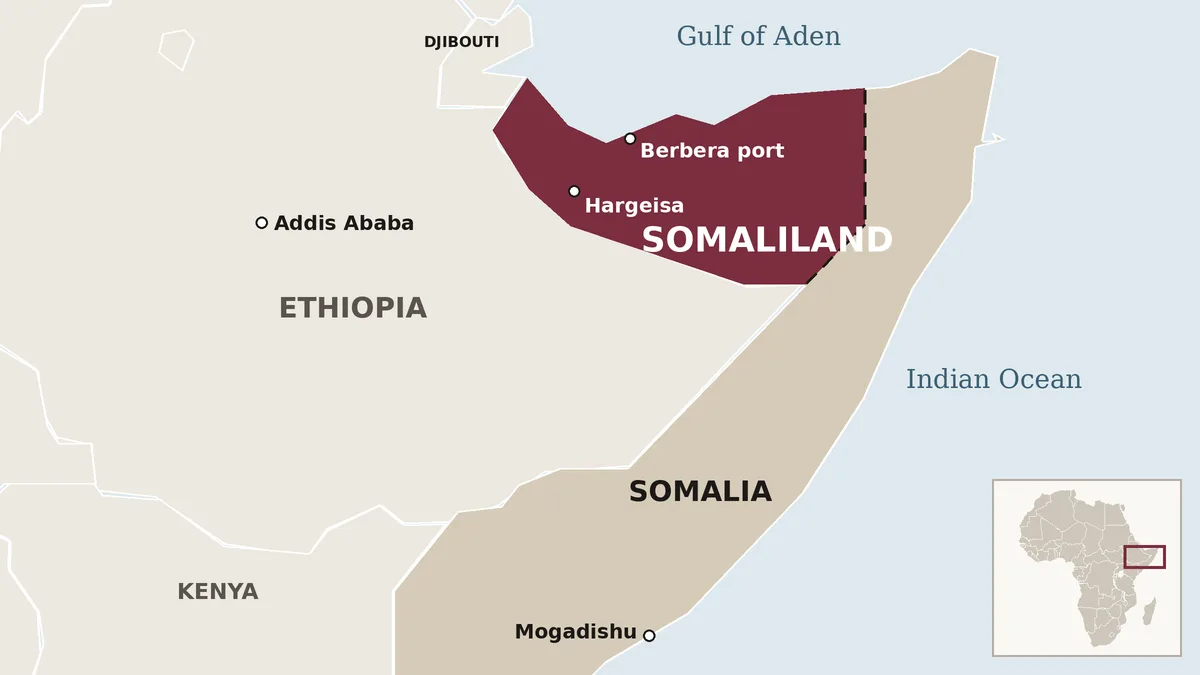
What Is Somaliland, and How Does It Differ From Somalia?
Where. On the southern shore of the Gulf of Aden, bordering Djibouti and Ethiopia. Its capital is Hargeisa and its main port is Berbera.
History. A British protectorate, it became independent on 26 June 1960. On 1 July it united with the former Italian territory to the south to form the Somali Republic.
The break. After years of civil war and the fall of Siad Barre’s government, it declared independence again on 18 May 1991.
Why it differs. Since 1991 it has run its own government, elections, security forces and currency, and has been far more stable than much of southern Somalia. It does not control all the territory it claims: its forces withdrew from Las Anod in the east in 2023, and Somalia’s federal government now recognises a separate North Eastern State there.
Status. Israel recognised it on 26 December 2025, the first United Nations member to do so since the 1991 declaration. Somalia and the African Union regard it as part of Somalia, and no other state had followed by 29 November 2026.
Somaliland’s importance is closely connected to the geography of international shipping. Its coastline faces the Gulf of Aden, near the Bab el-Mandeb Strait, one of the principal maritime passages linking the Indian Ocean with the Red Sea and the Suez Canal.
This route is particularly significant for trade between Asia and Europe. Disruptions in the Red Sea have demonstrated how insecurity around maritime chokepoints can increase shipping distances, delay deliveries and raise transport costs.
The United Nations Conference on Trade and Development (UNCTAD), in its Review of Maritime Transport 2024, highlighted how disruptions in the Red Sea and other maritime chokepoints have changed shipping patterns and extended voyage distances. For a country such as Brazil, whose exports travel across international shipping networks, the stability of these routes is not a distant regional concern.
It is part of the wider infrastructure supporting global commerce.
Berbera Port: A developing commercial gateway
At the centre of Somaliland’s maritime potential is Berbera Port. Its modernization under DP World has significantly increased its capacity and operational potential.
An independent impact assessment published by Itad in December 2025, examining British International Investment’s involvement in the port, reported that the first phase of expansion increased annual container-handling capacity from 150,000 to 500,000 twenty-foot equivalent units (TEUs). The expansion included a new 400-metre quay, a deeper 17-metre draught and modern cargo-handling equipment.
The same assessment found that Berbera’s share of regional gateway container traffic increased from approximately 9 per cent in 2017 to around 14.3 per cent in 2024. These figures indicate that the port is becoming a more significant participant in regional logistics.
They do not, however, mean that Berbera has replaced established regional ports. Rather, they demonstrate the emergence of an additional commercial option in a strategically important maritime area.
Berbera’s significance also extends beyond the coastline. The Berbera–Hargeisa–Wajaale corridor connects the port to the Ethiopian border, creating opportunities for the movement of goods between maritime and inland markets.
A 2025 draft planning document for a World Bank project, the Horn of Africa Infrastructure Integration Project, classes this 250-kilometre route as an international corridor with potential to serve Ethiopian trade. Its long-term competitiveness will depend on reliable road infrastructure, efficient customs procedures, predictable regulations and commercially viable logistics services.
Why Brazil should pay attention
Brazil already has substantial commercial links with Africa. Data published by Brazil’s national statistics agency, IBGE, recorded approximately US$8.38 billion in Brazilian imports from Africa in 2024.
This figure demonstrates the scale of Brazil’s existing economic engagement with the continent, although it should not be interpreted as trade specifically with Somaliland or the Horn of Africa. There is room to explore whether stronger commercial connections with the Horn could complement Brazil’s broader African trade relationships.
Brazilian exporters of agricultural products, food commodities, machinery and industrial goods may find opportunities in growing regional markets. At the same time, African markets offer potential demand for Brazilian expertise in agriculture, food production, logistics and infrastructure.
Somaliland could contribute to this relationship by developing its port services, logistics facilities and commercial connections with neighbouring markets. For Brazilian businesses, the relevant question is not simply whether Berbera is geographically close to an important shipping route.
It is whether the port and its inland connections can offer dependable services, competitive costs and transparent commercial arrangements. Any assessment should therefore be based on practical considerations: shipping schedules, freight rates, cargo volumes, insurance costs, customs procedures and the reliability of inland transport.
These are the factors that ultimately determine whether a port becomes a meaningful option for international businesses.
From geographical opportunity to commercial partnership
Brazil’s engagement with Somaliland need not begin with ambitious political declarations. It could develop through commercial research, private-sector dialogue, maritime cooperation and technical exchanges.
Brazilian trade associations, shipping companies, agricultural exporters and logistics operators could examine the commercial potential of Berbera and the wider Horn of Africa. There are also opportunities for cooperation in agricultural technology, food security, vocational training and port-related services.
Brazil’s experience in agricultural production and tropical farming could be relevant to regional development initiatives, while Somaliland’s geographical position could support commercial access to markets around the Gulf of Aden. Such cooperation would require careful assessment of legal, regulatory and political conditions.
Businesses need clarity on applicable regulations, investment protections, financial arrangements and the practical requirements of cross-border trade. A sustainable partnership must be built on commercial evidence rather than geographical assumptions alone.
A wider strategic perspective
For Brazil, looking towards Somaliland is part of a broader question: how can Latin American economies strengthen their understanding of emerging commercial gateways across Africa? The Horn of Africa is not merely a region of geopolitical competition.
It is also a space where infrastructure, trade corridors, maritime security and economic development intersect. Somaliland’s developing port infrastructure and location along the Gulf of Aden give it a credible place in that discussion.
Its potential should neither be exaggerated nor overlooked. The next stage will depend on the ability of its institutions and commercial partners to translate infrastructure investment into reliable services, regional connectivity and wider economic opportunities.
Brazil, with its established economic links across Africa and its experience as a major maritime trading nation, has reason to follow these developments more closely. A practical, business-oriented approach could open new conversations between Brazilian and Somaliland stakeholders.
Ultimately, the value of Berbera will be measured not simply by its location on the map, but by the trade, investment and reliable connections it can facilitate. For Brazil, that is a commercial opportunity worth examining.

Mohamed Abdi Idris is a Somaliland-based analyst of international relations with a Master’s degree in International Relations and Diplomacy. He works in the ICT Department of Somaliland’s Ministry of Information, Culture and National Guidance and writes in a personal capacity. Photo courtesy of the author.
Opinions expressed in this article are the author’s own and do not necessarily reflect those of The Rio Times.
Sources
- Itad (2025), Evaluating the impact of BII’s investment in ports in Somaliland: Insights from DP World Berbera, a study of British International Investment’s involvement. Link
- UN Trade and Development (2024), Review of Maritime Transport 2024, chapter 1. Link
- Horn of Africa Infrastructure Integration Project (P173119), draft environmental and social management framework, July 2025. Link
- Brazilian Institute of Geography and Statistics (IBGE), statistical yearbook 2024, foreign trade table. Link
Horn of Africa and the Red Sea
- Horn of Africa 2026: Why It Matters and Who Backs Whom
- Ethiopia’s Neighbors Explained, Ports, Eritrea, Somalia
- Eritrea Explained 2026, a Red Sea Country Guide
- Somalia Explained: Al-Shabaab, Somaliland, the Ports and the Fight Over a 2026 Vote
Editorial responsibility for publication: Matthias Camenzind, Publisher and Editor-in-Chief. The Rio Times also runs Ask Rio Times, which answers from 100,000+ of our own articles, the daily Latin America Power Map, and prediction-market odds on elections and markets.. Report an error