The battle for Argentina’s ‘blue hole’, an area of illegal fishing in the South Atlantic

By Sergio Pintado
Illegal fishing has turned the area known as the ‘blue hole’ into a sort of floating city in the South Atlantic that the Argentine government intends to regulate with a law.
Former Secretary of State César Lerena explained to Sputnik how the area came to become what it is and warned about the benefits that the United Kingdom obtains.
In March 2023, Solidaire, led by Argentine pilot and filmmaker Enrique Piñeyro, organized an unprecedented flight with Argentine and international officials, journalists, and activists to the ‘blue hole’, an area of the South Atlantic known as the best evidence of illegal fishing.
What the flight passengers could see from above left them perplexed.
The night darkness of the South Atlantic was interrupted by a cluster of lights of vessels from several countries that, within the limit of the Argentine maritime territory, fish the maritime resources of the area.
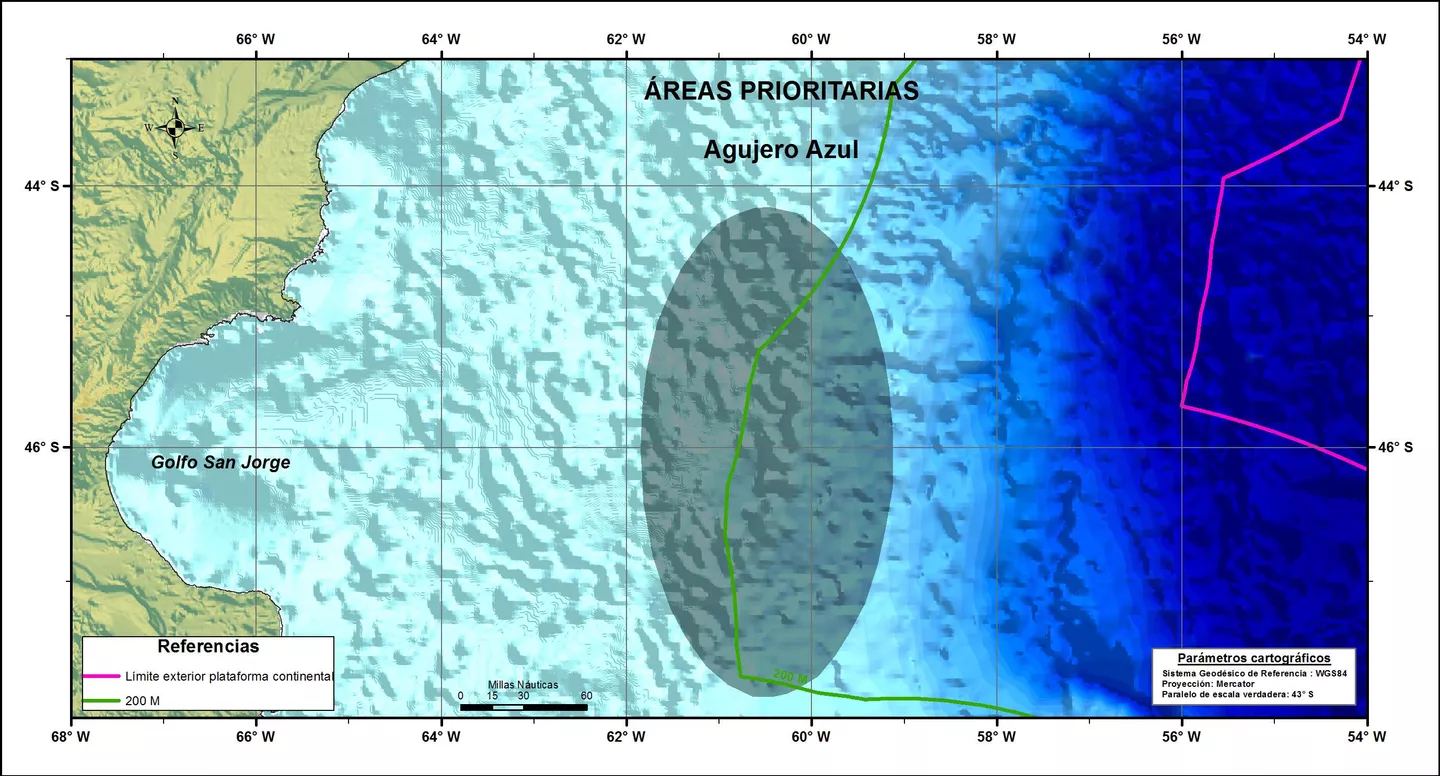
The ‘blue hole’ is located some 500 kilometers east of the Gulf of San Jorge and on the dividing line that separates Argentina’s Exclusive Economic Zone (EEZ) from international waters.
In fact, that imaginary line – drawn 200 miles from the continental territory – practically cuts the ‘blue hole’, of approximately 6,600 square kilometers in extension, in half.
What makes the blue hole so valuable is its biodiversity.
It is home to many marine species, such as hake, Patagonian scallops, and Illex argentinus squid, fishery resources of great value for Argentina and fishing powers worldwide.
As the boundary between the Argentine EEZ and international waters only makes sense to humans, all marine species that enrich the area pass from one side of the line to the other to feed or reproduce and then return to their area of origin.
The swarm of foreign fishing vessels keeps glued to the boundary, waiting, precisely, for marine species to cross into international waters to fish for them.
Although fishing may seem legal in international waters, Argentine experts and organizations warn that these vessels do nothing more than fish for resources that, although they are migrating, originate in the Argentine sea.
“Like birds, fishing resources migrate from the EEZ to the high seas and, if they manage to complete the process for feeding, reproduction or climatic reasons, they return to the Argentine EEZ”, explained to Sputnik César Lerena, Doctor of Science, former Secretary of State and Argentine expert on the South Atlantic and Fisheries.
The specialist remarked that, although the vessels do not enter Argentine territory – in any case, he stressed that “some do” – they are “fishing for migratory resources originating in the EEZ”.
Lerena also recalled that the vessels fishing in the ‘blue hole’ are not complying with some key requirements of the United Nations Convention on the Law of the Sea, which has been in force since 1982.
ILLEGAL FISHING IN INTERNATIONAL WATERS?
The expert assured that the vessels that fish Argentine resources in the high seas do not carry out studies on maximum sustainable catches to know to what extent to fish specimens without generating a permanent affectation.
While this knowledge is produced in the coastal states of the South Atlantic – Argentina, Uruguay, and Brazil – it is neither known nor respected by international fishers.
Lerena also warned that the vessels do not comply with another requirement of the Convention: to be controlled by their countries of origin.
According to the expert, although there is satellite monitoring of these vessels, the monitoring is ineffective and, in practice, non-existent when it comes to controlling some predatory practices at sea.
The expert emphasized that the Convention also establishes that fishing on the high seas “in no case may affect the interests of third countries”, which is also not complied with due to the impact on Argentina’s resources.
The presence of fishing vessels in the ‘blue hole’ is not scarce.
Only during the first week of March 2023, 404 vessels were detected in the ‘blue hole’, according to data handled by Greenpeace, which warns that the total amount of fishing hours is equivalent to 272 vessels operating 24 hours a day, 365 days a year.
The data reported by the Argentine newspaper La Nación is even more graphic.
The area covered by the cluster of vessels in the ‘blue hole’ is more than twice the size of the Autonomous City of Buenos Aires and its metropolitan area.
Lerena pointed out that although the problem of illegal fishing in the South Atlantic is historical, it has skyrocketed in the last four decades due to the “growing need for protein in the world.”
Currently, most vessels fishing in the ‘blue hole’ are squid fishing boats luring them with powerful lights to catch them with hooks.
However, there is also trawling, which erodes the sea floor and is the most damaging activity in the area.
THE PROTECTED AREA: A DOUBLE-EDGED SWORD?
In July 2022, the Argentine Chamber of Deputies approved a bill to convert the ‘blue hole’ into a Marine Protected Area (MPA) in an area of 148,000 square kilometers comprising the ‘blue hole’ and the area where the remains of the ARA San Juan submarine, sunk in 2017, lie.
The Argentine government defends the project but finds discrepancies among scholars.
For Lerena, one of the protected area’s negative consequences is that it benefits the United Kingdom’s administration of the seas surrounding the Malvinas Islands, South Georgia, and the South Sandwich Islands.
Lerena recalled that the British occupation of the Malvinas is in breach of the United Nations resolution not to innovate in the territory since, in recent decades, it has granted fishing licenses to vessels in the vicinity of the islands, whose sovereignty is claimed by Argentina.
“It is totally beneficial for the United Kingdom that, under the pretext of protecting the resource, they exploit it by granting illegal licenses,” he pointed out.
For the expert, Argentina could also restrict fishing in the area with an administrative act without requiring a law.
Lerena considered that Argentina must improve its capacity for control and deterrence in the South Atlantic to end illegal fishing of its fishing resources.
For the expert, one of the first actions should be to “sanction all vessels fishing in the Malvinas”, among which are vessels from Korea, Taiwan, or Spain, a country that paradoxically recognizes Argentine sovereignty over the Malvinas but whose vessels receive British licenses.
According to Lerena, improving Argentina’s presence in the area will cut illegal fishing and take a step toward recovering the islands.
“Argentina will not be able to recover the Malvinas if it does not begin to administer the South Atlantic, something it is not doing at the moment and which is nothing more than researching, conserving the resource, and distributing it,” he argued.
With information from Sputnik
More: Argentina news in English, every day from The Rio Times.
This article was produced by The Rio Times’ automated AI newsroom. Editorial responsibility: Matthias Camenzind, Publisher and Editor-in-Chief. The Rio Times also runs Ask Rio Times, which answers from 100,000+ of our own articles, the daily Latin America Power Map, and prediction-market odds on elections and markets.. How we use AI · Report an error