Sudan War Spreads to Blue Nile as RSF Claims Army Bases and Nearly 20,000 Flee
Africa · Conflict
Key Facts
- —The war Since April 2023, Sudan’s army and the paramilitary Rapid Support Forces (RSF) have fought and split the country.
- —The scale More than 14 million people have fled their homes, UNHCR says, in the world’s largest humanitarian crisis.
- —This week UN migration trackers recorded nearly 69,000 people newly displaced in South Kordofan and Blue Nile in late August.
- —The spillover Chad accuses Sudan’s army of a border air strike that killed 12; Chad hosts hundreds of thousands of Sudanese refugees.
- —The catch Despite being the world’s largest displacement crisis, Sudan gets little coverage and only 40% of the aid money it needs.
Aid agencies call Sudan’s war the world’s largest humanitarian crisis. It barely appears in news bulletins or summit talks.
That gap between reality and attention is part of the story.
Two generals, one state
The war started in April 2023 when two rulers fell out. Army chief Abdel Fattah al-Burhan and RSF commander Mohamed Hamdan Dagalo, known as Hemedti, both refuse to lose.
Three years on, the map has hardened. The army holds Port Sudan, the Red Sea coast, and most of the east and centre.
The RSF controls most of Darfur. It captured the army’s last stronghold there, El Fasher, in October 2025.
Fighting now is about the seams between those zones, especially Kordofan and Blue Nile.
The humanitarian arithmetic
More than 14 million people are displaced. That is 9 million inside Sudan and 4.4 million refugees abroad, UNHCR said in April 2026.
Researchers using ACLED data, which logs violent events worldwide, estimate at least 62,000 deaths in the war’s first 15 months. They warn the true toll is likely far higher.
Food security experts from the IPC, a UN-backed hunger-monitoring system, confirmed Famine in El Fasher and Kadugli in a November 2025 report. Famine is the worst of five hunger categories the IPC uses.
Their most recent update, from June 2026, found no area currently in Famine. But it flagged 14 places at high risk into 2027.
Fighting in South Kordofan and Blue Nile displaced almost 69,000 people between 28 and 30 August 2026 alone. The UN’s migration agency, IOM, reported the figure through its displacement-tracking unit on 3 September.
A regional war in everything but name
The conflict’s logistics cross borders daily. On 28 August, Chad accused Sudan’s army of an air strike near their shared border.
The strike killed at least 12 people at a fuel market, Chadian officials said.
Sudan’s foreign ministry said it was surprised by the accusation, made before any independent investigation. It said its forces were defending Sudanese territory.
A UN Panel of Experts that reports to the Security Council spoke on 4 September. It called credible reports of 1,500 to 2,000 former Colombian soldiers fighting for the RSF since March 2025.
The panel said they operated drones and artillery from Nyala, in Darfur.
Human Rights Watch reported similar findings in May 2026. Two separate investigations reaching the same conclusion is what gives the claim its weight.
Why diplomacy keeps failing
Every ceasefire format has hit the same wall: talks in Jeddah, Saudi Arabia, African Union mediation, and UN diplomacy. Both sides think their next attack will help them at the table.
Donor meetings promise money, but spending it falls far behind.
External sponsors matter more than mediators, analysts say. The RSF’s supply lines and the army’s air power both depend on foreign backers.
What to watch
Analysts are watching whether Kordofan becomes the war’s main front. They are also watching whether the UN panel’s contractor findings lead to sanctions.
A third question is whether the autumn donor round narrows a funding gap of roughly US$1.8 billion.
Sudan’s war will not stay Sudanese. Refugee flows, arms pipelines and mercenary networks already cross its borders.
The economy of the war
Sudan’s war is largely self-financing. The RSF draws on Darfur’s gold, smuggled through regional markets; the army controls Port Sudan’s customs revenue.
Neither side depends heavily on donors to keep fighting, so outside pressure has had limited effect. Analysts say both sides can outlast any ceasefire deadline the world sets.
The aid funding gap
Sudan’s 2026 aid appeal asks donors for about US$3 billion. By August, only 40%, or about US$1.2 billion, had arrived, the UN’s aid office OCHA said.
That leaves a gap near US$1.8 billion. Aid officials say the shortfall is about attention, not generosity.
Sudan competes for the same donor budgets as Ukraine and Gaza, and loses.
The paths out
Analysts sketch three possible endings. One is a military win that reunifies the country by force.
A second is a negotiated split of areas of control. A third is exhaustion, freezing today’s map into a real division.
Until foreign sponsors choose peace over position, analysts say, the war is likely to continue much as it is.
The map in September 2026
The army holds Port Sudan, the north, and most of the east and centre. It runs the recognised government from the Red Sea coast.
The RSF controls most of Darfur and is pushing into Kordofan and Blue Nile. In mid-August it seized the Blue Nile towns of Geisan and Kurmuk.
Khartoum, badly damaged and still contested, is the war’s symbol rather than its prize. The real prizes are supply corridors: border crossings, fuel routes and Darfur’s gold roads.
The escape routes
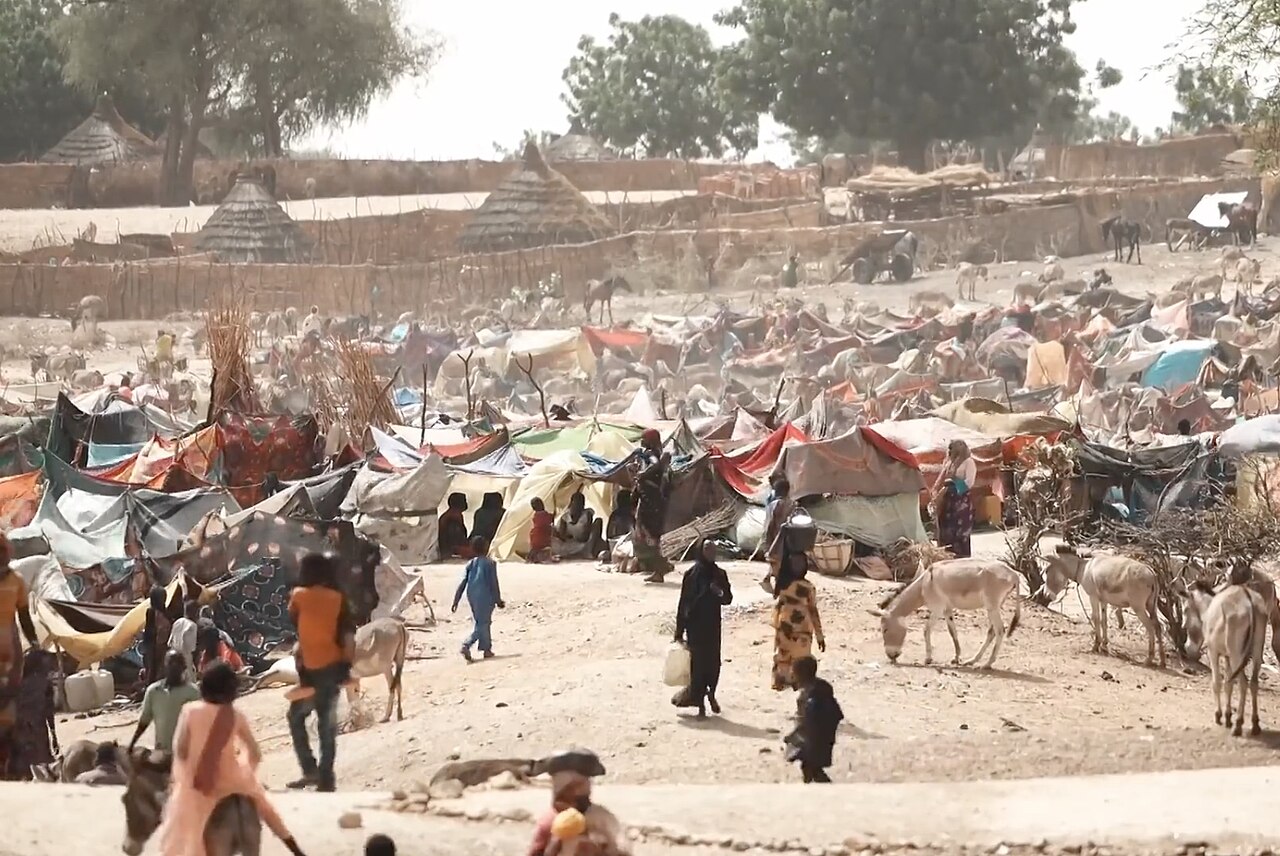
Most displaced Sudanese never cross a border. They move village to village ahead of the fighting, sleeping in schools and under plastic sheeting.
Of those who do cross, most go to Chad, a country that struggles to feed its own border provinces. Others go north to Egypt, where entry rules have tightened.
South Sudan gets a smaller, stranger flow: people who once fled north into Sudan are now fleeing back south. Ethiopia’s tense border takes in Blue Nile’s overflow.
A fraction of those displaced reach Libya and attempt the Mediterranean route north. The Chad fuel-market strike showed that even arrival does not end the risk.
The Darfur file
Darfur shows the war’s clearest logic. It is the RSF’s home region, the source of gold that helps fund it, and where Famine was confirmed in 2025.
Many of today’s camps shelter the children and grandchildren of people displaced by an earlier Darfur conflict two decades ago.
Aid access there is among the worst in Sudan, aid groups say. RSF checkpoints and the army’s suspicion of cross-line convoys leave trucks waiting, and food spoils at border points.
Darfur is also the war’s export route: fighters, gold and refugees move through it into Chad. That is why the border fuel-market strike hit so hard.
Any deal that ignores Darfur’s gold roads and crossing points is likely to fail, mediators involved in past talks say.
Connected Coverage
A UN Panel Puts Colombian Contractors at the Centre of Sudan’s War
Sudan: Blue Nile Fighting Displaces Nearly 20,000 in Two Days
Chad Says a Sudanese Air Strike Killed 12 at a Border Fuel Market
The Big Picture
Africa: The New Scramble — why the world’s powers are competing for the continent
Latest developments
- Suho Plays São Paulo on 20 December 2026 — 13 October 2026
- Mazatlán Marathon on 6 December 2026 — 13 October 2026
- French Montana Plays Cape Town on 4 December — 13 October 2026
- Sharks vs Stormers in Durban on 5 December — 13 October 2026
This article was produced by The Rio Times’ automated newsroom system. How we use AI · Report an error · Editorial responsibility: Matthias Camenzind, Editor-in-Chief
Horn of Africa and the Red Sea
- Horn of Africa 2026: Why It Matters and Who Backs Whom
- Ethiopia’s Neighbors Explained, Ports, Eritrea, Somalia
- Eritrea Explained 2026, a Red Sea Country Guide
- Somalia Explained: Al-Shabaab, Somaliland, the Ports and the Fight Over a 2026 Vote