Sudan Opens Jet Fuel Imports to All Firms on 12 October

ENERGY · SUDAN
Key Facts
- —The country Sudan has been at war since April 2023 between its army and the paramilitary Rapid Support Forces. The Khartoum refinery, once about 70% of fuel supply, is out of service.
- —Why it matters Sudan now leans on imported fuel, and local outlets say only a few companies controlled jet fuel supply. Who imports shapes prices and supply.
- —Why now On Tuesday 6 October, 24 Sudanese oil firms asked army chief Abdel Fattah al-Burhan to review import rules, citing margins of about US$7 million a cargo.
- —What happened On Monday 12 October the Ministry of Energy and Oil opened Jet A-1 and furnace oil imports to all qualified national companies.
- —The numbers Importing groups must back central bank guarantees with 200 kilograms of gold. No group may have more than four companies.
- —What it means for US readers Burhan has been under US Treasury sanctions since 16 January 2025. Suppliers selling to new Sudanese importers face compliance checks as well as commercial ones.
- —Still open The ministry has not named the firms that held the market, how many new importers qualify, or when the first cargoes will land.
Sudan’s energy ministry on Monday 12 October opened Sudan jet fuel imports, and furnace oil imports, to every qualified national company. Local outlets say the step ends the grip of a few firms on aviation fuel in a country at war since 2023.
For foreign readers, the change touches airlines, aid flights and fuel traders who supply a country that has lost its main refinery. It also ties fuel imports to gold deposits, so it reaches into the trade in Sudanese gold.
The ministry announced it in a press statement, reported that evening by Sudan Tribune and early on Tuesday by Sudan Akhbar. It said the opening reflects transparency and equal opportunity in the fuel market.
How the New Import Rules Work
Under the statement, Sudan jet fuel imports of the Jet A-1 grade are open to all national firms meeting the import conditions. Furnace oil, a heavy fuel oil burned mainly in industry and power generation, opens on the same terms.
The ministry attached financial and banking conditions to the opening. Importers need Central Bank of Sudan approval for letters and financial guarantees linked to a deposit of 200 kilograms of gold.
That gold requirement applies to importing groups rather than to single firms, according to both reports. No group may include more than four companies, in line with existing fuel import rules.
The gold rule itself is not new. On Monday 15 June the central bank made a deposit of 200 kilograms of 21-carat gold a condition for fuel import licences.
Sudan Tribune reported at the time that the aim was to curb manipulation of imports and ease pressure on foreign currency. Its circular also required importers to complete arrival and payment checks within 21 days.
The ministry said it would keep working to secure petroleum supplies and stable markets under the existing import framework. It gave no date for the first cargoes under the wider rules.
Why Oil Firms Pushed for Change
The decision came six days after 24 Sudanese oil companies sent a memo to Abdel Fattah al-Burhan. Burhan heads the Transitional Sovereignty Council, Sudan’s ruling body, and commands the Sudanese Armed Forces.
In the memo, dated Tuesday 6 October, the firms said current rules had weakened competition and disrupted both supplies and prices. They asked for imports to be opened to all qualified national firms under uniform, transparent criteria.
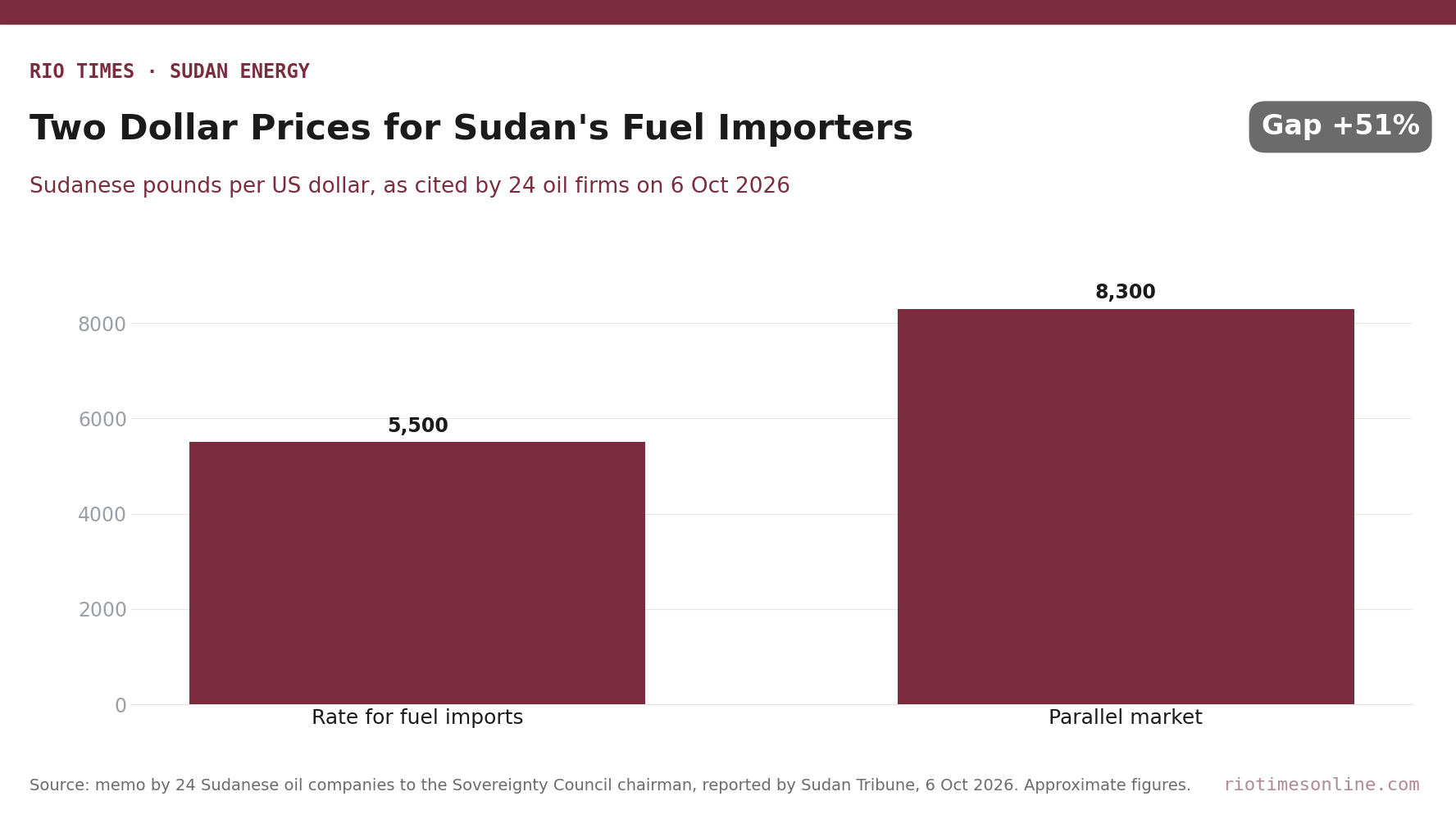
The companies said limiting imports to a few firms had let margins on some shipments reach about US$7 million a cargo. They linked those margins to a gap between two exchange rates.
According to the memo, the rate set for fuel imports was about 5,500 pounds to the dollar. The parallel market rate, they said, had reached about 8,300 pounds to the dollar.
The firms also asked for the gold guarantees to be replaced by more flexible tools. They wanted a published method for sharing fuel quotas among distributors as well.
Monday’s statement answers the first demand but keeps the gold guarantee in place. That leaves smaller firms, which a gold exporters’ official warned in June could be squeezed out, still facing a heavy entry cost.
The pressure came amid long fuel queues in Khartoum and several states in recent weeks, Sudan Tribune reported. The background is in Why Sudan Is Running Out of Fuel in 2026, which explains how the war broke the supply chain.
The currency strain behind the exchange-rate gap is covered in Sudanese Pound Slides to 8,800 a Dollar. A wider pool of importers could ease supply, but only if they can raise dollars.
What It Means for US Readers
The US Treasury sanctioned Burhan on 16 January 2025, nine days after sanctioning RSF leader Mohammad Hamdan Daglo. Traders who sell fuel into Sudan therefore check carefully who stands behind each buyer.
More importers means more counterparties for foreign refiners and shipping firms to screen. It could also mean more competition on price, which could matter for airlines and aid operators that buy jet fuel in Sudan.
The gold link matters too, because Sudan Tribune reported in June that the rule aimed to build central bank gold reserves. A gold exporters’ official said then that it links the two most important goods in Sudan’s economy, fuel and gold.
For investors, the reform is a small signal that wartime authorities are willing to loosen control of a lucrative trade. The risk is that the gold threshold keeps the same few groups in charge.
What Is Not Known
Neither the ministry nor the local reports named the companies that dominated jet fuel imports before Monday. It is also unclear how many firms or groups can meet the 200 kilogram gold condition.
The ministry did not say whether the exchange rate for fuel imports will change. Without that, the gap the oil firms described could keep margins high for whoever wins import rights.
The full text of the ministry statement was not available on an official website. Its content is known through two Sudanese outlets, whose accounts match on the main points.
The memo figures on margins and exchange rates come from the companies themselves and were not independently confirmed. Whether prices at the pump or the airport fall will only show once new cargoes arrive.
Frequently Asked Questions
What did Sudan decide on jet fuel imports?
On Monday 12 October the Ministry of Energy and Oil opened Sudan jet fuel imports and furnace oil imports to all qualified national companies. Local outlets say the step ends control of the market by a few firms.
What conditions do importers face?
Importing groups need Central Bank of Sudan approval for guarantees linked to a deposit of 200 kilograms of gold. A group may include no more than four companies.
Why did the government act now?
On 6 October, 24 Sudanese oil firms asked army chief Abdel Fattah al-Burhan to open fuel imports. They said limited competition had pushed margins on some cargoes to about US$7 million.
Does this affect US companies?
Burhan has been under US Treasury sanctions since 16 January 2025, so foreign suppliers must screen Sudanese buyers carefully. A larger pool of importers means more counterparties to check.
Will fuel get cheaper in Sudan?
That is not yet known. Prices depend on how many firms qualify, on the exchange rate used for fuel imports and on when new cargoes arrive.
Sources: Sudan Tribune, ministry decision, 12 Oct 2026 (sudantribune.net/article/319870); Sudan Akhbar, 13 Oct 2026 (sudanakhbar.com/1856705); Sudan Tribune, oil firms’ memo, 6 Oct 2026 (sudantribune.net/article/319671); Sudan Tribune, central bank gold rule, 15 Jun 2026 (sudantribune.net/article/315095); US Treasury, 16 Jan 2025 (home.treasury.gov/news/press-releases/jy2789).
This article was produced by The Rio Times’ automated newsroom system. How we use AI · Report an error · Editorial responsibility: Matthias Camenzind, Editor-in-Chief
Part of our ongoing coverage
Africa: The New Scramble — the great-power contest over the continent.