1,200 Homes Damaged by Floods in Piura, Peru
Peru’s government says El Niño floods have damaged about 1,200 homes in Piura, and the pumps meant to protect them are working below their design capacity.

Disaster Response: Peru
Peru’s Housing Minister, Mauricio Arnillas, said on Sunday 29 November 2026 that about 1,200 homes are damaged by flooding in two neighbourhoods of Piura city, on the country’s northern coast. The rain came with El Niño, a warming of Pacific waters that disrupts weather along Peru’s coast.
“In total, between El Chilcal and Ignacio Merino, we have more or less identified twelve hundred damaged homes,” Arnillas told television interviewers. Translations in this article are ours.
Key Facts
- Who. Peru’s Housing Minister Mauricio Arnillas, speaking on Sunday 29 November 2026.
- What. Flooding has damaged about 1,200 homes, and rainwater has mixed with sewage.
- Where. Two neighbourhoods of Piura city, on Peru’s northern coast.
- Next. Four more days of forecast rain, and an emergency decree on rainwater pumping stations.
- As of. 29 November 2026, 17:30 GMT.
Peru’s government says El Niño floods have damaged about 1,200 homes in Piura, and the pumps meant to protect them are working below their design capacity.
ENFEN, Peru’s official committee that studies El Niño, said in Official Communiqué No. 20-2026 on 13 November 2026 that the coastal El Niño, which began in March 2026, would stay at “extraordinary” magnitude until February 2027. It expects the event to weaken only gradually until July 2027.
On 18 February 2026 the housing ministry said in a news note that its SARE units, underground stations that pump rainwater away, kept El Chilcal and Ignacio Merino dry in a storm that dropped 13.4 millimetres of rain between 9:10 p.m. on Monday and 1:30 a.m. on Tuesday. Three electric pumps ran continuously in El Chilcal that night.
Arnillas now wants a National SARE Programme, the full name of SARE being Alternative Rainwater Collection and Evacuation System, to work “24 hours a day, every day of the year”. He also described an emergency decree under which the national government would manage and maintain the units all year, and President Keiko Fujimori has said the central government will take over the SARE units.
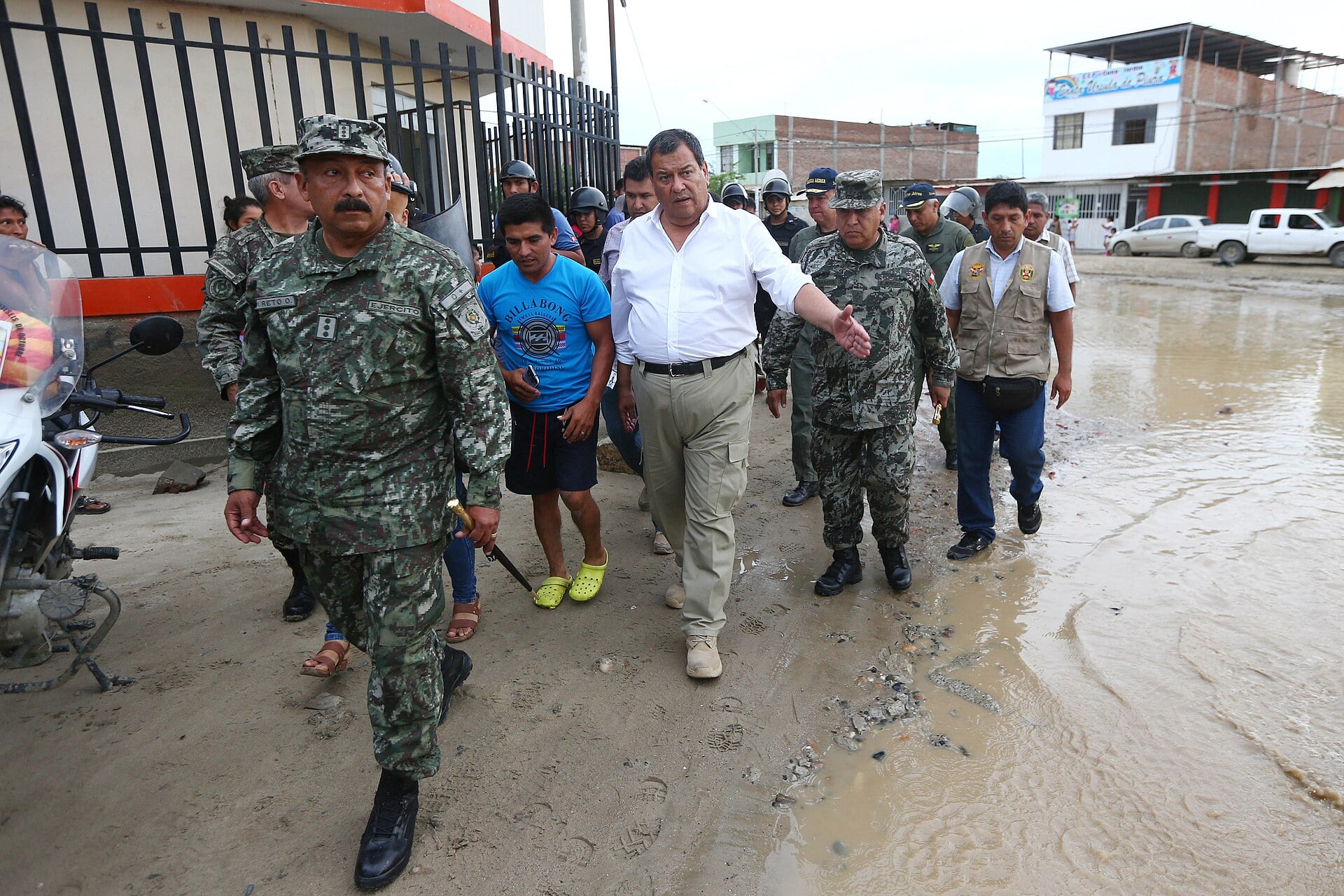
Arnillas gave his own advice to people in flood-prone zones: move valuables to the second floor. “Get ready, because a Mega Niño is coming,” he said.
He said: “Of all the El Niño records, at this stage, this one has already passed all records.” He cited a four-day rain forecast and said the Health Ministry must fumigate the areas once they are drained.
Arnillas said rainwater in both neighbourhoods had mixed with sewage. The ministry moved three 8-inch motor pumps to El Chilcal to reinforce its drainage unit and a transfer pump, and the water there fell by about 1 metre.
The aim was to drain the area on Sunday if no new rain fell. Boats delivered water and food until 2:30 a.m. to families who stayed in their homes.
A shelter is operating, and the ministry is preparing cash bonuses and other help for affected families. Arnillas gave no amount, and 42 pumps were handed to municipalities earlier.
One of the four motor pumps in the El Chilcal system was out of service for lack of special spare parts, Arnillas said. Technicians from Sedapal, Lima’s water utility, travelled from the capital to check the electric pumps.
They measured the electric pumps pushing out 60 litres per second against a design capacity of 250 litres per second. Arnillas said the El Chilcal system belongs to the regional government.
He admitted reluctance among some mayors and governors to the national plan. He said local governments had not maintained the equipment in dry years because El Niño comes about every four years.
Arnillas said the need for motor pumps and electric pumps is not limited to Piura, because Tumbes and Lambayeque, two other regions in the north, also face problems linked to the rain. He thanked private companies for their help and gave no cost for the plan and no date for the decree.
Arnillas rejected that an elderly woman’s death in Ignacio Merino was caused by the flood, saying she had earlier health problems. The cause has not been independently confirmed.
Frequently Asked Questions
What is El Niño and why does it flood Piura?
El Niño is a warming of Pacific waters that changes weather patterns. On Peru’s northern coast it can bring rain that the city’s drainage was not built to handle.
Who runs the pumping stations in Piura?
Arnillas said the El Chilcal system belongs to the regional government. The national government wants to take over management under an emergency decree.
Is the flooding likely to end soon?
ENFEN’s forecast points to a slow weakening of El Niño, not a sudden stop. The minister himself told residents in flood-prone zones to prepare.
Sources
Mauricio Arnillas, Peru’s Minister of Housing, Construction and Sanitation, television interviews, 29 November 2026 · ENFEN Official Communiqué No. 20-2026, 13 November 2026 (link) · Housing ministry note, 18 February 2026 (link)
Connected Coverage
Peru news · Piura Flood Pumps Stall, Minister Says · Analysts Say Peru Was Late on Piura Floods
This article was produced by The Rio Times’ automated AI newsroom. Editorial responsibility: Matthias Camenzind, Publisher and Editor-in-Chief. The Rio Times also runs Ask Rio Times, which answers from 100,000+ of our own articles, the daily Latin America Power Map, and prediction-market odds on elections and markets.. How we use AI · Report an error