Piura Flood Pumps Stall, Minister Says
A pumping system built to keep one Peruvian neighbourhood dry failed in the heavy storm. The agriculture minister blames a heavy downpour, while critics say the state was late.

Disaster Response: Peru
The main flood pumps in Piura, a northern Peruvian city, stopped working in the storm of 26 to 27 November 2026 after about 50 millimetres (2 inches) of rain fell in 45 minutes, Agriculture and Irrigation Minister Marco Vinelli Ruiz said on Friday 27 November. The water rose to the pumps’ electrical cables, and soldiers and ministry crews spent the night draining the neighbourhood by other means.
The pumps are called SARE, short for Sistema Alternativo de Recolección y Evacuación de Aguas de Lluvia, or Alternative Rainwater Collection and Evacuation System. Comando FEN, the government’s El Niño emergency command, said on Friday evening that the unit in Ignacio Merino had been restored.
Key Facts
- Who. Marco Vinelli Ruiz, Peru’s agriculture minister, said the Ignacio Merino rainwater pumps in Piura stopped.
- What. Vinelli says 50 mm (2 inches) of rain in 45 minutes lifted water to the pumps’ cables.
- Next. Pumps restored Friday 27 November; Senamhi, Peru’s weather service, warns of rain until Sunday 29 November.
- As of. 28 November 2026, 11:30 GMT.
- Power Index. Peru ranks 5th of 14 in The Rio Times Latin America Power Index, with 53.9 points (November 2026 edition).
A pumping system built to keep one Peruvian neighbourhood dry failed in the heavy storm. The agriculture minister blames a heavy downpour, while critics say the state was late.
El Niño, a warming of the Pacific Ocean that brings heavy rain to Peru’s north coast, is officially forecast to stay extraordinary until February 2027. ENFEN, the state committee that tracks it, set out that outlook in Official Communiqué 20-2026 on 13 November 2026 and said the event, which began in March, would fade by July 2027.
An earlier storm flooded Piura on 20 October 2026, and on 20 October the housing ministry said its crews and the army had set up two transfer pumps at Ignacio Merino and El Chilcal, another flood-prone neighbourhood. Touring the neighbourhood on 21 October with Defence Minister Rafael Belaúnde, Vinelli said (our translation): “This rain has allowed us to verify what our capacity to respond is.”
Money for the rivers came in August. Emergency Decree 008-2026 let the National Water Authority (ANA), the agriculture ministry’s river agency, spend up to 129.4 million soles (about US$37 million at S/3.47 per US$, the market rate from RT, a financial data provider, on 27 November) on clearing river beds, according to ANA’s resolution of 19 August 2026.
Who Was Ready for the Storm?
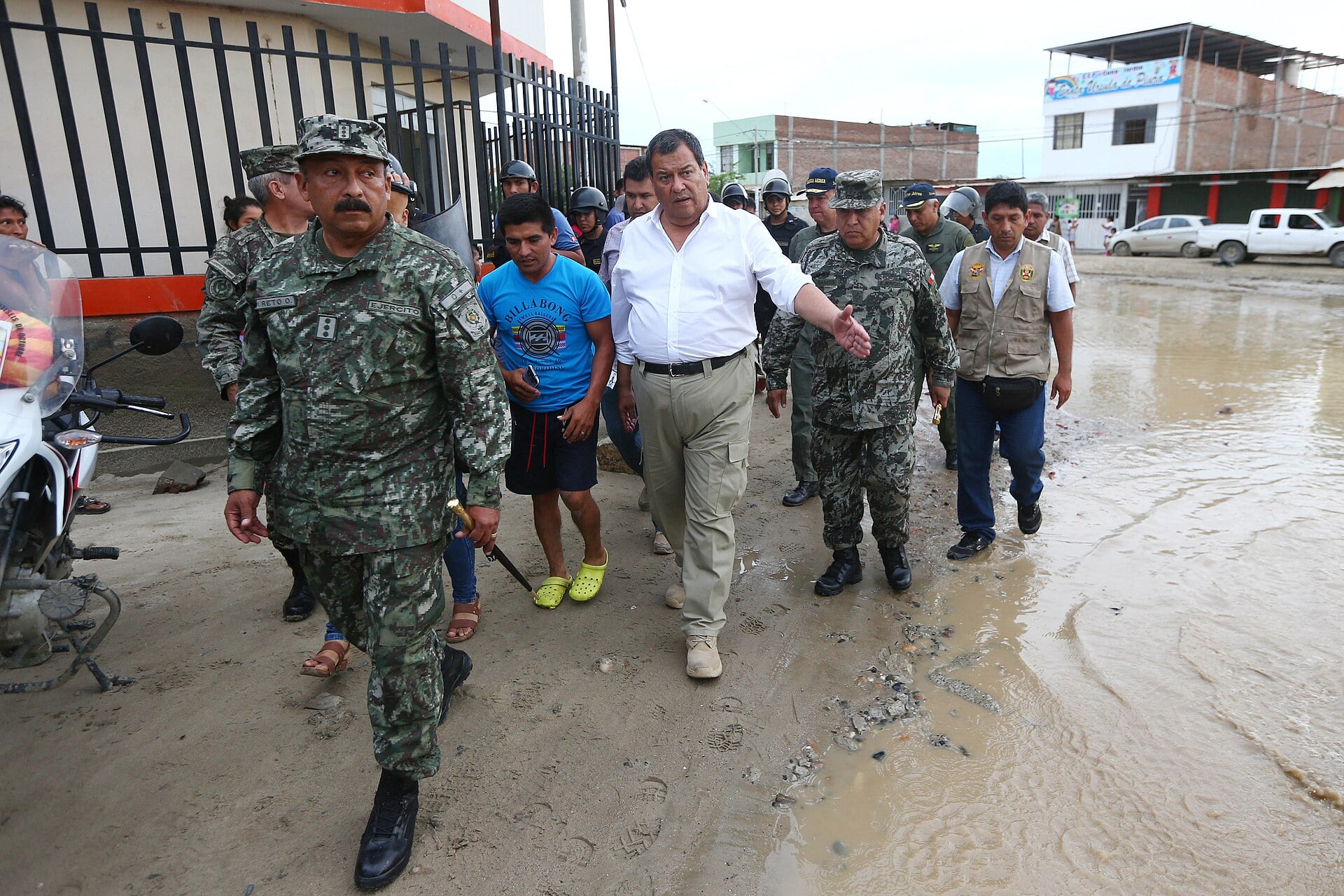
Vinelli said the rain, about 50 millimetres in 45 minutes, lifted the water to the cables of the Ignacio Merino pumps and shut the system down. Work to install a transfer pump, a portable pump that moves water through a hose, began at 1 a.m. on Friday and sent water towards the Piura river, he said.
Defence Minister Belaúnde, who said he had supervised the work since midnight, said soldiers alone laid the second pump’s hose to the river by hand. “We need regional and local institutions to come out in the early hours too, to support the army,” he said (our translation), adding that “we must correct this”.
Vinelli said a second transfer unit was on its way and that cables and other fittings were still missing: “To drain all the water we have here I need to switch that SARE on.” Comando FEN said that evening that a transfer pump installed with the Defence Ministry had lowered the water enough to restart the system.
Vinelli rejected any charge of complacency: “We have not underestimated the El Niño phenomenon; we said from the start that this is a mega El Niño” (our translation). On the river, he said that on 3 August, days after the government took office on 28 July, “there was not a single cubic metre of earth or sand from the Piura river that had been dredged”.
ANA’s release says double-shift work on the Piura river began on Monday 24 August 2026, but it gives no start date for the dredging itself. The agriculture ministry said on 2 September that the work had begun about three weeks earlier and had reached roughly 30% of a 500,000-tonne target, which fits Vinelli’s account but comes from his own ministry.
Senator Nora Bonifaz, of the Buen Gobierno party, said on 27 November that “there is no reaction” from the government, and that pumps left in the affected areas were not working for lack of fuel (our translation). She said Congress could summon ministers to explain the response.
Political analyst Enrique Castillo said on 26 November that Vinelli, who leads the national El Niño risk commission, should have been at his post since 23 November, when the forecast was clear, instead of at the CADE business conference in Cusco, an annual gathering of Peruvian executives. Former Defence Minister Antero Flores-Aráoz said the state was “late” because drains were never built in earlier years.
More Rain Is Forecast Through the Weekend
The February test shows what broke. The housing ministry said then that Piura’s SARE units handled 13.4 millimetres of rain over about four hours without flooding, while Thursday night’s 50 millimetres in 45 minutes, on Vinelli’s figures, was a far more intense burst.
Piura is a coastal region of farms and the Talara oil refinery. The official statements so far do not mention damage to either, so readers with exposure to Peruvian farm exports have no damage figure yet.
Senamhi has a red-level warning for the north coast, and its notice runs until 23:59 on Sunday 29 November. The ENFEN outlook means the same pumps will face more storms, and Bonifaz gave no date for a summons of ministers.
Frequently Asked Questions
Why did the Piura flood pumps stop?
Water reached the system’s electrical cables, so it shut down until crews pumped the level lower. The pumps work only while their electrics stay dry.
Are the Piura pumps working again?
Comando FEN said on Friday evening that the Ignacio Merino system was restored. Draining continues, and the weather service’s warning runs to Sunday 29 November.
Who is being blamed for the flooding?
Senator Nora Bonifaz and analyst Enrique Castillo fault the national government’s speed, while Defence Minister Belaúnde points to slow help from regional and local authorities. No official finding has assigned blame.
Sources
Housing ministry note on SARE units, 18 February 2026 (gob.pe) · ANA Resolution 0210-2026-ANA, 19 August 2026 (gob.pe) · Agriculture ministry notes of 25 August and 2 September 2026 on ANA dredging (25 Aug, 2 Sep) · ENFEN Official Communiqué 20-2026, 13 November 2026 (gob.pe) · Statements of Ministers Vinelli and Belaúnde and of Comando FEN, 27 November 2026; Senator Bonifaz, 27 November; analyst Castillo, 26 November · RT, USD/PEN, 27 November 2026
This article was produced by The Rio Times’ automated AI newsroom. Editorial responsibility: Matthias Camenzind, Publisher and Editor-in-Chief. The Rio Times also runs Ask Rio Times, which answers from 100,000+ of our own articles, the daily Latin America Power Map, and prediction-market odds on elections and markets.. How we use AI · Report an error