Singapore to Join 41 States on Panama Canal Neutrality

POLITICS · PANAMA
Key Facts
- —The country Panama, a dollarised Central American nation, has run its canal since 31 December 1999. Between 3 and 5 percent of world maritime trade crosses it, EFE reports.
- —Why it matters The 1977 neutrality treaty, signed by Panama and the United States, keeps the canal open to ships of all nations in peace and war. Washington has pressed Panama over China since 2025.
- —Why now President José Raúl Mulino ended a three-day state visit to Singapore on 5 October 2026, the first by a Panamanian head of state in 10 years, The Straits Times reported.
- —What happened On 5 October 2026 Singapore said it will accede to the treaty’s protocol, its Foreign Ministry said. Forty-one states, including the UK, France, Germany and South Korea, already belong, President Tharman said.
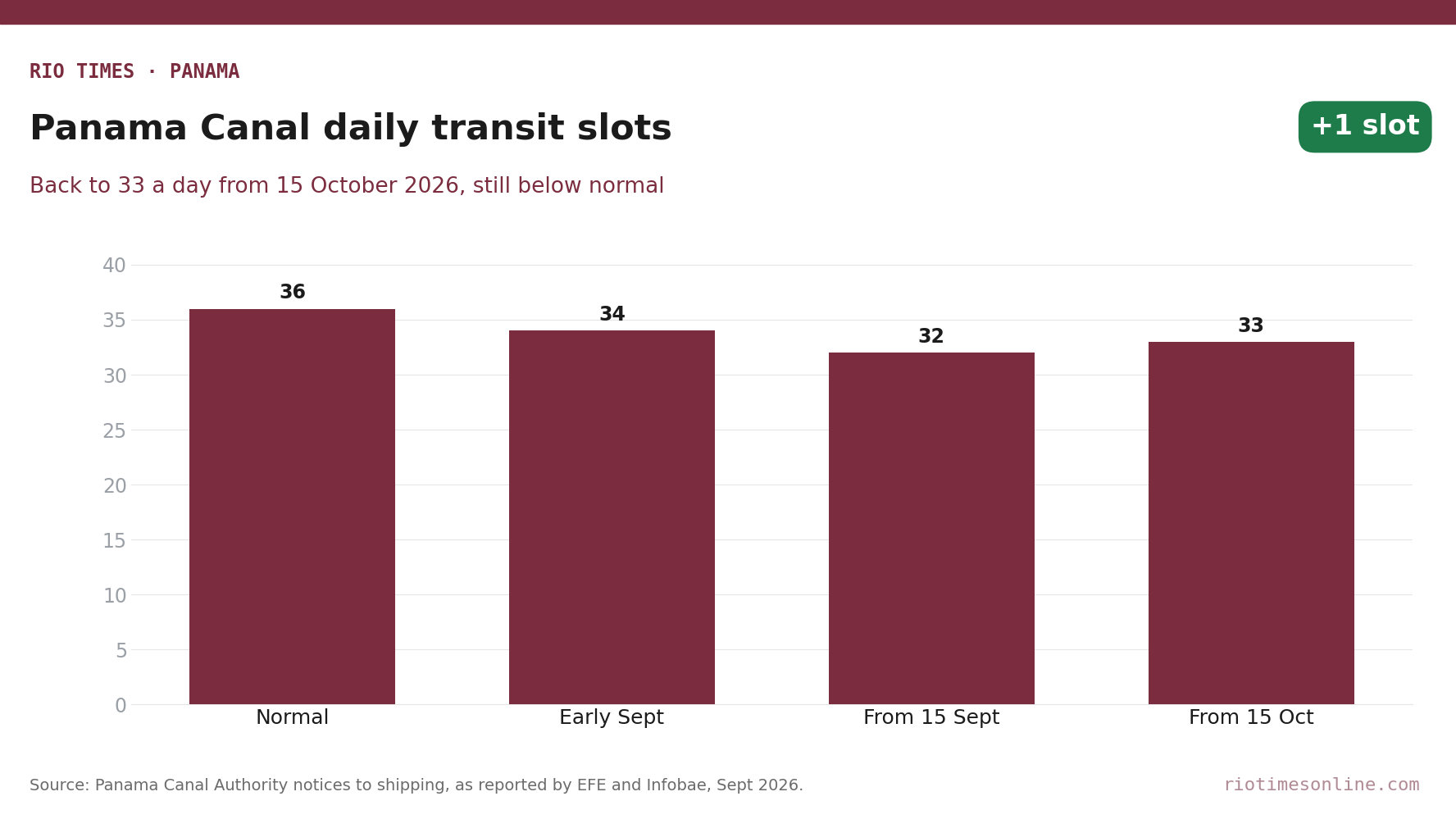
- —The numbers The canal will offer 33 daily transit slots from 15 October, up from 32 but below a normal 36, after drought cuts, the canal authority said on 28 September.
- —What it means for you US importers and exporters on the US East Coast to Asia route gain one more state pledging open, equal passage. Tolls and US rights under the treaty do not change.
- —Still open When Singapore deposits its formal instrument of accession, and whether Washington comments, had not been announced by late afternoon on 5 October.
- —Prediction markets Kalshi gives a 19% chance that the US takes control of part of the canal before 20 January 2029; Polymarket gives 2.6% before 2027 (5 October, 12:40 p.m. ET).
Panama Canal neutrality, the 1977 pledge that the waterway stays open to every flag, gained a new backer in Singapore on Monday, 5 October. Singapore’s government said it will join the treaty’s protocol during a state visit by Panama’s president.
For US shippers and investors, it adds a major Asian port state to the canal’s guarantee of equal access. José Raúl Mulino, Panama’s conservative president since July 2024, was ending a three-day visit.
What Singapore Agreed To
Prime Minister Lawrence Wong, head of Singapore’s government, conveyed the decision at a meeting with Mulino, the Ministry of Foreign Affairs said. President Tharman Shanmugaratnam, the head of state, announced it at a state banquet that evening.
Singapore said the move reflects its commitment to maritime security and freedom of navigation. It tied the decision to the 1982 UN Convention on the Law of the Sea.
The two governments also agreed to open talks on a mutual legal assistance treaty for criminal cases. Singapore’s Ministry of Law said it would ease requests for help with investigations and prosecutions.
Singapore’s airport cargo and catering group SATS and Panama’s Tocumen International Airport, the country’s main hub, signed a memorandum on air cargo. Mulino said the two sides are also forming a bilateral commission for shared projects, his office reported.
The visit was billed as a trade mission, covered in Mulino Asia Tour: Panama’s President Plans Six Accords in Singapore, Then Vietnam. The neutrality pledge adds a strategic dimension missing from the advance programme.
Why the Treaty Matters to Washington
Panama and the United States signed the neutrality treaty in 1977, together with the treaty that handed over the waterway. Panama took full control of the canal on 31 December 1999.
Under the treaty, the canal must stay open to peaceful transit by vessels of all nations, in peace and in war. The protocol, open since 1979, lets other states pledge to respect that regime.
The canal has become a stage for rivalry between Washington and Beijing over ports and influence. In January 2025 US President Donald Trump threatened to take it back, claiming China ran it; Panama denied any Chinese control.
Since then Panama has left China’s Belt and Road programme and accepted rotating US troop deployments, without permanent bases. Its Supreme Court also voided the canal ports concession in 2026. Background: Panama Explained: The Canal, the Economy, the Politics and What to Watch.
Singapore’s accession does not alter any US right under the treaty. It does widen the group of states that have publicly bound themselves to Panama Canal neutrality.
Traffic Is Recovering Slowly
The diplomatic news lands as the canal emerges from a drought squeeze linked to El Niño. The Panama Canal Authority, the state body that runs the waterway, cut daily transit slots from 36 to 34 in early September, then to 32 from 15 September.
Near-average September rain in the watershed allowed a partial reversal. From 15 October the canal will offer 33 daily slots, EFE and Infobae reported. The Neopanamax draft limit rose to 49 feet on 28 September.
The authority still says a booking is the only way to guarantee a transit date while the water deficit lasts. A study by the consultancy Deloitte, cited by the Panamanian daily La Prensa on 5 October, sees 2027 as the year of greatest El Niño exposure.
What It Means for You
For US importers and exporters, nothing changes in practice this week. Tolls, booking rules and equal treatment for all flags stay as they are.
The signal is political. Panama is gathering backing for a neutral canal run by Panamanians, while keeping its security ties with Washington. For investors in US-Asia shipping, it adds one more state publicly committed to keeping the route open to all.
The main risk for Panama is that drought, not diplomacy, limits the canal’s capacity next year. The stabiliser is that slots are already recovering and the booking system spreads the space available.
What Is Not Known
Singapore has not said when it will deposit its formal instrument of accession. The texts of the new agreements had not been published by late afternoon on 5 October.
The count of 41 parties comes from Singapore’s president. Panama’s canal minister, José Ramón Icaza, put it at 40 in May, and the official list could not be checked.
There was no public US government reaction by the same time. Mulino’s next stop is Vietnam, which already belongs to the protocol, so no similar pledge is expected there.
What Prediction Markets Say
Kalshi is an exchange regulated in the US by the CFTC. Its bets on “Will Trump take back the Panama Canal?” priced Yes at 19% at 12:40 p.m. ET on 5 October.
That is one point below the previous price, with about 608,000 contracts traded since January 2025.
On Polymarket, bets on “US takes Panama Canal before 2027?” priced Yes at 2.6% at the same time, with about US$178,000 traded. Neither market moved on the Singapore news.
Why we show this: prediction markets turn real-money bets into a live probability that moves within minutes of the news, which is why investors, campaigns and newsrooms in the United States now follow them closely. We show them next to polls and official results, never instead of them.
What is the Panama Canal neutrality treaty?
A 1977 treaty between Panama and the United States that declares the canal permanently neutral. The waterway must stay open to peaceful transit by ships of all nations, in peace and war, on equal terms.
What does Singapore’s accession change?
Singapore will join the 41 states that, by its count, have pledged, through the treaty’s protocol, to respect the canal’s neutrality. It does not change tolls, Panama’s control of the canal or the rights the United States holds under the treaty.
Is Panama Canal traffic back to normal?
Not fully. The canal will offer 33 daily transit slots from 15 October 2026, up from 32. That is still below the usual 36, after drought cuts linked to El Niño.
Sources: Singapore Ministry of Foreign Affairs, 5 October 2026; The Straits Times, 5 October 2026; EFE via Swissinfo, 5 October 2026; Panama presidency statement via En Segundos, 5 October 2026; Infobae on Panama Canal Authority notice A-36-2026, 28 September 2026; Icaza to La Estrella de Panamá via PDCC, 24 May 2026; La Prensa (Panama), 5 October 2026; Kalshi and Polymarket market prices, 5 October 2026, 12:40 p.m. ET.
Editorial responsibility: Matthias Camenzind, Editor-in-Chief · Editorial standards · Report an error