Milei Clears Brazil-Argentina Naval Exercise Despite Rift
Argentina · DEFENCE
Key Facts
—The authorization. President Javier Milei’s Decree 717/2026 permits Brazilian naval personnel and equipment to enter Argentina from 10 to 24 August for the bilateral Fraterno XXXIX exercise.
—The exercise. The drills run from 13 to 24 August at Puerto Belgrano and Mar del Plata naval bases and in Argentine waters between them.
—The mission. Fraterno trains the two navies in combined naval, air-naval and amphibious operations, including antisubmarine warfare.
—The legal route. Milei used an emergency decree because Congress had not considered the annual bill authorizing foreign-force entries and Argentine deployments abroad.
—The Brazilian force. Annex I lists Tamandaré- and Niterói-class frigates, the submarine-rescue vessel Guillobel and a Riachuelo-class submarine, carrying about 450 personnel between them, plus staff officers and specialists.
—The cost. Argentina budgets ARS1.309 billion (about US$875,000) for the operation from existing Argentine Navy funds.
—The contrast. Reuters reported, citing a Brazilian government source, that Brazil had reduced its representation in Buenos Aires to chargé d’affaires level after Milei again insulted President Luiz Inácio Lula da Silva.
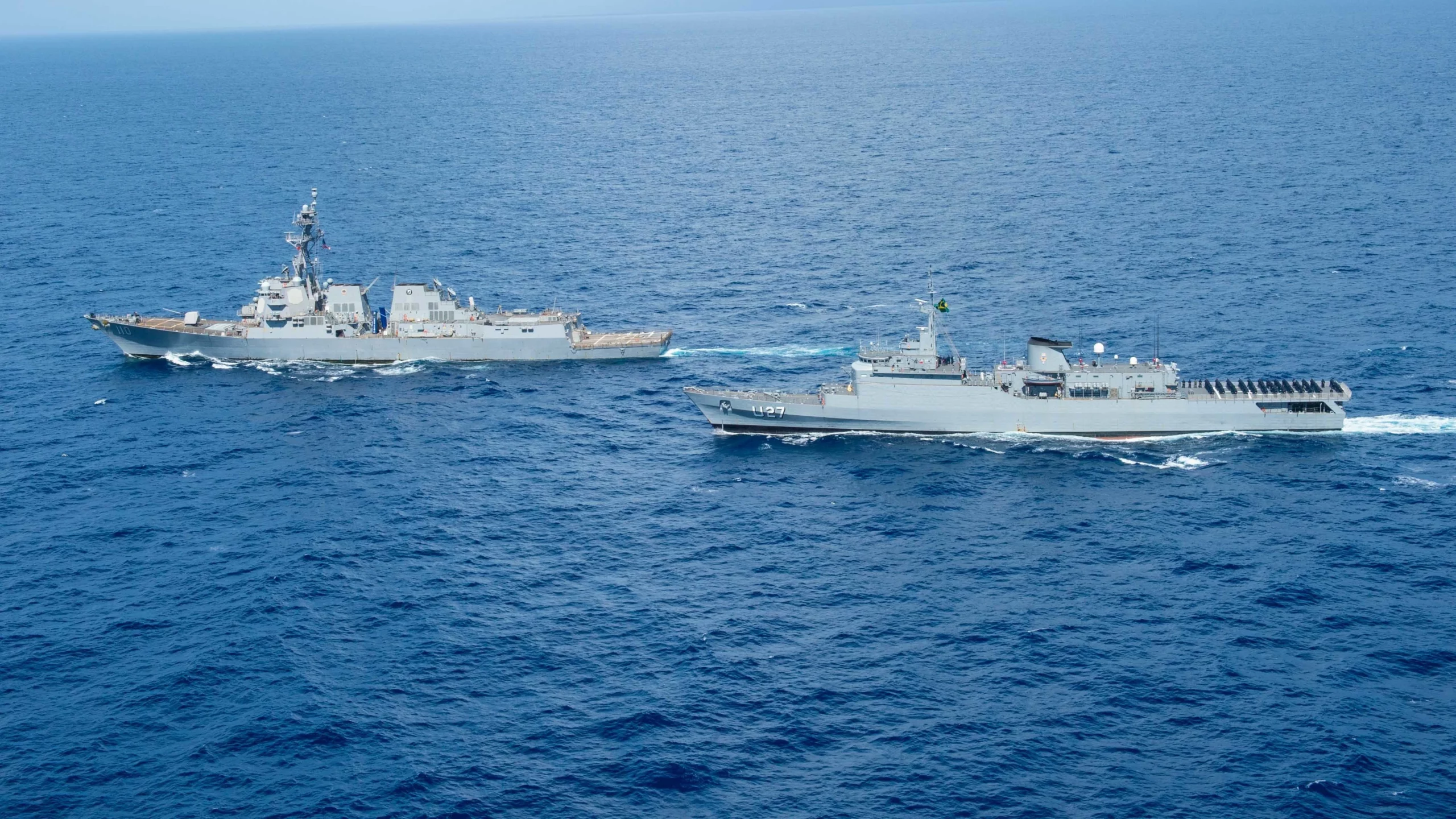
Milei approved a Brazil-Argentina naval exercise for August, keeping Fraterno XXXIX on schedule despite a sharp deterioration in diplomatic relations.
What Milei authorized
Decree 717/2026, signed on 5 August and published the following day, authorizes Brazilian naval personnel and assets to enter Argentine territory from 10 to 24 August. Fraterno XXXIX itself is scheduled for 13–24 August at the Puerto Belgrano and Mar del Plata naval bases and across the Argentine exclusive economic zone between them.
Annex I lists a Tamandaré-class frigate with about 135 personnel, a Niterói-class frigate with about 200, the submarine-rescue vessel Guillobel with about 80 and a Riachuelo-class submarine with about 35, plus Brazilian staff officers and specialists. It puts Argentina’s operating cost at ARS1.309 billion (about US$875,000), financed from the Argentine Navy’s budget.
Why Fraterno matters to both navies
Argentina and Brazil have conducted Fraterno annually since 1978. The exercise is designed to standardize planning and command procedures while improving interoperability in naval, air-naval and amphibious operations. Argentina’s decree specifically identifies antisubmarine warfare as a reason for participating.
The Argentine government argued that withdrawal would significantly weaken training for high-complexity tactical operations with Brazil. That language frames participation less as a diplomatic gesture than as a practical requirement for maintaining combined naval skills.
An emergency decree fills Congress’s gap
Under Argentina’s constitutional framework, Congress authorizes the entry of foreign troops and the deployment of national forces abroad. The executive had submitted a bill covering the combined-exercise program from 1 September 2025 through 31 August 2026, but lawmakers had not acted on it.
With the first Brazilian arrivals due on 10 August, Milei’s cabinet used a decree of necessity and urgency. The same instrument also authorizes Argentine participation in Viekaren XXVI with Chile and in Siforex XIV and Unitas LXVII in Peru. The decree must now be reviewed by Congress’s Permanent Bicameral Commission under Argentina’s DNU procedure.
Military links survive the diplomatic freeze
The timing gives the exercise political significance. Reuters reported, citing a Brazilian government source, that Brazil told Argentina relations would be handled at chargé d’affaires level and that Ambassador Julio Bitelli would not return to Buenos Aires for now. The move followed Milei’s renewed attacks on Lula during an Argentine television interview.
Argentina’s foreign minister, Pablo Quirno, said Buenos Aires would not answer with a reciprocal diplomatic measure. Milei and Lula have not held a formal bilateral meeting since the Argentine president took office in December 2023. Yet the decision to proceed with Fraterno shows that professional military channels can remain functional even when presidential diplomacy is nearly frozen.
Why this matters for Latin America
Brazil and Argentina share long South Atlantic coastlines. Their naval cooperation supports shared procedures in waters carrying regional trade and helps prevent a personal political conflict from spreading into every layer of the bilateral relationship.
For governments and companies watching regional risk, the distinction matters. Diplomatic downgrades can slow political coordination, but they do not automatically dissolve technical arrangements built over decades. Fraterno XXXIX is a test of whether that institutional insulation still holds under unusually hostile rhetoric.
What to watch next
The immediate test is whether the authorized Brazilian personnel and equipment begin entering on 10 August and the full exercise starts on 13 August as planned. Beyond the drills, watch the bicameral commission’s review of the emergency decree and whether Brazil keeps its embassy at the lower level after Fraterno ends. Any operational reduction or cancellation would signal that the political rupture is beginning to affect defense cooperation.
Background: our brazil tax reform complete guide guide.
Background: our santa catarina brazil guide.
Frequently Asked Questions
What is Fraterno XXXIX?
It is the 2026 edition of an annual Argentina–Brazil naval exercise held since 1978 to improve combined planning, interoperability and tactical training.
When and where will the exercise take place?
Brazilian personnel and equipment are authorized to enter Argentina from 10 to 24 August. The drills run from 13 to 24 August around Puerto Belgrano, Mar del Plata and the Argentine waters between them.
Why did Milei use an emergency decree?
Congress had not considered the annual bill authorizing foreign forces to enter Argentina and Argentine forces to deploy abroad before the exercise dates.
Has Brazil broken diplomatic relations with Argentina?
No. Reuters reported, citing a Brazilian government source, that Brazil downgraded its representation in Buenos Aires to chargé d’affaires level and that Ambassador Julio Bitelli would not return for now.
What will the two navies practise?
The decree identifies naval, air-naval and amphibious operations, standardized command procedures and antisubmarine warfare training.
Sources
- Argentina’s Official Gazette — Decree 717/2026
- Argentina’s Official Gazette — Decree 717/2026, Annex I
- Central Bank of Argentina — A3500 reference exchange rate
- Argentina.gob.ar — conclusion of Fraterno XXXVIII in 2025
- Reuters — Brazil downgrades diplomatic ties with Argentina
- Reuters — Argentina declines reciprocal diplomatic action
This article was produced by The Rio Times’ automated newsroom system. How we use AI · Report an error
In depth