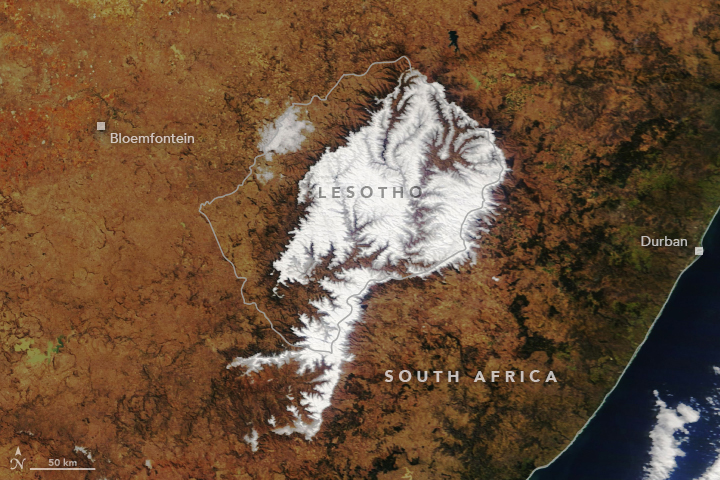
—Only resort. Afriski in the Maluti Mountains is sub-Saharan Africa’s sole operating ski resort south of the equator.
—Visitor surge. The resort recorded over 1,600 day visitors and overnight guests on its busiest day in 2025.
—Employment anchor. Afriski employs 227 full-time and seasonal workers, nearly all Lesotho nationals, plus about 30 South African ski instructors.
—South African market. Roughly 70 percent of visitors come from neighbouring South Africa, making cross-border mobility a commercial lifeline.
—Tourism share. Tourism contributes about 7 percent of Lesotho’s GDP, with winter sports forming a small but strategically visible segment.
The Maluti Mountains ski scene has evolved from a quirky novelty into a genuine winter tourism asset, as Lesotho converts extreme altitude and artificial snow into a seasonal revenue stream that employs hundreds and draws tens of thousands of regional visitors.
Lesotho is the only country on Earth where every square kilometre sits above 1,000 metres of elevation, a geographical quirk that delivers regular winter snow and temperatures cold enough to sustain a ski industry. The Maluti Mountains near Mahlasela Pass, where Afriski operates at about 3,200 metres, form the backbone of a product that simply does not exist anywhere else in sub-Saharan Africa.
The resort relies on artificial snow machines to extend a season that typically runs from June to August, because natural snowfall alone is unreliable. That engineered winter window has turned a landlocked kingdom into a curiosity that increasingly functions as a real business.
The Business of Snow in Southern Africa
Afriski is not a mass-market alpine resort. It offers three small slopes, a snow park, a kids’ club, a ski school, and rental equipment, a compact setup aimed squarely at South African families, young professionals, and a smaller cohort of local and regional first-timers.
CEO Theo Ferreira told media in 2026 that about 70 percent of visitors come from South Africa, with the rest drawn from Lesotho and elsewhere in the region. The resort employs 227 full-time and seasonal workers, nearly all Basotho nationals, plus roughly 30 South Africans who work mainly as ski instructors, making it a meaningful local employer in a country with limited industrial depth.
Visitor numbers tell a story of post-pandemic recovery and growing regional appetite. The resort recorded its busiest day ever in 2025 with over 1,600 day visitors and overnight guests, and a single day in 2026 drew more than 1,400 people to the slopes.
Power Costs and the Fragility of Niche Tourism
For all its branding success, the Maluti Mountains ski model sits on a knife-edge. High electricity costs, driven by the energy needed to run snowmaking equipment, have repeatedly strained operations, and the resort closed temporarily in 2023 amid power problems and legal disputes.
The pandemic exposed deeper vulnerabilities. The Guardian reported pandemic-era losses of about 40 million rand, and Afriski was described as the main employer in its area, underscoring how heavily local livelihoods depend on a single seasonal asset.
Managing director Puseletso Mahlakajoe told DW in 2024 that the resort wants African children to grow up skiing there, but acknowledged that electricity bills remain a serious drag on profitability.
The resort has responded by diversifying into off-season activities such as mountain biking, motorbiking, hiking, and conferencing, a strategy designed to smooth revenue beyond the narrow winter window. That pivot reflects a broader truth about extreme niche tourism: geography creates the brand, but infrastructure costs and seasonality still determine the bottom line.
South Africa’s Shadow and Regional Integration
Lesotho is entirely surrounded by South Africa, and the ski industry’s commercial fate is inseparable from cross-border mobility, road access, and disposable income in Gauteng and the Free State. When South African consumers feel squeezed, Afriski feels it immediately.
That dependence cuts both ways. The resort gives Lesotho a rare soft-power asset, a “snow Africa” brand that differentiates the kingdom from every other destination in the region and attracts media attention far beyond its economic weight.
The national tourism master plan explicitly identifies Lesotho as one of only two ski destinations in Southern Africa and frames winter adventure as a tool for investment, rural development, and foreign exchange earnings.
Tebello Thoola, chief executive of the Lesotho Tourism Development Corporation, has said tourism plays a major role in the economy and supports job creation, a message that resonates in a country where formal employment options are scarce. The winter snow season benefits accommodation providers, craft sellers, and small firms in Butha-Buthe, Leribe, and Mokhotlong, creating a multiplier effect that extends well beyond the ski slopes.
The Great-Power Contest and the Branding of African Destinations
Afriski is not a strategic asset in the traditional sense, but it sits inside a wider contest over African tourism investment, infrastructure finance, and the global branding of the continent. As powers compete for influence under the framework we track in Africa: The New Scramble, even small-scale tourism projects become signals of where capital, visitors, and soft power are flowing.
Lesotho has been courting more investment and partnerships, including a three-year agreement with the African Tourism Board to boost year-round tourism, economic growth, and youth entrepreneurship. For a Latin American reader, the parallel is instructive: just as Andean nations have converted high-altitude geography into ski and adventure tourism that draws regional and international visitors, Lesotho is attempting a similar play, albeit on a smaller scale and with far tighter infrastructure constraints.
The BRICS thread is indirect but present. South Africa’s dominance as a source market means that any shift in regional economic integration, visa policy, or infrastructure spending inside the bloc ripples into Lesotho’s tourism calculations.
What to Watch Next
The immediate test is whether Afriski can sustain its visitor growth while managing electricity costs that show no sign of falling. Any further disruption to South African consumer spending or cross-border travel would hit the resort hard, given the lopsided source-market concentration.
Longer term, the question is whether Lesotho can use the Maluti Mountains ski brand to attract infrastructure investment that lowers operating costs and extends the tourism season. If it succeeds, the kingdom will have turned a geographical oddity into a durable economic platform.
If it stumbles, the slopes will remain a charming but fragile footnote in Southern Africa’s tourism story.
Yes. Afriski, located in the Maluti Mountains at about 3,200 metres above sea level, is sub-Saharan Africa’s only operating ski resort south of the equator. It uses artificial snow machines to maintain slopes during the Southern Hemisphere winter, typically from June to August.
Who visits the Maluti Mountains ski resort?
Roughly 70 percent of visitors come from neighbouring South Africa, with the remainder drawn from Lesotho and other regional countries. The resort recorded over 1,600 day visitors and overnight guests on its busiest day in 2025, reflecting strong post-pandemic demand.
What challenges does Lesotho’s ski industry face?
High electricity costs for snowmaking are the primary operational challenge, and the resort closed temporarily in 2023 due to power problems and legal disputes. Heavy dependence on South African visitors also makes the business vulnerable to regional economic downturns and cross-border disruptions.
 RTAsk Rio TimesLatin American markets, currencies and companies.Answers are generated from Rio Times reporting only — every claim links to its source article.Open the full Ask Rio Times →