Latin American Pulse for Saturday, September 19, 2026
Executive Summary
Most Latin American markets fell this week as the dollar firmed. Chile's exchange closed for Fiestas Patrias and Colombia's peso was the region's weakest
Rio Times · Latin America
Key Facts
—Region Most major Latin American indices and funds fell this week, with the regional fund ILF down 2.59 percent.
—Brazil The Ibovespa fell 0.41 percent on Friday to 185,229 points and lost 1.06 percent over the week.
—Mexico The IPC closed at 63,375.93, down 0.78 percent, with 22 of 35 index members lower on the day.
—Chile The exchange closed on Friday 18 September for Fiestas Patrias and reopens on Monday 21 September.
—Argentina The dollar ended at 1,514 pesos, up 0.26 percent on Friday and 0.35 percent over the week.
—Colombia The peso was the region’s weakest currency this week, with the dollar up 2.10 percent to 3,166.69.
—Peru The sol firmed 0.09 percent on Friday to 3.374 per dollar but weakened 0.58 percent over the week.
A Week That Ended in the Red
The mood across the region this week was resignation rather than alarm. Most major Latin American indices and funds fell. The dollar rose against most regional currencies, with the Chilean peso and Peruvian sol the exceptions on Friday.
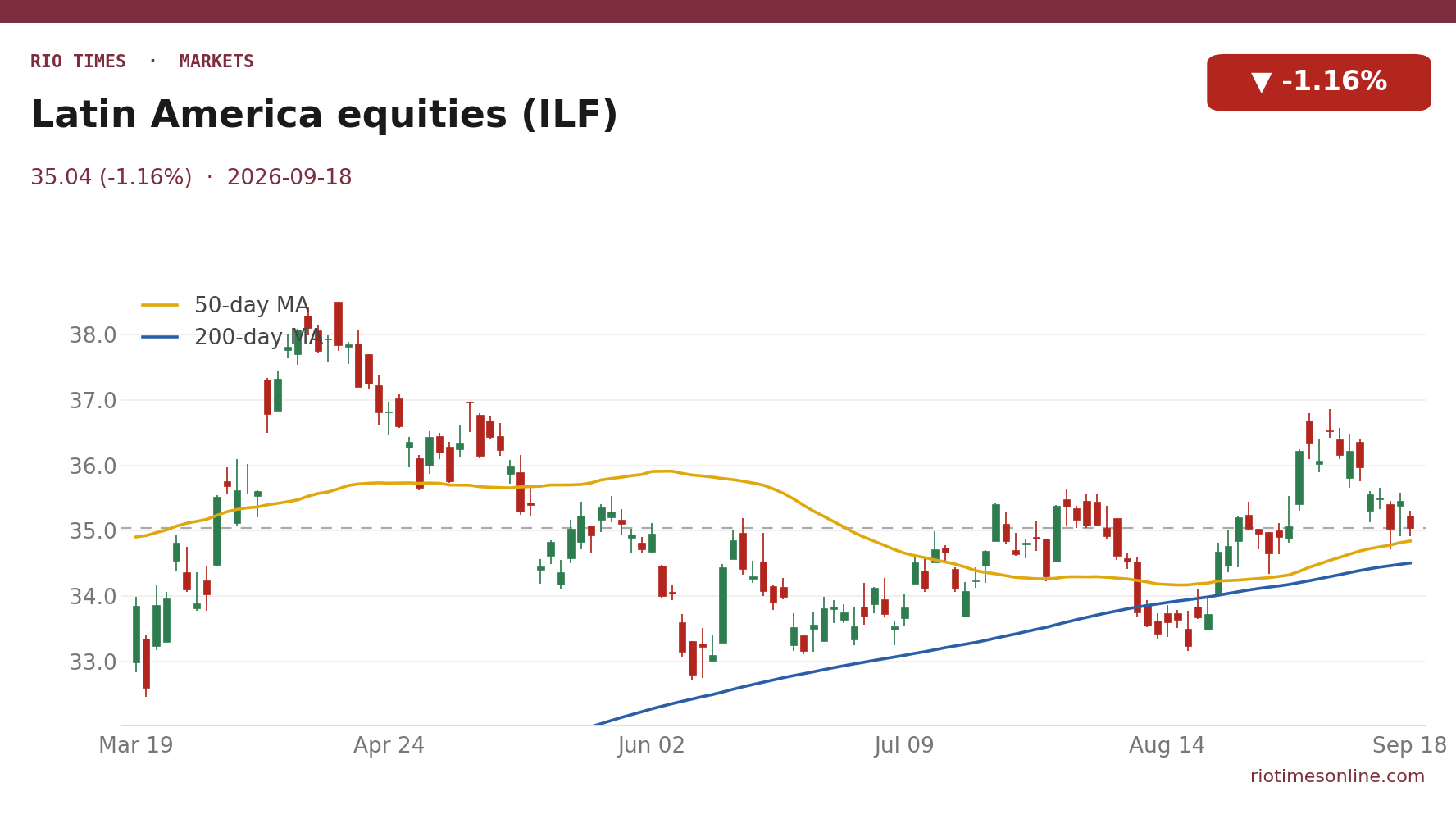
The regional fund ILF closed at 35.04 dollars, down 1.16 percent on Friday and 2.59 percent over the week. The Brazil fund EWZ fell 1.75 percent for the week and the Mexico fund EWW 2.71 percent.
The dollar index ended at 100.215, up 1.10 percent over the week. It slipped 0.03 percent on Friday, so the week’s gain came earlier.
Copper held up better than equities. The copper tracker CPER rose 1.44 percent on Friday and 2.68 percent over the week, and Southern Copper closed at 195.70 dollars.
Gold rose 0.77 percent on Friday to 4,380.01 dollars an ounce, and silver gained 1.41 percent to 66.35 dollars. Both metals ended the week higher.
Oil was the exception among commodities. The oil fund USO fell 0.96 percent on Friday and 0.70 percent over the week, closing at 153.82 dollars.
Brazil: A Paused Rally and a President Heading to New York
The Brazilian mood is one of a rally that has paused rather than reversed. The Ibovespa closed at 185,229.17 points, down 0.41 percent on Friday and 1.06 percent over the week.
President Luiz Inácio Lula da Silva said on 17 September that he will go to the UN General Assembly. He will tell President Donald Trump not to meddle in Brazil’s elections, according to AFP.
Two polls released on 14 September pointed in opposite directions. BTG Pactual/Nexus had Lula ahead of Senator Flávio Bolsonaro by 47 percent to 46 in a runoff. Quaest had Bolsonaro ahead by 42 to 40, according to Reuters.
That was the first weekly decline after four consecutive positive weeks. The index remains 10.37 percent higher than a month ago and its 14-day relative strength reading is 71.6.
The real weakened only slightly. The dollar ended at 5.1445 reais, up 0.30 percent on Friday and 0.46 percent over the week, against a 52-week high of 5.606.
Brazilian equities in New York fared worse than the local index. The Brazil fund EWZ fell 0.58 percent on Friday and 1.75 percent over the week, and Vale dropped 6.70 percent for the week.
The steel complex was the week’s clearest loser. CSN fell 6.78 percent on Friday and 13.39 percent over the week, while Gerdau lost 4.08 percent and the steel fund SLX 2.64 percent.
The week ahead brings the central bank’s Focus survey on Monday, the Copom minutes on Tuesday and the inflation report on Thursday. The mid-month inflation reading is due on Friday, with consensus at 4.5 percent year on year against 4.24 percent prior.
Live Market IntelligenceLatin America — Cross-Market Board
Rio Times · Live Market Intelligence
Latin America — Cross-Market Board
-0.41%
185,229.17
-0.41%
63,375.93
-0.78%
11,381.18
+1.30%
3,021,926
-1.29%
2,548.22
+1.05%
60,023.65
-1.13%
| Instrument | Last | Change | YoY | Prev. | High | Low | Volume |
|---|---|---|---|---|---|---|---|
| IBOV | 185,229.17 | -0.41% | +21.85% | 185,992.03 | 168,310 | 167,142 | — |
| IPSA | 11,381.18 | +1.30% | — | 11,235.60 | 11,210 | 10,984 | 1,513,213,483 |
| IPC MEX | 63,375.93 | -0.78% | +12.17% | 63,873.32 | 66,121 | 65,405 | 108,886,187 |
| MERVAL | 3,021,926 | -1.29% | +30.51% | 3,022,485 | 3,042,365 | 2,991,150 | — |
| COLCAP | 2,548.22 | +1.05% | — | 9.04 | 9.05 | 9.02 | 4,133 |
| BVL PERÚ | 60,023.65 | -1.13% | — | — | — | — | — |
| USD/BRL | 5.16 | +0.01% | -5.13% | 5.16 | 5.18 | 5.14 | — |
| EUR/BRL | 5.95 | +1.01% | -5.83% | 5.89 | 5.98 | 5.94 | — |
| USD/MXN | 17.06 | -0.24% | -8.58% | 17.10 | 17.08 | 17.01 | — |
| USD/CLP | 913.98 | +0.04% | -5.67% | 913.65 | 915.11 | 906.68 | — |
| USD/COP | 3,140 | +0.03% | -22.04% | 3,139 | 3,141 | 3,105 | — |
| USD/PEN | 3.36 | -0.66% | -4.82% | 3.38 | 3.38 | 3.35 | — |
| USD/ARS | 1,493 | +0.10% | +12.96% | 1,491 | 1,494 | 1,480 | — |
| USD/UYU | 40.27 | +1.24% | +1.80% | 39.77 | 40.27 | 40.23 | — |
| USD/PYG | 5,939 | +1.68% | -19.54% | 5,841 | 5,939 | 5,925 | — |
| USD/BOB | 11.64 | -0.76% | +72.04% | 11.73 | 11.72 | 11.64 | — |
| USD/DOP | 58.34 | +1.25% | -3.44% | 57.62 | 58.34 | 58.04 | — |
| USD/CRC | 445.92 | +0.89% | -9.71% | 441.97 | 448.50 | 445.92 | — |
Mexico: A Broad Decline and a Very Good Phone Call
Mexico’s mood is cautious ahead of Thursday’s central bank decision. The IPC closed at 63,375.93, down 0.78 percent on the day and 0.86 percent over the week.
President Claudia Sheinbaum said on 18 September that her 16 September telephone call with President Donald Trump was very good. Mexico is working to reach a trade deal soon ahead of USMCA review talks, according to Reuters.
RT’s end-of-day feed shows 63,706.89 for Friday, a snapshot taken before the close. The official figure is the one used here.
Breadth was negative. Of 35 index members with data, 22 fell and 13 rose, with Chedraui down 4.29 percent and La Comer 3.19 percent.
The peso weakened through the week. The dollar ended at 17.221 pesos, up 0.31 percent on Friday and 1.46 percent over the week. The 14-day relative strength reading is 67.7.
The Mexico fund EWW fell 1.28 percent on Friday and 2.71 percent over the week. Cemex fell 5.89 percent for the week and América Móvil 1.75 percent.
The central bank meets on Thursday 24 September. Retail sales for July are published on Tuesday, with consensus at 2.5 percent year on year against 2.7 percent prior.
Chile: A Holiday Shutdown and a Government Under Strain
Chile’s mood is festive and its currency is not. The exchange closed on Friday 18 September for Fiestas Patrias. It reopens on Monday 21 September, so the IPSA’s last close was 11,381.18 points on Thursday.
Friday and Saturday are non-waivable public holidays, with supermarkets, malls and large retailers legally required to close, according to Latin Times. President José Antonio Kast, six months into his term, faces rising unemployment and crime concerns, according to Courthouse News Service.
The peso tells the harder story. The dollar ended at 958.97 pesos, down 0.31 percent on Friday but up 1.75 percent over the week. That is close to a 52-week high of 966.03.
The 14-day relative strength reading for the pair is 68.8, and the dollar is 4.00 percent stronger than a month ago. The Chile fund ECH was almost flat for the week, down 0.08 percent.
SQM dropped 5.68 percent on Friday and 3.09 percent over the week. Albemarle fell 5.62 percent over the same week.
The lithium fund LIT fell 1.38 percent over the week and its 14-day relative strength reading is 18.2. Sigma Lithium was the counter-example, rising 12.27 percent on Friday.
The central bank publishes its monetary policy meeting minutes on Thursday. Producer prices for August are due the same day, with consensus at 21 percent year on year.
Argentina: A Budget With Submarines and a Market Without a Benchmark
Argentina’s mood is one of quiet erosion. The dollar ended at 1,514 pesos, up 0.26 percent on Friday. It rose 0.35 percent over the week, just below its 52-week high of 1,516.5.
The government submitted its 2027 budget bill to Congress on 15 September. It projects 4 percent growth, 18 percent inflation and an average exchange rate of 1,728 pesos per dollar, according to Página/12.
The bill also authorises 3.5 billion dollars for three conventional submarines and two multi-mission frigates, according to Mercopress. The operation is expressed in pesos at a December 2027 rate of 1,847.6 pesos per dollar.
The Merval cannot be quoted reliably. RT’s series for the index is corrupt, so this report uses only the ADR and fund prices that are verified.
Those prices were weak. The Argentina fund ARGT fell 1.50 percent on Friday and 3.11 percent over the week, and Grupo Galicia lost 4.79 percent.
The energy names led the decline. Central Puerto fell 7.04 percent on Friday and 4.74 percent over the week, Pampa Energía lost 5.76 percent and TGS 4.52 percent.
Mercado Libre fell 2.07 percent on Friday and 5.80 percent over the week. Banco Macro lost 3.55 percent and Supervielle 5.41 percent.
Retail sales for August are published on Wednesday, with consensus at 11 percent year on year against 13.4 percent prior. Economic activity follows on Thursday, with consensus at 3.5 percent against 2.7 percent prior.
Colombia: The Weakest Currency and a Missed Activity Reading
Colombia’s mood is the most uncomfortable in the region. The peso was the region’s weakest currency this week. The dollar rose 1.11 percent against it on Friday and 2.10 percent over the week.
The statistics agency’s July activity index came in at 1.11 percent against a consensus of 2.9 percent. That was a clear miss that weighed on sentiment.
The dollar ended at 3,166.69 pesos, against a 52-week high of 3,846.88. The 14-day relative strength reading is 66.2.
The COLCAP rose 1.03 percent on Friday to 2,548.22 points, according to La República. That is a single-source figure.
Ecopetrol rose 1.15 percent on Friday to 17.58 dollars but fell 0.96 percent over the week. Bancolombia fell 1.63 percent on Friday and 5.30 percent over the week.
The trade balance for July is published on Monday, with consensus at a deficit of 1.9 billion dollars against 2.54 billion prior. Imports are seen up 18 percent year on year.
Business confidence follows on Thursday, with consensus at 5 against 6.1 prior. That is the last scheduled Colombian release of the week.
Peru: The Calmest Currency and a Debate Season
Peru’s mood is steadier than its neighbours’. The sol firmed 0.09 percent on Friday to 3.374 per dollar. It still weakened 0.58 percent over the week.
The electoral authority scheduled 25 regional debates between 8 and 19 September ahead of the regional and municipal elections, according to RPP. That debate season ends today.
The Peru fund EPU was almost unchanged, up 0.17 percent on Friday and 0.03 percent over the week. It closed at 90.75 dollars.
Credicorp fell 0.55 percent on Friday to 381.83 dollars but rose 1.04 percent over the week. Buenaventura fell 1.09 percent on Friday and rose 0.85 percent over the week.
Southern Copper fell 0.21 percent on Friday but gained 1.14 percent over the week. Freeport-McMoRan rose 0.97 percent on Friday and 0.66 percent over the week.
Nexa Resources fell 2.25 percent over the week and its 14-day relative strength reading is 47.0. The silver miners fund SIL fell 1.20 percent over the week.
What the Week Adds Up To
The shared mood across the region is patience running thin. Most major indices and funds fell this week. The dollar rose against most regional currencies, with the Chilean peso and Peruvian sol the exceptions on Friday.
The adjustment has been orderly rather than violent. The VIX ended at 14.81, down 6.50 percent over the week, which is not the reading of a market in distress.
Brazil is the test case for the week ahead. Its currency barely moved and its equity market posted its first weekly loss since mid-August.
Colombia is the warning. The peso was the region’s weakest currency this week, with the dollar up 2.10 percent against it.
Chile returns on Monday with a currency near its weakest point of the year. Its central bank publishes minutes on Thursday.
Frequently Asked Questions
How did Latin American markets perform this week?
Most major regional indices and funds fell. The Latin America fund ILF lost 2.59 percent, the Brazil fund EWZ 1.75 percent and the Mexico fund EWW 2.71 percent over the week to Friday 18 September.
Why did the Brazilian market fall this week?
The Ibovespa closed at 185,229.17 points, down 0.41 percent on Friday and 1.06 percent over the week, its first weekly decline after four positive weeks. The real weakened only 0.46 percent against the dollar.
What happened in Mexico on Friday?
The IPC closed at 63,375.93, down 0.78 percent, with 22 of 35 index members lower. The peso weakened 0.31 percent to 17.221 per dollar ahead of Thursday’s central bank decision.
Are Chilean markets open this weekend?
No. The exchange closed on Friday 18 September for Fiestas Patrias and reopens on Monday 21 September. The IPSA’s last close was 11,381.18 points on Thursday.
Why was the Colombian peso the region’s weakest currency?
The dollar rose 1.11 percent against the peso on Friday and 2.10 percent over the week to 3,166.69. July activity came in at 1.11 percent against a 2.9 percent consensus.
What did Argentina’s 2027 budget propose?
It projects 4 percent growth, 18 percent inflation and an average exchange rate of 1,728 pesos per dollar, and authorises 3.5 billion dollars for three submarines and two frigates, according to Página/12 and Mercopress.
What economic data is due in the region next week?
Mexico’s central bank decides on Thursday, Brazil publishes the Copom minutes on Tuesday and mid-month inflation on Friday, and Argentina reports retail sales on Wednesday and activity on Thursday.
Sources: RT end-of-day series for indices, currencies, funds, ADRs and metals, 18 September 2026; BMV official IPC close; La República on the COLCAP; Página/12 and Buenos Aires Times on Argentina’s 2027 budget; Mercopress on the naval authorisation; Reuters and AFP on Brazil and Mexico; Latin Times and Courthouse News Service on Chile; RPP on Peru’s regional debates; RT economic calendar for 19-25 September 2026.
This article was produced by The Rio Times’ automated newsroom system. How we use AI · Report an error