Guinean government launches emergency food project to support 47,000 farmers
The government of Guinea-Bissau launched today an emergency food project to support about 47,000 farmers in the next twelve months, announced today the coordinator of the initiative, Luís Besna Ialá, of the Guinean Agriculture Ministry.
The Emergency Food Security Support Project (PAUSA) is coordinated by the Guinean government, funded by the African Development Bank (ADB) to the tune of US$6.6 million, and will be implemented jointly with the World Food Program (WFP).
The project is expected to support farmers from all regions of Guinea-Bissau directly, and about 70% of the beneficiaries will be women, mainly those involved in horticulture.
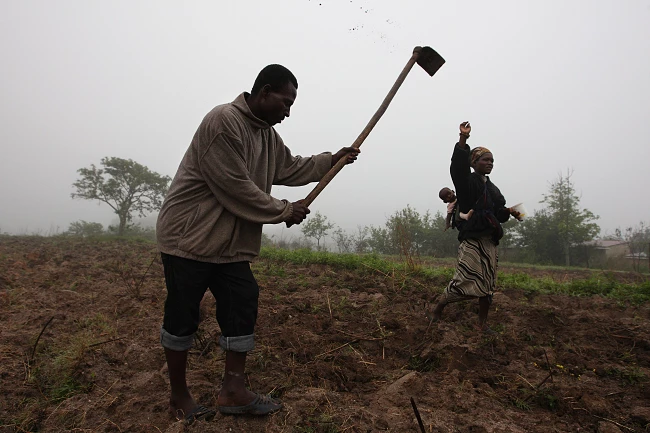
The secretary-general of the Ministry of Agriculture and Rural Development, Malam Cassamá, pointed out, in his speech on behalf of the minister in charge, that food insecurity “is increasing in Guinea-Bissau,” citing a survey published last March.
The official noted that this is due to the Covid-19 crisis, the conflict in Eastern Europe, the low price of cashew nuts – the main agricultural and export product in Guinea-Bissau – and the increase in prices of basic necessities.
PAUSA “was set up to help Guinean farmers as a response to the crisis caused by the covid-19 pandemic and the war in Ukraine,” said Luís Ialá to justify the importance of the project launched today in Bissau.
The PAUSA coordinator pointed out that the project should have been implemented between 2022 and 2023, but delays in signing the documents meant that it is only now being initiated.
Specifically, the project will provide seeds, fertilizers, and agricultural equipment to the beneficiaries, a task that the president of the National Association of Farmers of Guinea-Bissau (ANAG), Jaime Boles, fears may be late considering the proximity of the rainy season, officially starting in May.
“We know we are running against time,” emphasized the PAUSA coordinator, but pointed out that the monitoring committee already has information about the companies that supply equipment and entities that sell agricultural seeds.
Luis Ialá mentioned that the project intends to acquire the seeds, fertilizers, and equipment necessary for the project in Guinea-Bissau.
President of the Follow-up Committee and former Guinean Minister of Agriculture, Rui Nené Djata, said the “project is well designed and will go well.
To the concern of those present that the seeds could be made available out of time to be used in the next agricultural campaign, Nenê Djata said that “if it is the case, they will be used in the next harvest.
Isabel Almeida of the non-governmental organization Alternag, which also works with farmers, urged the need to align the project schedule with that of Guinean farmers and the profile of people who “really should benefit” from the project.
Several NGO officials working with farmers called for the project to be extended beyond the 12 months, which they consider “short for the needs.
With information from Lusa
This article was produced by The Rio Times’ automated newsroom system. How we use AI · Report an error
Read More from The Rio Times