Guatemala Rains: Villa Hermosa Told to Evacuate as Pinula River Eats Away Homes

WEATHER · GUATEMALA
Key Facts
- —The country Guatemala, in Central America. Villa Hermosa is a riverside neighbourhood of San Miguel Petapa, a municipality on the southern edge of Guatemala City.
- —What happened Guatemala rains on 3 October swelled the Pinula River. Conred, the national disaster agency, urged residents to evacuate, and the local bridge was closed (La Hora, Infobae).
- —The numbers Conred counted 206,500 people affected, 23,741 evacuated and 19 dead this rainy season, as of 3 October at 07:00 (via República).
- —What it means for you The Villa Hermosa bridge is shut in both directions. Conred advises staying away from swollen rivers; its emergency line is 119.
- —Still open How the Constitutional Court rules on the mayor’s petition, due to be heard on 4 October, and whether families will be relocated.
Guatemala rains swelled the Pinula River on Saturday, 3 October, and pushed the disaster agency to urge a whole neighbourhood to leave. Conred called on residents of Villa Hermosa, in San Miguel Petapa, to evacuate to safe places, La Hora reported.
Authorities closed the bridge linking the area with Boca del Monte after the river undermined its foundations, Infobae reported. Many families have stayed put, saying they have nowhere else to go.
A river eating into homes
The trouble did not start this weekend. In the week of 22 September, the current undercut houses in sectors 2 and 4 until they collapsed, La Hora reported.
A Conred report cited by the mayor puts 250 to 300 homes at high risk or already damaged, Infobae reported. That figure has not been published by Conred itself.
Soy502 spoke to Carlos Figueroa of Villa Hermosa II, whose house was split in two. “I have nowhere to go,” he said, as rain kept entering the ruined rooms.
The area has carried a formal high-risk declaration since 2001, under high-risk declaration 179-2001. Infobae cites the disaster agency as saying successive governments knew of the danger without a lasting fix.
Not El Niño, a monsoon trough
The downpours came as Insivumeh, the national weather and seismology institute, confirmed an El Niño phase on 3 October. El Niño usually means less rain in Guatemala, not more.
According to La Hora, Insivumeh links the rain to a monsoon trough near the Pacific coast and troughs over the Gulf of Mexico. In some regions, El Niño has cut rainfall by about a third.
The institute measured 55.6 millimetres of rain in Guatemala City on 4 October and warned of more. Its maps show topsoil saturation of 60 to 100% across much of the country.
That dry backdrop has already hit power supply, as covered in Guatemala Drought Cuts Hydropower to 22.2% of Supply. The regional picture is in El Niño Splits Latin America Into Winners and Losers.
Guatemala rains: the season so far
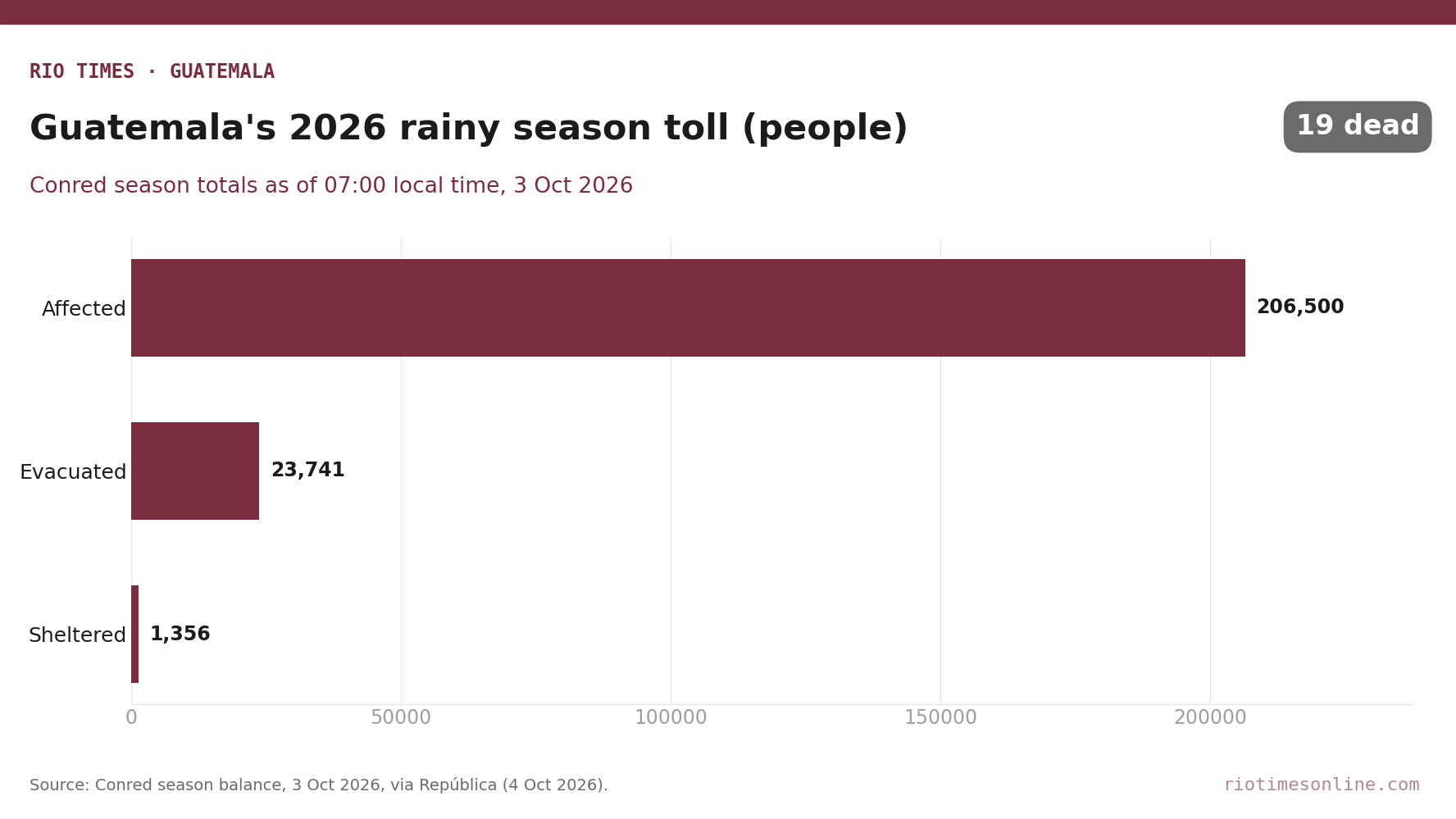
Conred’s season balance, as of 07:00 on 3 October, lists 1,871 emergencies and 206,500 people affected, República reported. It counts 23,741 people evacuated, 1,356 in shelters, 19 dead, one missing and 42 injured.
Floods are the most common incident, with 524 cases, ahead of 316 fallen trees. A week earlier, on 27 September, Emisoras Unidas had reported 1,758 emergencies and 18 deaths.
Nationally, the pace of new damage from the Guatemala rains has eased. In the 24 hours to Sunday, Conred handled 15 emergencies, with four evacuated and no deaths, state news agency AGN reported. By Sunday, Conred’s season tally since 19 April had reached 1,892 emergencies, 528 of them floods.
In nearby Mixco, a new sinkhole opened in the Pablo VI neighbourhood on 3 October, the third in that sector. The road was closed again and one house is at risk, Infobae reported.
The mayor takes the state to court
San Miguel Petapa mayor Mynor Morales filed an amparo, a constitutional petition, against President Bernardo Arévalo and several government bodies. He wants affected families compensated or relocated, Infobae reported.
The Constitutional Court was due to hear it at 13:00 on Sunday, Prensa Libre reported. Morales blames drainage from upstream municipalities such as Santa Catarina Pinula and Villa Canales, according to Publinews.
Morales says the municipality has built rock embankments with its own money since 2020. Crews were again placing stones on Sunday to hold the bank, Soy502 reported.
What Is Not Yet Known
It is unclear how many people actually left Villa Hermosa after the call, and how long the bridge will stay shut. None of the reports cited deaths in the neighbourhood.
The court’s decision on the mayor’s petition had not been reported by Sunday evening. Who pays for relocation, if it happens, is also open.
Sources: La Hora (Conred evacuation call, 3 Oct); La Hora (Insivumeh on rain and El Niño, 4 Oct); La Hora (El Niño confirmed, 3 Oct); Soy502; República (Conred season balance); Infobae; Prensa Libre; Publinews; AGN; Emisoras Unidas (27 Sep count). 3–4 October 2026 unless stated.
Editorial responsibility: Matthias Camenzind, Editor-in-Chief · Editorial standards · Report an error