US Stocks Drop 3.7% as Fed Rate-Hike Bets Grow | Global Economy, Nov 23
The global stock selloff deepened as Wall Street hit a six-month low and the Fed eyed more rate rises. What it means for Latin America this week.
Key Facts
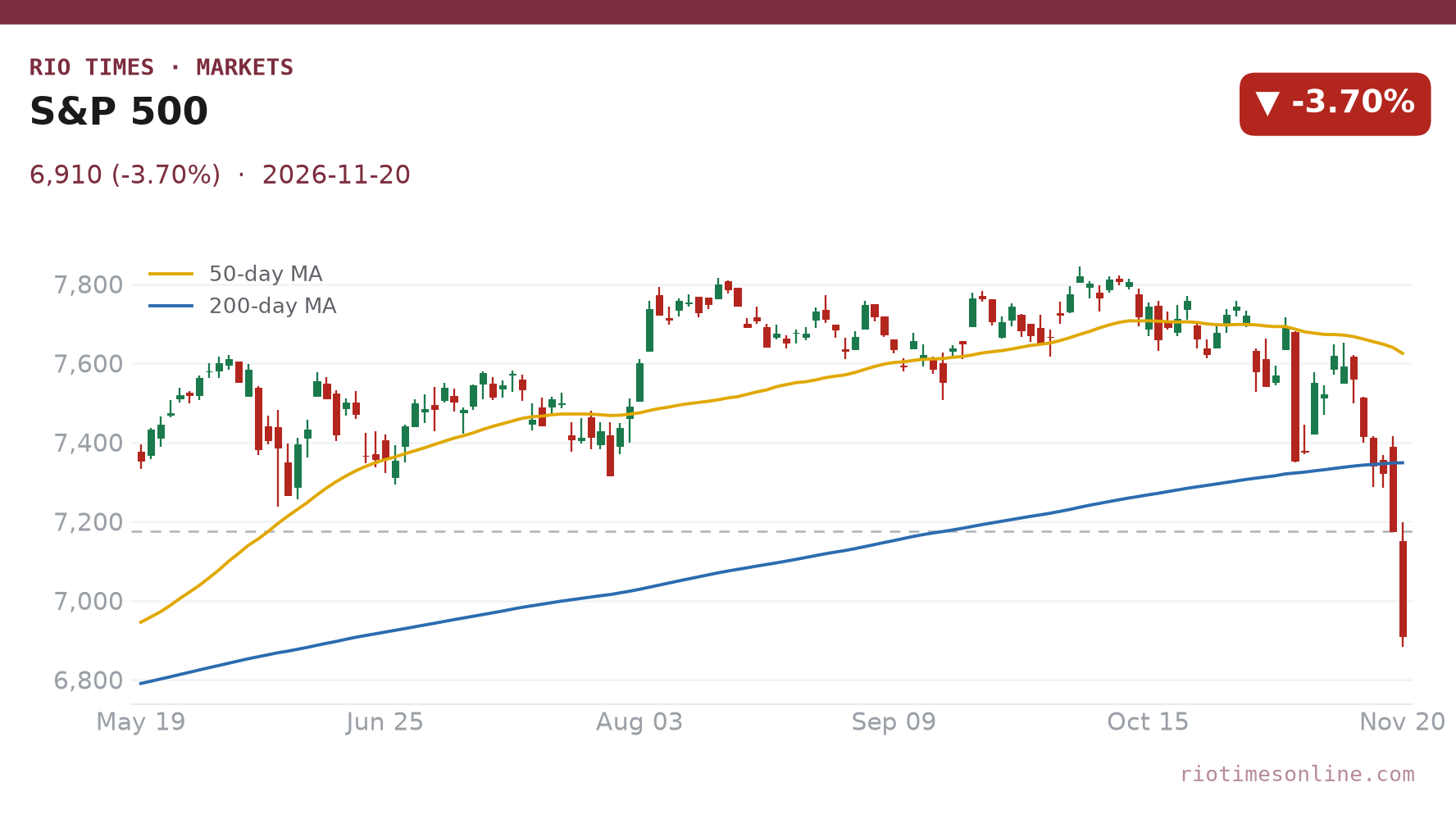
- Seven straight daily losses have pushed US stocks to their lowest close in at least six months, leaving the S&P 500 (the broad index of 500 large American companies) at 6,910, which is 11.6% below its 6 October high of 7,819.
- Wall Street’s fear gauge, the VIX, jumped 26.20% in one session to 35.89, its highest level since April 2025 and a sign that investors are paying up for protection.
- The Federal Reserve’s October minutes showed nearly all policymakers expect more rate rises, so the argument at America’s central bank is now about the size of the next hike, not whether it comes.
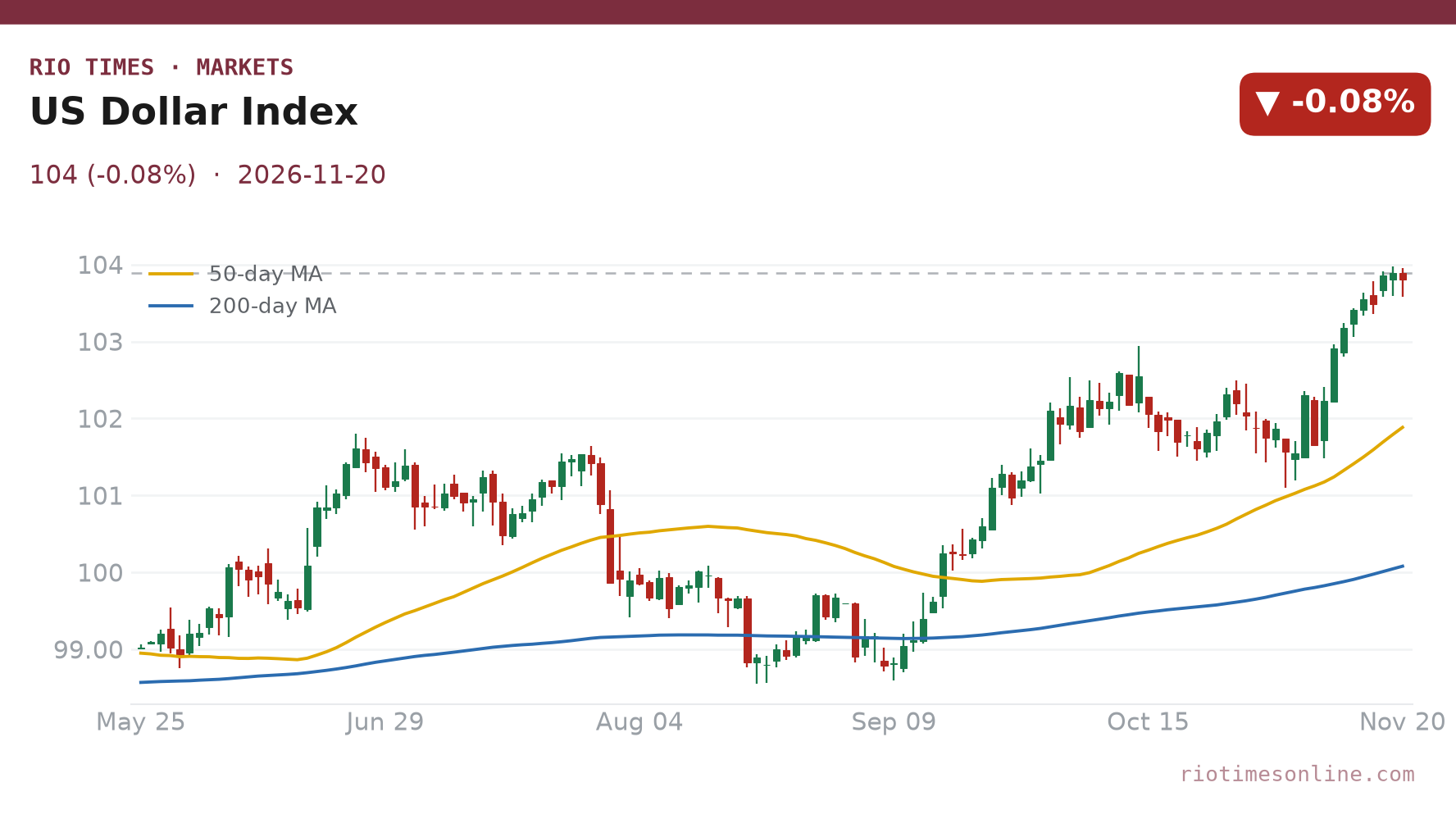
- The US 10-year Treasury yield, the benchmark cost of government borrowing, fell 10 basis points to 4.944%, while the dollar index barely moved at 103.807, a mix that says investors are running for safety.
- Gold fell 2.25% to US$3,526 an ounce and silver fell 3.38% to US$41.125, which suggests even traditional havens were sold to raise cash.
- Prediction markets: Polymarket puts a December Fed rate rise at the start of every leading path for December to March (US$41,720 traded, 22 November, 11:13 pm ET).
Today’s Focus
Wall Street has lost its footing, and the rest of the world has to decide whether it is a stumble or a fall. The S&P 500 has dropped seven sessions in a row and closed at its lowest level in at least six months, while the Nasdaq, the tech-heavy index, fell 5.28% on Friday alone.
The backdrop is a sharp change of mind about interest rates. The Fed’s October minutes, published on Wednesday 18 November, showed nearly all policymakers expect more rate rises, which makes borrowing dearer for companies and households and cuts the value investors put on future profits.
This is a new phase, not a continuation. The S&P 500 is down 9.36% over 20 sessions, and the Nasdaq is 18.1% below its 6 October high of 27,600.
Sellers have not yet broken the lows of last spring. The S&P 500 sits 8.9% above its 30 March low of 6,344, and that is the level the whole market is now watching.
What matters today. The world’s most important stock market is falling because the Fed may raise rates again, and the next test is Wednesday’s US inflation reading.
| Instrument | Level | Session |
|---|---|---|
| S&P 500 (US) | 6,910 | -3.70% |
| USD/BRL | 5.949 | +0.24% |
Source: market close, 20 November 2026.
01 The world in one read
Wall Street ended last week like a ship that has just met a storm it did not see coming — battered, and still rolling. The S&P 500 fell 3.70% on Friday, its seventh straight daily loss, and the Nasdaq fell 5.28%.
The backdrop is a change of mind about interest rates. The Fed’s October minutes, published on federalreserve.gov on Wednesday 18 November, showed nearly all policymakers expect more rate rises.
Investors had been betting on cuts. Now the debate is over how large the next hike should be, and shares that were priced for cheap money are paying for it.
Europe and Asia get their first clean read on the damage when trading resumes this week. Germany’s Ifo business survey, a closely watched gauge of company sentiment, lands on Tuesday.
The evidence points to a repricing of the rate path rather than a collapse in the economy. Falling bond yields and a steady dollar are what investors do when they want safety, and the sell-off in gold looks like forced cash-raising rather than a verdict on growth.
History says sharp falls like this often bounce, but not always. The variable to watch is Wednesday’s PCE inflation reading, because a hot number would make a bigger Fed hike harder to dismiss.
02 The global board
| Instrument | Level | Change | Read |
|---|---|---|---|
| S&P 500 | 6,910 | −3.70% | Seventh straight fall; lowest close in at least six months |
| Nasdaq | 22,618 | −5.28% | Tech and chip shares bore the brunt |
| Dow Jones | 48,147 | −1.93% | Older industrial names fell less |
| VIX fear gauge | 35.89 | +26.20% | Highest since April 2025 |
| US 10-year yield | 4.944% | −2.06% | Haven buying despite hike talk |
| Dollar index | 103.807 | −0.08% | Steady, not the cause |
| Gold | US$3,526/oz | −2.25% | Sold alongside shares |
| Oil (USO fund) | 139.63 | +1.12% | Small bounce after weekly losses |
Read the table from the top: the loss is widest where the hopes were highest. The Nasdaq fell more than the Dow because technology shares carry the most future profit, and future profit is what higher rates erode first.
The oddity is in the lower rows. Yields fell, the dollar held, and gold dropped — a pattern that looks more like panicky selling of everything than a tidy rotation. Rio Times · Live Market Intelligence
Live Market IntelligenceGlobal Markets — Live Board
Global Markets — Live Board
Instrument Last Change YoY Prev. High Low Volume
SPX
6,910
-3.70%
—
—
—
—
—
NDX
25,029
-5.61%
—
—
—
—
—
DJI
48,147
-1.93%
—
—
—
—
—
RUT
2,582
-2.76%
—
—
—
—
—
US10Y
4.9120
-2.77%
—
—
—
—
—
VIX
35.89
+26.20%
—
—
—
—
—
DAX
24,803
-2.60%
—
—
—
—
—
FTSE
10,346
-1.02%
—
—
—
—
—
CAC
7,928
-1.89%
—
—
—
—
—
STOXX
625.65
-2.00%
—
—
—
—
—
NIKKEI
56,437
-5.06%
—
—
—
—
—
HSI
22,267
-0.64%
—
—
—
—
—
KOSPI
4,719
-3.11%
—
—
—
—
—
CSI300
3,930
-0.62%
—
—
—
—
—
NIFTY
25,635
-0.64%
—
—
—
—
—
TSX
33,190
-2.47%
—
—
—
—
—
GOLD
3,607
+2.61%
-11.89%
3,515
3,630
3,552
44,573
SILVER
42.05
+2.46%
-16.40%
41.03
42.43
41.40
17,937
03 The main event — rate-hike fears turn a wobble into a rout
The first factor is the Fed. Its October minutes showed nearly all policymakers expect more rate rises, so the market has had to throw out its hopes of cuts. Confidence: medium.
The second factor is the unwinding of a crowded tech trade. The Nasdaq is 18.1% below its 6 October high, it has lost 10.02% over five sessions. Confidence: medium-high.
The third factor is positioning. When the VIX jumps 26.20% in a day and gold falls with shares, funds are usually cutting risk everywhere at once, not making a considered call. Confidence: medium.
The usual drivers disagree with the move, and that is worth saying plainly. The 10-year yield fell 10 basis points and the dollar index slipped 0.08%, so this was not a bond or currency shock; it looks like a stock-led scramble for safety.
History offers no promise: sharp falls have been followed by both rebounds and deeper losses, so the price levels below matter more than the pattern.
The chart levels are simple. The S&P 500 has support at its 30 March low of 6,344 and faces resistance at the round 7,000 mark and then its 7,819 peak, while the Nasdaq’s support is its 30 March low of 20,795.
04 Policy and data
The Fed is the story, and its own minutes are the best evidence. Nearly all policymakers expect more rate rises, which is why markets are now reading every inflation number for how hard the next move will be.
Friday’s other data fitted the cautious mood. The University of Michigan’s US consumer sentiment index was 51.5 (consensus 51.5, previous 48.0), its one-year inflation expectations eased to 3.7% from 4.7%, and its five-year expectations slipped to 3.3% from 3.5%. Euro-zone consumer confidence improved to -16.9 (consensus -18.0, previous -17.9), UK Retail Sales rose 0.7% in October (consensus 0.0%) and 2.3% year on year (consensus 1.7%, previous 0.4%), and UK Retail Sales ex Fuel rose 0.9% (consensus -0.1%), while Mexico’s Retail Sales fell 0.3% in September (consensus -0.3%, previous +1.2%); all from the RT economic calendar (RT, 20 November).
The flash S&P Global Manufacturing PMI, Services PMI and Composite PMI (purchasing managers’ surveys) for November land today: euro zone at 4:00 am ET (consensus 52.8, 51.8 and 51.9), UK at 4:30 am ET (53.0, 53.0 and 53.1) and US at 9:45 am ET (consensus 54.5 manufacturing and 55.6 services), per the RT economic calendar.
The key date is Wednesday 25 November, when the October PCE inflation data arrives. PCE is the price index the Fed prefers over the better-known consumer price index.
Tuesday brings the Conference Board’s (a US business research group) US consumer confidence reading, expected at 92.5 against 91.7 before. The same day, Germany’s Ifo business climate is expected at 90.5 against 90.2, a small test of whether Europe is feeling the US chill.
The US Treasury also sells five-year notes on Tuesday, and weak demand there would push borrowing costs up and add pressure on shares.
05 Commodities and currencies
Oil has been a quiet relief. The oil fund USO rose 1.12% on Friday but is down 4.09% over five sessions, and crude has now had three straight weekly losses.
Cheaper oil is good news for fuel-importing countries and a headache for producers. It also eases the inflation worry that is driving the Fed, though supply fears around the Strait of Hormuz, the narrow oil route out of the Gulf, keep recurring.
Gold is the surprise. It fell 2.25% to US$3,526 an ounce and silver fell 3.38% to US$41.125, which says investors sold what they could, not what they wanted to.
The dollar index at 103.807 moved only 0.08% lower, which means the dollar is holding its year-to-date highs rather than driving the fall.
06 The Latin American read-through
Latin America feels this through the dollar and through risk appetite. The dollar rose against every major regional currency on Friday: Brazil’s real weakened to 5.949 per dollar, up 0.24%, and Mexico’s peso to 19.1625, up 0.41%.
The Chilean peso weakened to 1,023 per dollar, up 0.60%, and Colombia’s peso took the sharpest hit at 3,429, up 2.14%. Argentina’s peso slipped to 1,580, up 0.95%.
Local shares were quiet by comparison: Mexico’s IPC slipped 0.12% and Chile’s IPSA rose 0.16% (RT, 20 November close).
The weaker real is the one to note for Brazilian importers and travellers, because the dollar is at the top of its 12-month range. Dollar-linked debt and holiday spending abroad both get dearer.
Mexico publishes growth data today and mid-month inflation on Tuesday, expected at 3.92% against 3.62% before. That reading will test whether Banxico, Mexico’s central bank, has room to ease while the Fed leans the other way.
What Prediction Markets Say
On Polymarket, a crypto-based prediction market, the Fed-decisions market for December 2026 to March 2027 prices “hike, pause, hike” at 30.5%, “hike, hike, pause” at 23.0%, “hike, hike, hike” at 20.0% and “hike, pause, pause” at 14.5%, so every leading path starts with a December rate rise (US$41,720 traded, as of 22 November 2026, 11:13 pm ET). These prices are real-money bets, not polls.
Why we show this: prediction markets turn real-money bets into a live probability that moves within minutes of the news, which is why investors, campaigns and newsrooms in the United States now follow them closely. We show them next to polls and official results, never instead of them.
07 What to watch
- PCE inflation, Wednesday 25 November: The Fed’s favoured price gauge decides how big the next hike could be, and a hot number would deepen the rout.
- S&P 500 at 6,344: The 30 March low is the line between a sharp correction and a deeper bear market.
- Day after Thanksgiving, Friday 27 November: The NYSE (New York Stock Exchange) closes at 1pm New York time, so thin trading can exaggerate moves.
Background: Wall Street Drops 3.7% as AI Stocks Crack.
Background: Wall Street Falls 2% as Fed Hike Fears Grow.
Frequently Asked Questions
Why are US stocks falling?
The Fed’s October minutes showed nearly all policymakers expect more rate rises, which hurts shares priced for cheap money. Tech stocks and a crowded trade made the fall steeper.
How bad is the sell-off in context?
The S&P 500 is 11.6% below its 6 October high and has fallen seven sessions in a row. The Nasdaq is 18.1% below its own 6 October high.
Does a fall like this usually continue?
No one can say. The S&P 500 is 8.9% above its 30 March low of 6,344, which is the level traders are watching, and history is not a forecast.
What does it mean for Latin American investors?
A firmer dollar and weaker risk appetite hit regional currencies, with Colombia’s peso worst on Friday. Brazil’s real is near its weakest in 12 months.
Market data: The Rio Times
This article was produced by The Rio Times’ automated AI newsroom. Editorial responsibility: Matthias Camenzind, Publisher and Editor-in-Chief. The Rio Times also runs Ask Rio Times, which answers from 100,000+ of our own articles, the daily Latin America Power Map, and prediction-market odds on elections and markets.. How we use AI · Report an error
LatAm Markets: Live Signals → — real-time movers, turnover leaders and FX across Latin America.