For vice-president Mourão, Brazil will only get money if it proves it has reduced deforestation
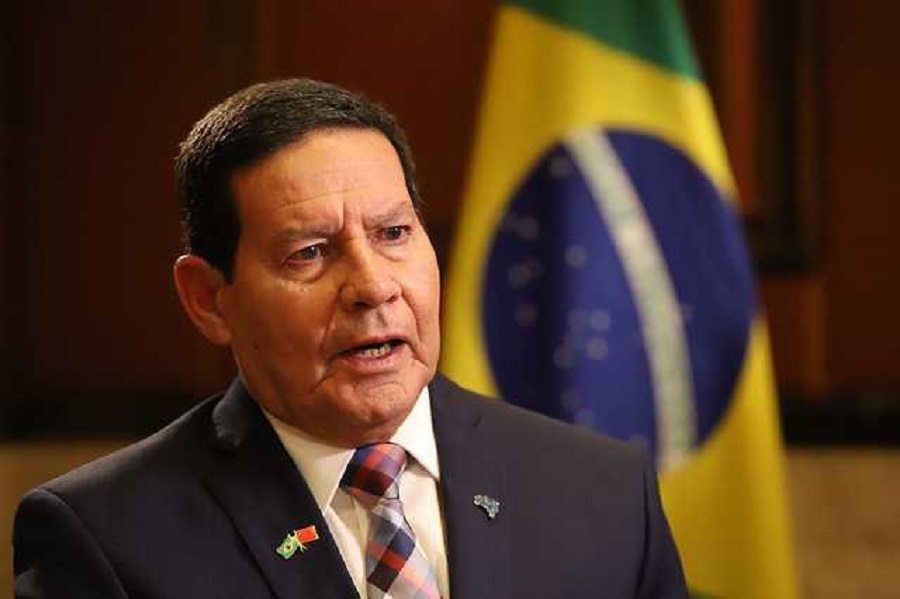
RIO DE JANEIRO, BRAZIL – As president of the National Council for the Legal Amazon, a body established in February last year at the height of the worst forest fires in recent decades in the country, vice-president Hamilton Mourão is skeptical that the U.S. government and the European Union will be able to provide resources to Brazil while the country does not demonstrate, with figures, its commitment to reducing deforestation.
American president Joe Biden promotes a meeting with 40 heads of state on the 22nd to discuss the climate agenda. Environment minister Ricardo Salles, is betting all his chips in getting US$1 billion of foreign aid for Brazilian forests in this meeting and thus ensure his permanence in office. He wants money to avoid deforestation.

Mourão, however, thinks that the order is reversed. He says that nobody will give money to Brazil before July, when the data from Prodes, the satellite monitoring of deforestation in the Amazon forest conducted by the National Institute for Space Research (INPE), are released.
“I don’t believe Biden is going to release money to Brazil now.”
The vice president is still skeptical about the increase of the National Force in the surveillance of the Amazon, as Salles intends. The agenda is the background for the friction between the minister of the Environment and the chief of the Federal Police in the Amazon, Alexandre Saraiva.
The final straw in their dispute was the seizure by the Federal Police of 150,000 cubic meters of wood (equivalent to 40,000 logs) between the borders of Pará and Amazonas. Salles criticized the seizure and Saraiva said that it was due to irregularities in the Rural Environmental Registry (CAR) that ignored the Permanent Preservation Areas (APP).
“The Federal Police will not pass the herd,” Saraiva told “Folha de S.Paulo”. This friction would have led Salles to favor the National Security Force over the Federal Police starting April 30, when Operation Verde, which led the Armed Forces to act in the prevention of fires and deforestation in the region, comes to an end.
The vice-president of the Republic even received the loggers’ group in his office, together with the leaders of the Federation of Industries of Pará. He asked the Federal Police to give them the opportunity to present the documentation of the logs that they say are regularized, which, so far, has not been done.
“The seizure is based on false documents. If there is no presentation of a legal record of the extraction of this wood, it is difficult to release it,” he says. Mourão doesn’t see how the National Security Force, made up of military police from the states, can solve the imbroglio. Not only because it is the responsibility of the Federal Police to investigate environmental crimes in federal areas, but also because the National Force lacks manpower and money. Operation Green, by the Armed Forces, for example, will cost R$400 million by the end of this month.
The intention already expressed by Salles to use one third of foreign resources to fund the National Force is feared by non-governmental organizations that operate in the region as part of the project to strengthen Bolsonarist cells in the Military Police.
Any intention in this direction, in the opinion of the vice-president, runs into three obstacles. The first is the difficulty for any donation to be released before July. The second is that the allocation of eventual donation resources will be made by the National Council of the Legal Amazon, which, besides the vice-president, is composed of 15 ministers. The third is that, with the spending cap in place, the donations will be subject to it.
For this reason, both Mourão and the consortium of Amazon governors have defended that any donations should be made to the states, whose budgets are not subject to the ceiling.
Salles has taken advantage of the closeness of President Jair Bolsonaro to the American ambassador Tod Chapman to try to release these resources. The ambassador, appointed by former U.S. President Donald Trump, has not yet been replaced. The change of government, however, has made him subject to the new guidelines of American policy.
With an eye on these new guidelines, the governors of the nine states of the Legal Amazon met with the American ambassador to try to make him aware of the sustainable development projects being developed by the states.
Even though there is a predominance of governors allied to the Bolsonaro party in the consortium, the expectation of new money in the current situation of fiscal restriction has kept the states united in the expectation that it is the subnational entities and not the federal government that will be the recipients of these resources.
New money would be welcome not only because of the absence of resources for the recovery of degraded areas and environmental management but also because of the difficulty of sending police officers to join the National Security Force in states where public security absorbs all the demand for such personnel.
The participation of large businessmen in initiatives such as the Business Dialogue, which brings together names like Guilherme Leal (Natura), Candido Bracher (Itaú), and Marcos Molina (Marfrig), dilutes the prospect of a clash between governors and the federal government on the issue, broadens the alliance in defense of the Amazon and isolates the “pass the buck” mentality that prevails in sectors of the root Bolsonarism to which members of the government like Salles and the Secretary of Land Issues Nabhan Garcia, are linked.
Source: Valor
More: Brazil news in English, every day from The Rio Times.
This article was drafted with automated assistance and reviewed before publication. How we use AI · Report an error · Editorial responsibility: Matthias Camenzind, Editor-in-Chief