Costa Rica Rises in PISA, Reading and Maths Flat

EDUCATION · COSTA RICA
Key Facts
- —The country Costa Rica, in Central America, has taken part in PISA, the OECD’s international test of 15-year-olds, since 2010.
- —What happened Results published on 8 September 2026 show science up 13 points to 424, a statistically significant gain. Reading (416) and maths (387) were unchanged from 2022, the OECD says.
- —The numbers Among 13 Latin American countries, Costa Rica ranks third in science and reading and fourth in maths, one place up in each, La Nación reported on 3 October.
- —What it means for you Only 30 percent of Costa Rican students reach baseline maths proficiency, against an OECD average of 65 percent; in reading it is 53 against 69 percent (OECD, 2025 data).
- —Still open Whether the science gain holds in the next PISA round, and what the Education Ministry does about maths and reading, where scores remain below their 2010–2018 levels.
Costa Rica PISA 2025 results lift the country one place in the Latin American table in all three subjects tested. A data column in La Nación on Saturday 3 October argues that the scores themselves tell a narrower story.
Only science clearly improved, rising 13 points to 424, according to the OECD (Organisation for Economic Co-operation and Development). Reading and maths moved by one and two points, which the OECD treats as no change.
Why Costa Rica Climbed the Table
PISA, the Programme for International Student Assessment, tests 15-year-olds in reading, maths and science. The 2025 round, published on 8 September, covered 91 countries and economies.
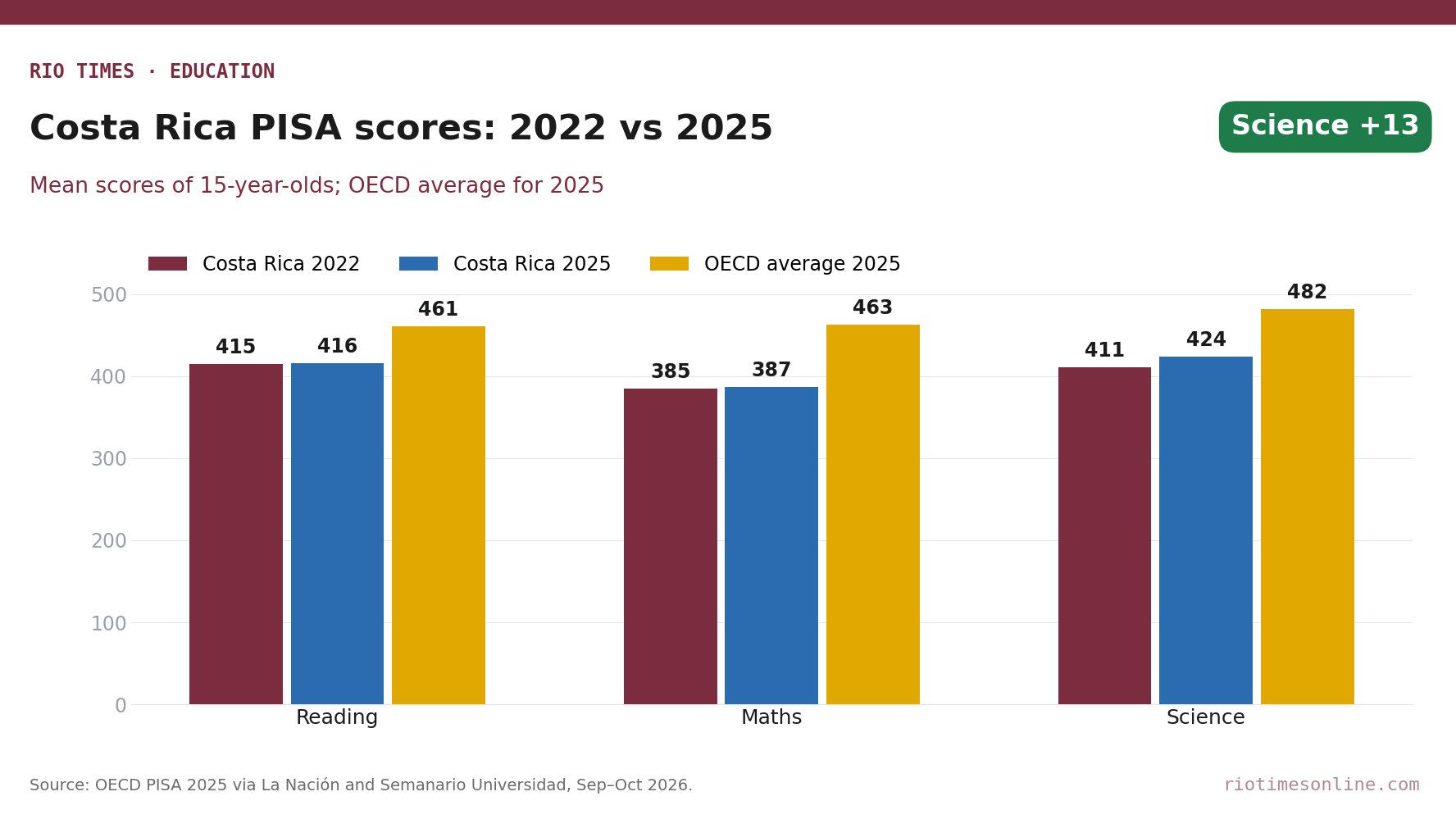
Costa Rica’s science average rose from 411 to 424, the only change the OECD rates as statistically significant. Reading went from 415 to 416, and maths from 385 to 387.
Columnist Andrés Fernández Arauz writes in La Nación that the ranking gains came largely from neighbours slipping. In reading, Mexico fell from 415 to 408 and dropped below Costa Rica.
In maths, Peru fell from 391 to 382, according to the same analysis. Costa Rica moved up without a measurable improvement of its own in either subject.
A Statistical Tie in Maths
In maths, Costa Rica scored 387, Mexico 388, Peru 382 and Colombia 381, La Nación reports. Once statistical uncertainty is considered, the four results cannot be told apart with confidence.
Calling Costa Rica fourth describes the order of the averages, not a real gap, the column argues. In 2018 the country also ranked third in reading and fourth in maths, with higher scores of 426 and 402.
Where the Science Gain Is Real
Science is a different case. Costa Rica moved past Colombia and Mexico, both on 414, while Chile and Uruguay remain above 440, according to La Nación.
The Education Ministry (MEP) calls the result historic, the first statistically significant improvement in the subject. It says Costa Rica is one of three OECD members, with Slovakia and Türkiye, that avoided a fall in every subject.
The OECD adds context that softens the longer decline. Between 2015 and 2025 more 15-year-olds became eligible for the test, despite a shrinking age group, which suggests higher secondary enrolment.
The OECD links part of the drop in reading and maths to students from marginalised groups now staying in school. It says results for more advantaged students did not decline.
How Far Behind the OECD Average
The gaps remain wide, Semanario Universidad and Delfino.cr report. Costa Rica PISA 2025 scores sit 45 points below the OECD average in reading, 76 in maths and 58 in science.
Only 30 percent of Costa Rican students reach the baseline Level 2 in maths, against 65 percent across the OECD. In reading the shares are 53 and 69 percent, and in science 56 and 74 percent.
Education Minister Leonardo Sánchez said Costa Rica “held steady” compared with 2022, Semanario Universidad reported. Across the region the picture is weaker, as PISA 2025: Argentina’s Worst Result Since 2006, Chile Slips set out on 8 September.
The results also land amid labour tension in schools, covered in Costa Rica Teachers Strike Over Pay Shortfall. The test itself was taken in 2025, before the current dispute.
What Is Not Yet Known
It is not yet clear whether the science gain will hold in the next PISA round, or what drove it. The MEP points to reforms such as a revised national exam, but has not shown that these caused the result.
Ecuador took part in 2025 but not in 2022, while Panama took part in 2022 but not in 2025, which changes the regional table slightly. La Nación says Costa Rica’s positions hold when only the 12 countries present in both rounds are compared.
Sources: La Nación (Andrés Fernández Arauz), 3 October 2026; OECD, PISA 2025 Results Volume I, Country Note Costa Rica, September 2026; Ministry of Public Education (MEP), 8 September 2026; Semanario Universidad, September 2026; Delfino.cr, September 2026.
Editorial responsibility: Matthias Camenzind, Editor-in-Chief · Editorial standards · Report an error