What is Vaca Muerta, the mega oil and gas reserve in which Brazil will invest?
By Juliana Estigarríbia
Vaca Muerta was an unknown name in Brazil until a few weeks ago.
Argentina’s mega natural gas reserve came to light after the Brazilian government said that Brazil’s National Bank for Economic and Social Development (BNDES) would finance the new section of the Néstor Kirchner Gas Pipeline so that the input can supply the Brazilian market.
For Argentina, the plan is to obtain financing at attractive interest rates to extract gas from one of the country’s largest reserves; for Brazil, it is to reduce dependence on the input imported from Bolivia.

President Lula recently defended the BNDES loan for the project.
But, in the end, does it make sense for the Brazilian economy, given its estimated US$690 million credit?
In theory, the plan is viable. In practice, however, there are doubts about the costs, the project’s execution time, and even the product availability for Brazil, given that Argentina is a large consumer of gas in winter, even becoming an importer in the coldest seasons the year.
This is what experts consulted by Bloomberg Línnea recently said.
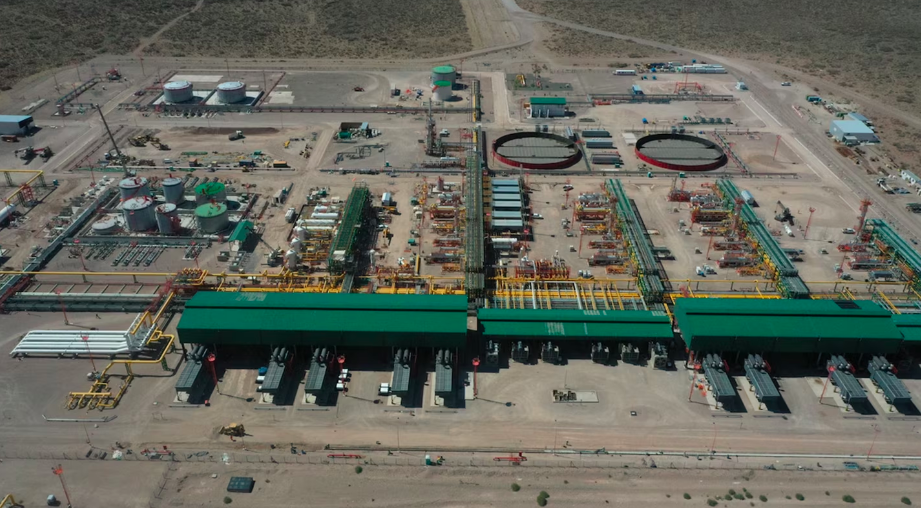
Vaca Muerta is an extensive area with unconventional oil and gas (shale) in the province of Neuquén, in western Argentina, with several fields in production and contracts with different operators.
The field’s production is estimated to reach a maximum of 1.2 million barrels of oil equivalent per day (boed) in 2033.
For comparison purposes, Petrobras’ total production in the fourth quarter of 2022 reached 2.64 million boed.
According to the specialized consultancy Wood Mackenzie, total hydrocarbon production in Vaca Muerta reached a record of 706 thousand boed in June 2022.
A relevant part of this production is exploited by the Argentine state-owned company YPF (YPF).
Still, foreign oil companies such as Shell (SHEL), Total (TTE), and ExxonMobil (XOM) are also exploring it, according to the Wood Mackenzie study.
The upstream research director for Latin America of the global consulting firm, Marcelo de Assis, explained that, due to the significant increase in production in the region, it is necessary to increase the transportation capacity of gas associated with production; otherwise oil volumes will be limited.
“Vaca Muerta production is increasing; that is why it is so critical that there is the construction of a new gas pipeline,” said the expert.
NÉSTOR KIRCHNER GAS PIPELINE
The projection is that the first section of the Néstor Kirchner gas pipeline, which will connect Neuquén with Buenos Aires, will be completed between 2023 and 2024.
A second section would take the input from the Argentine capital to the province of Santa Fe, where there is already a gas pipeline connection with Uruguaiana in the Brazilian state of Rio Grande do Sul (RS).
In the municipality, a thermal power plant is not on all year round, said the founding partner of the Brazilian Infrastructure Center (CBIE), Adriano Pires.
“To be economically viable, the project to distribute gas from Vaca Muerta to Brazil necessarily requires a connection from Uruguaiana to Porto Alegre, where the so-called anchor consumers are, who demand gas all year round,” he said.
In addition to hosting the Triunfo petrochemical pole, Porto Alegre (capital of RS) could have a new thermal power plant, according to the expert, who was even invited to chair Petrobras last year but turned it down.
“It is also possible to use the new infrastructure to the existing gas pipeline between Brazil and Bolivia, which would allow gas to be transported to the states of Santa Catarina and Paraná.”
According to Pires, integration in the gas area between Brazil, Bolivia, and Argentina is an old dream of the sector and of the governments involved.
“The project makes a lot of sense; the problem is that Argentina and Bolivia are unreliable partners,” he valued.
He also recalled that, in the past, the governments of both countries changed the rules of gas supply contracts to Brazil, with unpredictable price increases, threats of supply cuts, and the end of incentives for the production of the input, which ended up limiting the available supply.
“This integration never happens because there is no legal certainty or regulatory stability. With the change of governments, even in Brazil, suddenly the neighbor becomes an enemy”, he stated.
“The idea is good because we need gas, but if all these infrastructure works are not done, it makes no sense.”
According to the CEO of the specialized consultancy Gas Energy, Rivaldo Moreira Neto, the stretch of a gas pipeline from Uruguaiana to Porto Alegre would be about 600 kilometers long.
“We are talking about a project worth billions of reais.”
He further stated that the Argentine government’s plans to expand Vaca Muerta’s drainage infrastructure are not new and that the currency crisis has hindered the project.
“It is difficult to attract investment for the pipeline; tariffs were frozen for a long time. That is why the government looked to BNDES because there is no national capital or foreign interest for the project,” Moreira said.
ENERGY DIVERSIFICATION
Pires stated that the diversification of energy sources is something that has proven to be a necessity worldwide.
“The bigger the gas supply, the more competitive the Brazilian market. Especially after the war in Ukraine, we realized the magnitude of the problem caused by dependence on a single energy source,” he said.
With increased sanctions on Russia due to the conflict, European natural gas prices nearly tripled in a few months, demonstrating the region’s dependence on the Russian supply.
“We had the first oil crisis, the second, and now the natural gas crisis,” Pires said.
The alternative that has been gaining momentum in recent years is liquefied natural gas (LNG), which can be transported by ship.
However, for this option to be possible, it is necessary to have liquefaction (at origin) and regasification (at destination) plants.
In Brazil, there are LNG regasification terminals in the states of Ceará, Rio de Janeiro, Bahia, and Sergipe, and future operations in the states of Santa Catarina, São Paulo, and Pará.
In addition, there are studies for new plants in the states of Pernambuco, Espírito Santo, and Maranhão.
Tendências Consultoria oil and gas analyst Walter de Vitto said that a significant part of Brazil’s gas consumption comes from domestic production, in addition to Bolivia, which reduces dependence on ships for now.
“LNG is more expensive and serves to supplement supply.”
For Moreira, LNG should play an important role in the Brazilian market, but the international price context does not favor Brazilian competitiveness.
“If we want to buy LNG, we will compete with Europe. Whoever pays more will guarantee supply.”
BRAZILIAN PRE-SALT GAS
Pires said that although the option of Argentine gas is welcome, the priority should be Brazilian input, especially from the pre-salt.
According to the specialist, the volume of gas reinjection in the pre-salt (when the input is extracted in the production process but “returned” to the field) reaches almost 70 million cubic meters daily.
Moreira said that one of the main reasons for this reinjection is the lack of a consolidated and stable market, with demand throughout the year.
The solution, according to Pires, is to increase gas transportation capacity from the pre-salt to the Brazilian coast.
“To send gas extracted from ultra-deep waters to the coast, we need anchor consumers,” the expert said, citing the fertilizer, steel, and chemical industries, among others.
Assis said that some projects that will still have peak production in Brazil would aggravate the problem of a lack of gas transportation capacity locally.
“Some will have 100% reinjection.”
With information from Bloomberg
Read More from The Rio Times