Argentina’s rural population suffers from exposure to pesticides
By Daniela Gschweng*
People in pesticide-polluted areas of Argentina have a 2.5 times higher risk of dying from cancer than the population average.
That’s what researchers at the University of Rosario’s Institute of Social Environmental Health (InSSA) in Argentina found.
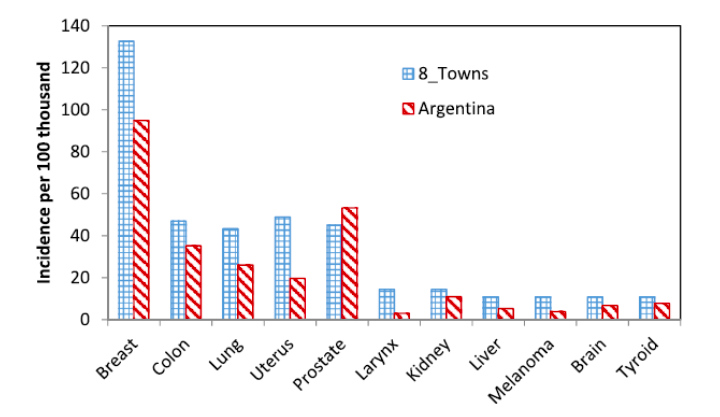
According to the study, the cancer rate in eight villages in the Santa Fe region is significantly higher than the Argentine average.

There are significantly more cancer deaths in the 15 to 44 age group. 2.48 times more women and 2.77 times more men died of cancer.
Cancer deaths as a percentage of all deaths are higher than the national average.
“HAS ANYONE IN THE HOUSE HAD CANCER IN THE PAST 15 YEARS?”
Medical students surveyed people from eight regional villages between 2014 and 2018.
They went door-to-door with the initial question, “Has any member of your household been diagnosed with cancer in the past 15 years?”
The eventual 28,000 respondents represent 68% of residents living up to 400 meters from the fields.
In the south of Santa Fe province, soybeans, sunflowers, wheat, and corn are the main crops grown.
Since the 1990s, Argentina has allowed the cultivation of genetically modified seeds.
Glyphosate and many other new pesticides have been used on a large scale since then.
Millions of liters are applied yearly, even near residential areas.
Country air is probably much unhealthier than urban smog throughout Argentina.
The study’s findings “suggested that living in small rural towns affected by nearby agricultural pesticide applications has negative health effects, particularly on cancer rates,” the researchers write in the paper published in Clinical Epidemiology and Global Health.
THE RURAL POPULATION HAS LONG STRUGGLED
Rural people in Argentina have long been fighting for stricter regulation of glyphosate and the like – or at least for existing laws to be respected.
The “Mothers of Ituzaingó” have been known throughout the country since the group successfully fought against the construction of a seed factory by Monsanto (now Bayer) near Cordoba.
Bayer and BASF generate half of their sales with pesticides, according to the Heinrich Böll Foundation. Among them are pesticides that have long been banned in Europe.
The resistance began when Maria Godoy’s daughter died of a kidney malformation, reports “Deutschlandfunk” in an audio report.
Children in the neighborhood had leukemia, and their mothers wore headscarves because of chemotherapy, Godoy says.
In 2012, there had already been 142 cancer deaths in the neighborhood.
Regulations on the use of pesticides were not being followed, he says.
Soybean was the main crop grown in Godoy’s neighborhood, with a lot of glyphosate being used.
Argentina has the highest per capita consumption of herbicide in the world.
Most of Argentina’s soybean crop is exported and is used mainly for animal fattening in other countries.
PESTICIDES HARM RURAL POPULATIONS WORLDWIDE
Argentina is not the only country where pesticides harm the health of rural populations.
This is the conclusion of a study published in January 2021 on the use of pesticides in developing countries.
Pesticides trigger respiratory and skin diseases.
They cause cardiovascular and gastrointestinal diseases, as well as neurological problems, lists a study commissioned by the European Parliament.
Those who live near treated fields face a higher health risk.
The harmful effects of pesticides on health are underestimated and often go undetected.
This is often because they only occur after a longer period.
The study covers Costa Rica, Brazil, South Africa, and Vietnam and criticizes that too little data is collected.
Pregnant women and children are particularly at risk.
In developing countries, incidents are more frequent because people know less about the toxicity of pesticides.
Farmers wear less protective clothing. DDT was found to be the most harmful pesticide, remaining in the food chain for decades.
WHEN HUNGER IS JOINED BY POISON
Pesticides in developing countries are also often used in the wrong places. For example, insecticides are used for cotton plantations in horticulture.
Another risk is pesticides used to treat seeds. Those who eat the seeds in scarce times poison themselves with them.
The EU study highlights another aspect of wasteful pesticide use: 20% of global suicides involve pesticides.
An estimated 800,000 people die each year from self-induced pesticide poisoning, especially in Asia.
Pesticide bans in Sri Lanka have dramatically reduced suicide mortality since the 1990s, demonstrated by a study published in 2017 in the journal The Lancet.
*Author’s subject-related commitment to interest: None
**Opinions expressed in articles on Infosperber are the personal assessments of the author
With information from Infosperber
More: Argentina news in English, every day from The Rio Times.
Editorial responsibility: Matthias Camenzind, Editor-in-Chief · Editorial standards · Report an error