
Key Facts
— Albemarle filed for environmental review of a $3.1 billion direct lithium extraction project in Chile’s Salar de Atacama, the largest lithium investment currently under review in the country
— The technology would nearly double lithium recovery while reducing net brine extraction, returning roughly 90% of processed brine to the salt flat
— The project would operate through 2045 without expanding authorized extraction volumes or requiring new evaporation ponds
— The filing comes as Chile reshapes its lithium sector through the Codelco-SQM joint venture NovaAndino Litio and a national strategy requiring state majority ownership in new projects
The world’s largest lithium producer has begun the environmental review for the biggest Albemarle Chile lithium investment in the country’s history, filing a $3.1 billion project to deploy direct lithium extraction technology at the Salar de Atacama. The Rio Times, the Latin American financial news outlet, examines what the filing means for Chile’s evolving lithium strategy and the global race to develop cleaner extraction methods.
How the Albemarle Chile Lithium DLE Works
The project, called TED (Transition to Direct Lithium Extraction), would integrate DLE technology alongside Albemarle’s existing solar evaporation methods in the Atacama. The company says the system can recover nearly twice as much lithium from each liter of brine while returning roughly 90% of processed brine back to the salt flat.
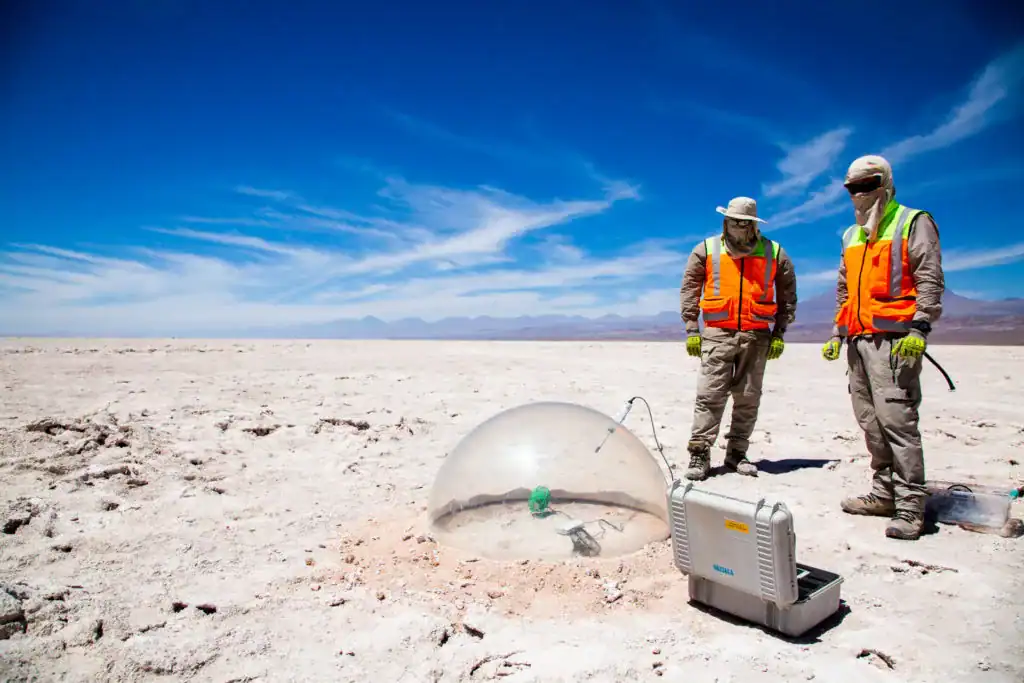
The plant would feature up to six processing circuits with a combined capacity of 300 liters per second. Net brine extraction would drop from the current 442 liters per second to 342 with the first circuit operating, and as low as 142 liters per second at full deployment. No new evaporation ponds or expanded extraction areas would be required.
A Decade of Research Behind the Filing
Albemarle completed validation of its DLE pilot plant in December 2025, logging over 3,000 hours of operation and achieving lithium recovery rates above 94%. Water reuse reached up to 85% during the validation phase, giving the company enough data to finalize its commercial design and submit the environmental filing.
If fully built, the project would have a useful life extending through 2045 — two years beyond Albemarle’s current extraction contract with the Chilean government. The total $3.1 billion price tag makes it the largest lithium investment currently under environmental review in Chile.
Chile’s Lithium Sector in Transition
The filing arrives at a pivotal moment for Chile’s lithium strategy. In December, state miner Codelco and SQM formally launched NovaAndino Litio, a joint venture that will control lithium production at the Salar de Atacama through 2060 under a model granting the state majority ownership.
Chile’s National Lithium Strategy, announced by President Boric in 2023, requires that all future projects operate through public-private partnerships with at least 51% state participation. Albemarle, whose contract runs until 2043, operates alongside SQM as one of only two lithium producers in the country.
Albemarle, whose contract runs until 2043, operates alongside SQM as one of only two lithium producers in Chile. Chile remains the world’s second-largest lithium producer but has been steadily losing market share to Australia, Argentina, and emerging African producers over the past decade. Output is projected to grow modestly in 2026, with SQM continuing to expand capacity even as global lithium prices remain well below their 2022 peaks.
The Water Question at the Heart of Chile Lithium
DLE’s appeal in Chile goes beyond efficiency. The Atacama’s extreme water scarcity has made lithium extraction a persistent source of tension between mining companies, indigenous communities, and environmental groups. Traditional evaporation ponds consume vast quantities of brine and have been blamed for lowering water tables in one of the driest places on Earth.
Albemarle’s promise to return 90% of brine and cut net extraction by up to two-thirds could reshape that debate — if the technology performs at commercial scale as it did in pilot testing. The environmental review through Chile’s SEIA system will determine whether the claims hold up under regulatory scrutiny, with community participation already underway before the formal filing.
This article was produced by The Rio Times’ automated newsroom system. How we use AI · Report an error · Editorial responsibility: Matthias Camenzind, Editor-in-Chief
In depth
Lithium in Latin America
- Lithium in Latin America 2026: Inside the Lithium Triangle
- Bolivia’s Lithium Explained for 2026
- Chile Lithium 2026: Deals, Policy Shift and Race to Stay No. 2
- Argentina Natural Resources Explained 2026
Read More from The Rio Times