
Rio Times Markets · Mexico
Key Facts
—Who. INEGI, Mexico’s statistics agency, tracks consumer prices every two weeks.
—What. Annual inflation rose to 3.62% in early October, from 3.42%, against a 3.6% forecast.
—Core. Core inflation, which skips volatile prices, was 3.78%, with a 0.25% two-week rise against 0.18% forecast.
—Jobs. Unemployment fell to 2.8% in September from 3.0%, below the 3.0% forecast.
—Why it matters. Firm core prices give the central bank less reason to cut its 6.50% rate on 5 November.
—Prediction markets. Polymarket prices no Banxico change on 5 November at 73.0% and a cut at 26.4%; Kalshi last traded 70% and 35% (10:24 a.m. ET, 22 October 2026).
—Power Index. Mexico ranks 2nd of 14 in The Rio Times Latin America Power Index, with 71.4 points (October 2026 edition).
Core prices in Mexico rose faster than forecast in the first half of October, which gives the central bank little reason to hurry a cut to its 6.50% interest rate.
Mexico’s annual inflation rate rose to 3.62% in the first half of October, up from 3.42% in the first half of September, the statistics agency INEGI reported on Thursday 22 October 2026. The consensus forecast in the RT economic calendar was 3.6%.
The data matter to US readers because Mexico is a top trading partner of the United States. Inflation decides how fast Mexico’s central bank can lower interest rates, and rates drive the peso and Mexican bonds.
What INEGI Reported
Prices rose 0.41% in the two weeks to 15 October, against a forecast of 0.37% and 0.33% in the previous fortnight. The yearly rate of 3.62% is inside the central bank’s tolerance range of 2% to 4%, and almost the same as the 3.63% of a year earlier.
Core inflation, which leaves out fuel, farm goods and other volatile prices, stood at 3.78% a year, a touch below 3.79% in the first half of September. Over the fortnight, core prices rose 0.25%, more than the 0.18% forecast, and the annual core forecast was 3.7%.
Within core, goods prices rose 0.17% in the fortnight and services 0.31%. Services therefore led the rise.
Electricity and Tomatoes Led the Rise
The non-core part of the index, which holds the most volatile prices, rose 0.98% in the fortnight. Energy and government-set tariffs rose 1.85%, while farm products fell 0.11% overall.
Electricity prices jumped 18.5% as summer-rate subsidies ended in 18 cities, including Monterrey, Mérida and Cancún. Green tomatoes rose 22.1% and courgettes 16.3%, while limes fell 10.4% and avocados 4.8%.
In Plain English
INEGI. Mexico’s national statistics agency.
Fortnight. Mexico publishes inflation every two weeks, not only monthly.
Core inflation. Price growth without fuel, farm goods and other volatile items.
Banxico. Mexico’s central bank, formally the Banco de México.
Unemployment Falls to 2.8%
INEGI also reported that Mexico’s unemployment rate fell to 2.8% in September from 3.0% in August. The consensus forecast in the RT economic calendar was 3.0%.
A low jobless rate is normal in Mexico, where many people work in informal jobs instead of staying unemployed. The figure shows few people out of work, but it says little about pay or job quality; see our report on the August data.
What It Means for Interest Rates
Banxico held its target interest rate at 6.50% on Thursday 24 September 2026. Its next decision is due on Thursday 5 November at 19:00 UTC (2:00 p.m. New York time).
Core prices that beat forecasts argue for patience, since a cut is harder to defend while underlying inflation stays near 3.8%. Headline inflation of 3.62% is still within the 2% to 4% tolerance range around Banxico’s 3% target.
Monthly inflation for September was 3.45%, with core inflation at 3.75%, as we reported in early October. The next monthly reading, for all of October, is due on Monday 9 November.
What to Watch
Friday 23 October, 12:00 UTC. Mexico’s economic activity index for August (forecast: 0.3% on the month).
Friday 30 October, 12:00 UTC. Mexico’s third-quarter GDP estimate.
Thursday 5 November, 19:00 UTC. Banxico’s interest-rate decision.
Monday 9 November, 12:00 UTC. Mexico’s inflation for the full month of October.
The Peso Barely Moves
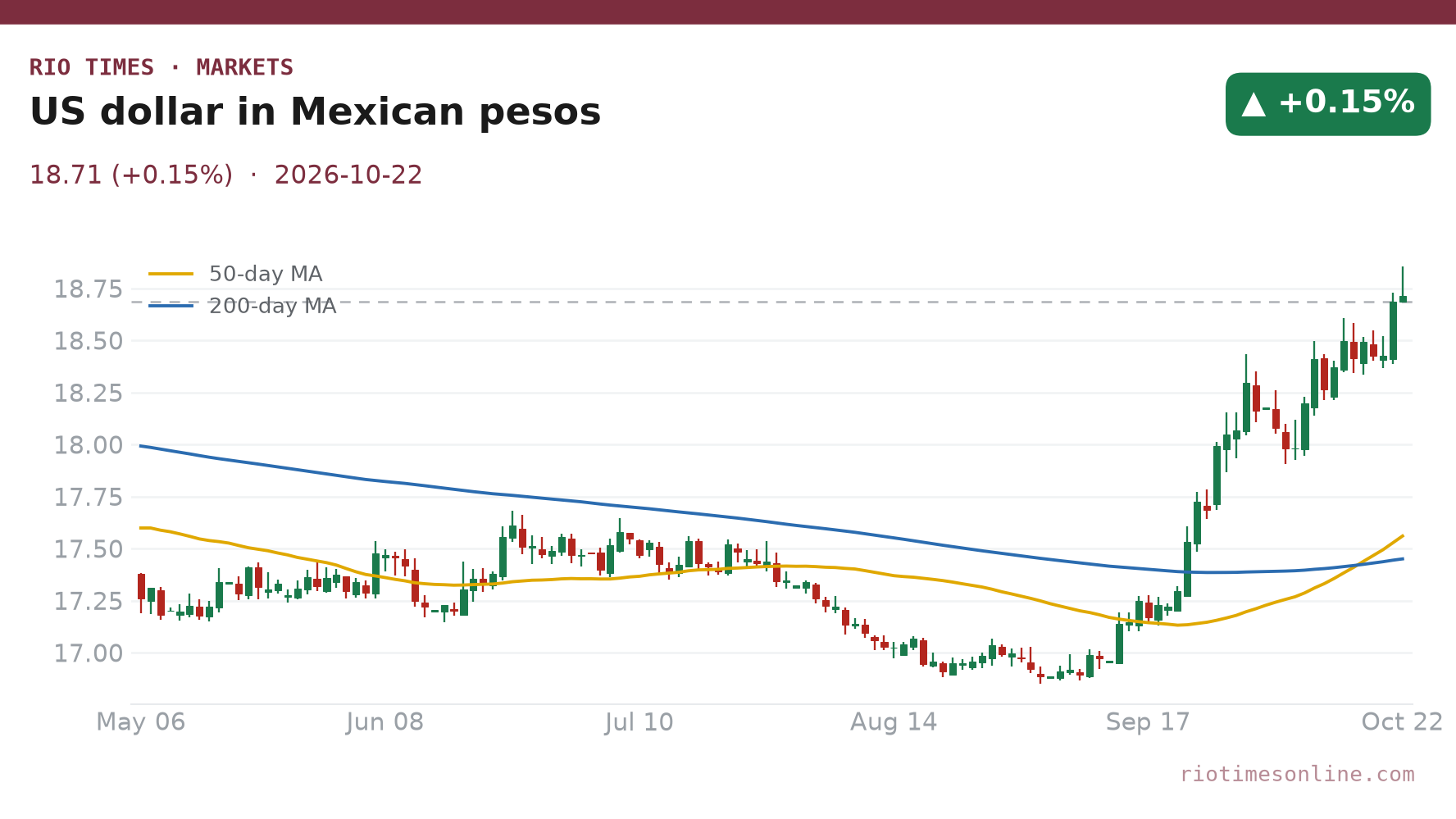
The dollar traded near 18.70 pesos on Thursday, against 18.68 at Wednesday’s close, according to RT market data. One peso is worth about US$0.053 at that rate.
The peso had already weakened about 1.4% on Wednesday, so the inflation data added little on top. It is not possible to separate the effect of the data from other news on the day.
What Prediction Markets Say
Polymarket is a platform where users trade contracts on real events, and its market on Banxico’s November decision has US$88,160 traded. As of 10:24 a.m. ET on 22 October 2026, traders price no change at 73.0% and a 25-basis-point (0.25 percentage point) cut at 26.4%.
Kalshi, regulated in the US by the Commodity Futures Trading Commission (CFTC), last traded no change at 70% and a 25-basis-point cut at 35%, with 8,603 and 11,238 contracts traded. Trading there is thin and prices for each outcome are quoted separately, so they do not add up to exactly 100%, and all these prices are bets, not polls.
Why we show this: prediction markets turn real-money bets into a live probability that moves within minutes of the news, which is why investors, campaigns and newsrooms in the United States now follow them closely. We show them next to polls and official results, never instead of them.
What It Means for You
For US investors in Mexican stocks, bonds or the peso, the data point to sticky underlying prices and a central bank in no hurry to cut. Higher Mexican rates support the peso, but they also raise borrowing costs for the companies that sell to Mexican shoppers.
For residents and visitors, inflation of 3.62% means everyday prices are rising at a moderate pace. At about 18.7 pesos per dollar, US$100 buys roughly 1,870 pesos, and electricity bills may jump in the 18 cities where the summer subsidy ended.
What Is Not Known
It is not yet clear whether electricity and tomatoes will keep pushing prices up in the second half of October. The next fortnight will show whether the jump in non-core prices was a one-off.
What supports a calmer path is a fall in farm prices and a yearly rate still inside the tolerance range. What could reverse it is a weaker peso, which raises the cost of imports, and further rises in energy prices.
Frequently Asked Questions
How much was Mexico’s inflation in early October 2026?
Annual inflation was 3.62% in the first half of October 2026, up from 3.42% in the first half of September, INEGI reported on 22 October. Analysts had expected 3.6%.
What is core inflation in Mexico?
Core inflation leaves out volatile items such as fuel, farm goods and government-set prices. It was 3.78% a year in early October, against a forecast of 3.7%.
What pushed Mexican prices up in early October?
Electricity prices rose 18.5% in the fortnight as summer-rate subsidies ended in 18 cities. Green tomatoes rose 22.1% and courgettes 16.3%.
Will Banxico cut interest rates in November?
Banxico decides on 5 November and held its rate at 6.50% on 24 September. Core prices above forecast argue for patience, though one reading does not set policy.
What was Mexico’s unemployment rate in September 2026?
Unemployment was 2.8% in September, down from 3.0% in August, INEGI reported on 22 October. Forecasters had expected 3.0%.
Sources
INEGI, consumer price index · INEGI, national employment survey · La Razón · Milenio · López-Dóriga · Banco de México, policy announcements · Polymarket · Kalshi. Forecasts and earlier values from the RT economic calendar; peso rates from RT market data. This is news, not investment advice.
Connected Coverage
Mexico inflation rises to 3.45% in September, core eases to 3.75%
Mexico retail sales rise 1.2% in August
This article was produced by The Rio Times’ automated newsroom system. How we use AI · Report an error · Editorial responsibility: Matthias Camenzind, Editor-in-Chief
In depth
LatAm Markets: Live Signals → — real-time movers, turnover leaders and FX across Latin America.