Tunisia Holds Rate at 7% as Energy Imports Jump 28%

CENTRAL BANKS · TUNISIA
Key Facts
- —The country Tunisia is a North African economy on the Mediterranean that relies heavily on imported fuel and pays for it in hard currency.
- —Why it matters Costlier fuel imports are draining reserves and widening the external deficit, the pressure points that foreign creditors watch most closely.
- —Why now The board met on Wednesday 7 October, two days after data showed inflation rising to 5.6%, and as the dinar weakened past three to the dollar.
- —What happened The Central Bank of Tunisia kept its policy rate at 7.00% on 7 October and said inflation risks still point upwards.
- —The numbers Inflation 5.6% in September. Energy imports about US$3.8 billion to August, up from US$2.9 billion. Reserves cover 92 days of imports, down from 104.
- —What it means for US readers Holders of Tunisian debt face a thinner reserve cushion. A dollar now buys more than three dinars, which helps US visitors.
- —Still open How long global energy prices stay high, and whether the bank moves to a rate rise if inflation keeps climbing.
The Tunisia central bank decision came on Wednesday 7 October: the Central Bank of Tunisia (BCT) held its policy rate at 7.00%. It warned that a costlier energy bill is eating into the country’s foreign reserves. For foreign investors and visitors, the message is that Tunisia’s money is holding steady while its external cushion thins.
The bank’s board of directors, which sets monetary policy, said the risks to inflation “remain tilted to the upside” (translated from French). It added that it stands ready to act if price pressures build.
The decision followed fresh data from the National Institute of Statistics (INS), the state statistics office. On Monday 5 October it reported that consumer prices rose 5.6% in the year to September.
Energy Imports Drive the Pressure
The board’s statement put energy at the centre of its worries. Global energy prices have climbed well above the levels assumed in the bank’s June forecasts, it said.
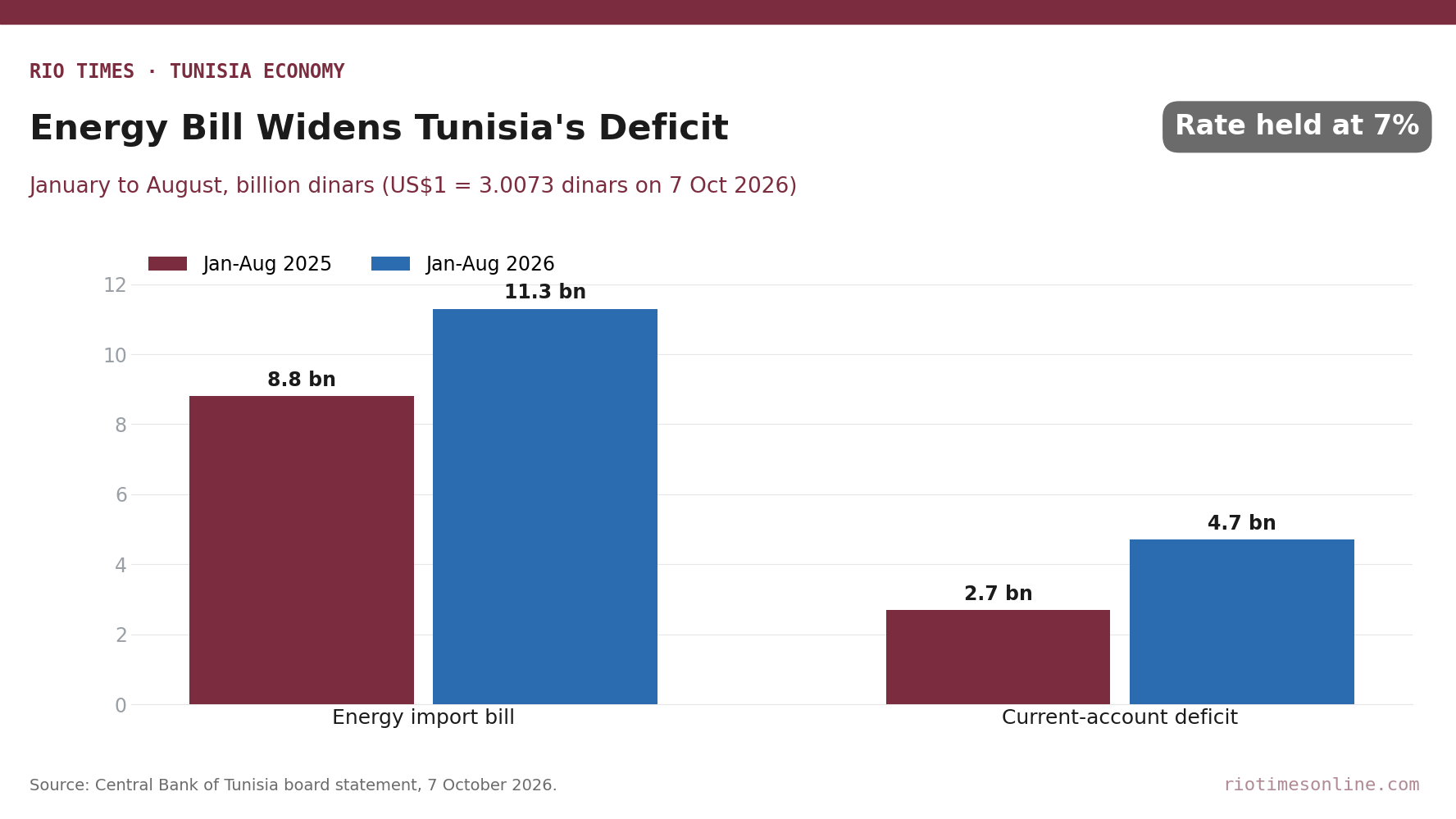
Tunisia’s energy import bill reached 11.3 billion dinars (about US$3.8 billion) by the end of August. A year earlier it stood at 8.8 billion dinars (about US$2.9 billion). That is a rise of roughly 28%.
The bill has spilled into the wider accounts. The current-account deficit, which measures the gap in trade, services and income with the rest of the world, widened sharply. It reached 4.69 billion dinars (about US$1.6 billion) in the first eight months of 2026. That equals 2.5% of gross domestic product.
In the same period of 2025 the gap was 2.72 billion dinars (about US$906 million), or 1.6% of GDP.
All dollar conversions in this article use the BCT’s average interbank rate for 7 October, when US$1 bought 3.0073 Tunisian dinars and one euro bought 3.3671.
Reserves and Growth Lose Ground
Net foreign-currency reserves stood at 23.7 billion dinars (about US$7.9 billion) on 6 October. That covers 92 days of imports.
A year earlier the bank held 24.3 billion dinars (about US$8.1 billion), worth 104 days of imports. The board called for an adequate level of reserves to be preserved, mainly through tighter control of the energy deficit.
Growth is also slowing. The economy expanded 2.3% year on year in the second quarter, down from 2.6% in the first, the bank said. It pointed to a clear slowdown in industrial activity.
There is a stabiliser in the picture. With the policy rate at 7.00% and inflation at 5.6%, savers still earn a real return of about 1.4 points. A positive real rate is the main tool central banks use to keep savings in the local currency attractive.
Food Prices Push Inflation Higher
The INS figures show where households feel the squeeze. Food and drink prices rose 8.4% in the year to September, up from 7.5% in August.
Fresh fruit was up 16.3% and fresh vegetables 12.9%. Poultry rose 16.5%. Overall prices climbed 0.8% in a single month.
Underlying inflation was calmer. The INS measure that excludes food and energy held at 4.9%. The bank’s own core gauge, which strips out fresh food and state-set prices, stayed at 5.1% for a third month.
That gap explains the hold. A rate rise would do little to cool vegetable prices, while it would weigh on an economy that is already slowing. The Tunisia central bank board chose to wait and watch instead.
What It Means for US Readers
For investors, the reserve figure is the one to watch. Ninety-two days of import cover is a thinner buffer than a year ago. It leaves less room if energy prices stay high.
For travellers, the weaker dinar is good news. A dollar now buys more than three dinars, which makes Tunisian hotels and meals cheaper for US visitors.
For companies that sell into Tunisia, the picture is mixed. A slower economy and dearer imports could squeeze demand, while steady rates keep borrowing costs predictable for now.
Tunisia also matters beyond its size. It is a major departure point on the central Mediterranean migration route to Europe, so its economic health is watched in Washington and European capitals alike. For background, see our guide Tunisia Explained 2026: Saied’s Republic, the Economy, Migration Pressure and What to Watch.
What Is Not Known
The bank gave no forecast for inflation or the exchange rate in its statement. It did not say what would trigger a rate change.
It is also unclear how long the energy shock will last. The board itself said uncertainty over the return of normal supply on energy markets “remains high”.
Finally, the effect of the 2027 budget is still unknown. The bank tied the inflation path partly to how the government handles its fiscal imbalances. Our earlier report, Tunisia’s Kais Saied Runs Low on Options as IMF Deal Stalls and Debt Tops 82 Percent, sets out the debt side.
Frequently Asked Questions
What did the Central Bank of Tunisia decide?
On Wednesday 7 October 2026 its board kept the policy rate unchanged at 7.00% and said the risks to inflation remain tilted to the upside.
What is Tunisia’s inflation rate?
The National Institute of Statistics put annual inflation at 5.6% in September 2026, up from 5.4% in August, driven by fresh food.
Why is Tunisia’s energy bill rising?
Global energy prices are well above the levels the bank expected in June. Energy imports reached about US$3.8 billion by August, up from about US$2.9 billion a year earlier.
How strong are Tunisia’s reserves?
Net reserves were about US$7.9 billion on 6 October 2026, enough for 92 days of imports, compared with 104 days a year earlier.
Is Tunisia cheaper for US travellers now?
Yes. On 7 October the dinar traded at 3.0073 to the US dollar at the central bank’s average rate, so hotels and meals cost less in dollar terms.
Sources: Central Bank of Tunisia, board press release, 7 October 2026; Central Bank of Tunisia, average interbank exchange rates, 7 October 2026; National Institute of Statistics, consumer price index, September 2026; Kapitalis, 7 October 2026.
Editorial responsibility: Matthias Camenzind, Editor-in-Chief · Editorial standards · Report an error
Part of our ongoing coverage
Africa: The New Scramble — the great-power contest over the continent.