Trinidad and Tobago Geopolitics Explained 2026

TRINIDAD AND TOBAGO · GEOPOLITICS
Key Facts
- —What is happening Washington, Beijing, New Delhi, Abu Dhabi and Ankara all court Trinidad and Tobago, which won a UN Security Council seat for 2027 and 2028 on 3 June 2026.
- —Why it matters The two islands sit just off Venezuela and ship gas, ammonia and methanol to US buyers, so their choices touch US energy security, fertiliser supply and Caribbean policing.
- —The numbers The US tariff on its goods is 10%, announced on 23 July 2026, with energy and fertiliser exports at 0%, and China trade has passed US$1 billion for four years running.
- —Who is who Prime Minister Kamla Persad-Bissessar of the United National Congress leads a US-leaning line, and Foreign Minister Sean Sobers handles Washington, Beijing, New Delhi and the United Nations.
- —What to watch The Security Council term starts on 1 January 2027, and US licences for cross-border Venezuelan gas can still be changed by Washington.
- —What it means for you US investors and buyers deal with a security ally that also keeps China, India and Venezuela close, and gas supply is the main risk for ammonia, methanol and LNG.
One close ally, five courting powers and a seat at the UN. Here is who wants what from the islands in October 2026.
Trinidad and Tobago geopolitics in October 2026 means one close ally, Washington, and several powers competing for a place beside it. China, India, the Gulf states and Turkey all keep a foothold in this two-island gas exporter off Venezuela.
Prime Minister Kamla Persad-Bissessar has tied security policy to the United States since 2025. Her government still signs deals in Beijing, New Delhi and Abu Dhabi.
Two earlier Rio Times guides cover the region, the Latin America role guide and the Caribbean neighbourhood guide. This guide follows the great powers instead and leaves the Venezuela reset and the CARICOM dispute to them.
Conversions use 6.77 Trinidad and Tobago dollars per US$1, the open.er-api.com rate of 20 October 2026 (00:02 UTC). More coverage sits on the Rio Times Caribbean page.
What Drives Trinidad and Tobago Geopolitics
The islands are small, rich in gas and close to Venezuela, which gives every great power a reason to call. The government in Port of Spain uses that interest to collect security help, trade deals and diplomatic cover.
Prime Minister Persad-Bissessar leads the United National Congress (UNC), the governing party since 2025. Pennelope Beckles-Robinson leads the opposition People’s National Movement (PNM), which governed before it.
Sean Sobers, Minister of Foreign and CARICOM Affairs, carries most of the diplomacy. Davendranath Tancoo is Finance Minister, and Satyakama Maharaj is Trade Minister, according to the Trinidad Guardian’s July 2026 reporting.
Energy decisions sit with Roodal Moonilal, Minister of Energy and Energy Industries. On 27 July 2026 he told a US embassy delegation that the islands want an open partnership with Washington, the ministry said.

Gas is the prize behind most of these calls, and falling output is the weakness. The earlier guide on gas output falling 4.5 percent and the report on the Nutrien shutdown show what a shortage costs.
The United States, Security Partner and Tariff Collector
Washington is the power that Port of Spain has chosen to stand closest to. Deputy Secretary of State Christopher Landau phoned Persad-Bissessar on Monday, 8 September 2025, and called her a strong US partner.
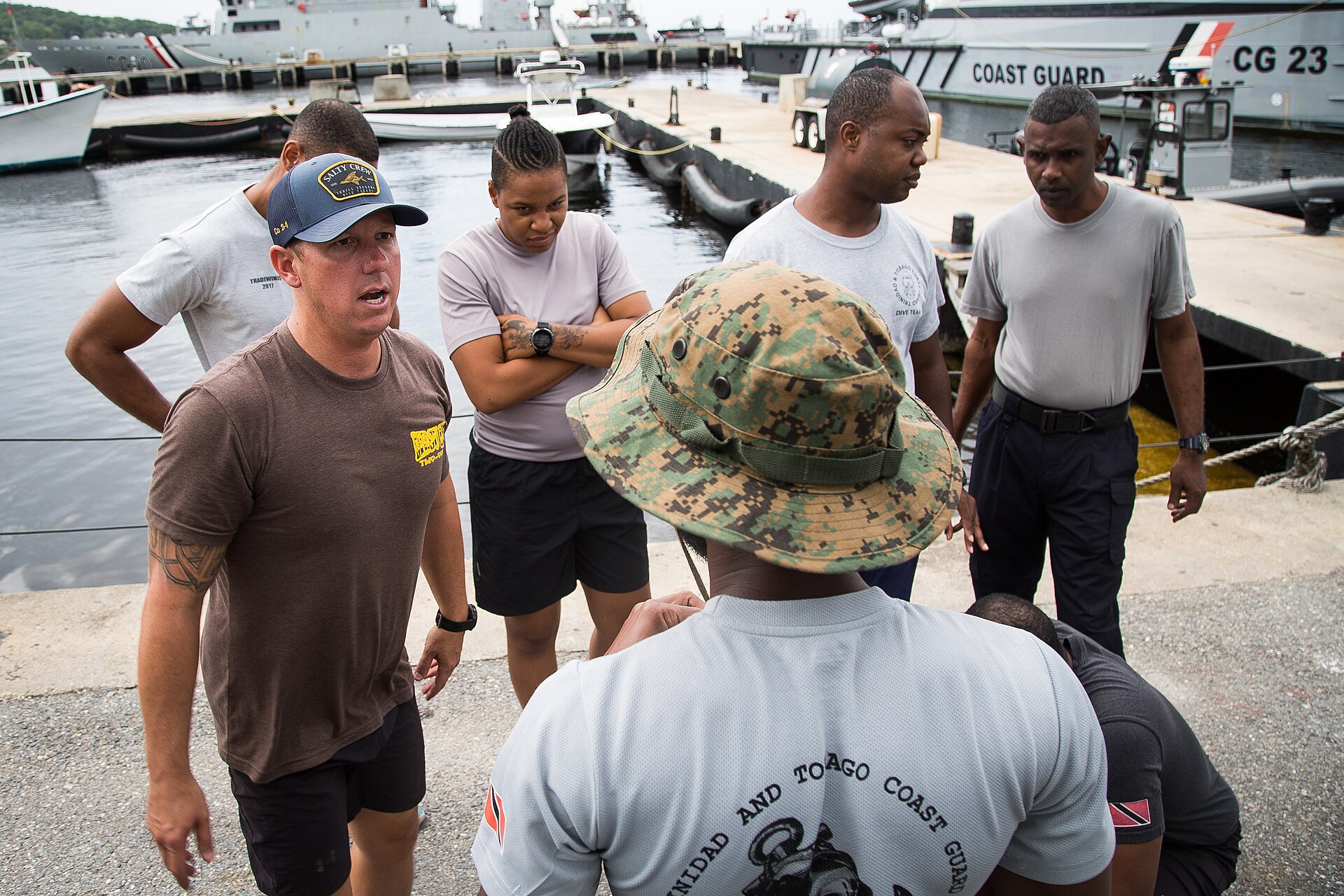
She had publicly backed US military operations in the southern Caribbean Sea, a line many CARICOM leaders did not share. In March 2026 the islands joined the Americas Counter-Cartel Coalition, a US-led anti-cartel grouping, the Trinidad Express and TTT News reported.
She defended the move in Parliament on Friday, 13 March 2026, saying cartels cannot be fought alone, TTT News reported. A Status of Forces Agreement, a legal framework for visiting US troops, was signed in December 2024, Newsday reported.
In November 2025 she said US Marines were helping at Tobago’s airport and denied any war base. The role guide covers the security detail, and what matters here is Washington’s leverage.
Trade is the first lever. From January to July 2026 US goods exports to the islands were US$2.01 billion and imports US$1.86 billion, the Census Bureau shows.
Tariffs are the second lever. The US President announced a 10% rate on 23 July 2026, down from 15% since August 2025, the Foreign Ministry said.
The Foreign Ministry says crude oil, liquefied natural gas, anhydrous ammonia, urea and iron pellets stay at 0%. It says those goods are over 85% of the islands’ exports to the United States.
The rate followed a US Section 301 probe, opened on 12 March 2026, into 60 partners’ bans on forced-labour imports. Parliament banned such imports on 12 June 2026, and the foreign minister met US trade officials on 14 May and 16 July.
Energy is the third lever. On 27 July 2026 US Chargé d’Affaires Philip Kern called it a unique moment, and talks covered data centres and steel.
Venezuela, Where Washington Sets the Rules for Gas
Venezuela turns the contest into a gas question, and the foreign minister’s Caracas visit and the Venezuela guide give the history. Here the point is who controls the tap.
On 13 February 2026 the US Treasury issued General Licences 49 and 50 for Venezuelan oil and gas, the Trinidad Express reported. Licence 49 lets firms negotiate contracts with state oil company PDVSA, but any work needs a separate US authorisation.
Both licences bar dealings with persons in, or controlled from, Russia, Iran, North Korea, Cuba or China. Licence 50 lets listed companies resume oil and gas operations under conditions, and the Express named Shell, BP, Chevron, Eni and Repsol.
Venezuelan royalties and taxes must flow through a US-controlled deposit fund, according to the licence terms. Payments are also barred in gold or Venezuela’s Petro digital currency.
Shell holds an interest in the Dragon field, under a 30-year licence signed in December 2023, and BP in the Manakin-Cocuina field. The state gas company NGC takes part, the American Chamber of Commerce of Trinidad and Tobago said.
Politics moved fast in September 2026. After a Caracas roadmap, Persad-Bissessar met acting President Delcy Rodríguez in New York on Wednesday, 23 September.
The two leaders agreed to exchange official visits, but no dates are public. The reset with Caracas works inside a US licence system that bars dealings with China, Russia and other named states.
China, Trade Above US$1 Billion and a One-China Pledge
China is the other great power with a large stake, and it works through trade, grants and projects. The Chinese ambassador, Ren Hongyan, said on 28 September 2025 that bilateral trade had passed US$1 billion for a fourth straight year.
That day the two governments signed an economic and technical cooperation agreement with a Chinese grant, the Trinidad Guardian reported. The grant is for projects that directly benefit citizens, and its currency was not specified in the report.
Two projects stand out. Phoenix Park Industrial Estate is a flagship Belt and Road project, and a China-donated Forensic Science Centre was about to be built.
Beijing wants political backing as much as business. On 27 May 2026 Chinese Foreign Minister Wang Yi met Sobers in New York and welcomed the one-China pledge.
Sobers said Trinidad and Tobago holds firmly to that policy and wants to coordinate with China at the UN. According to the Chinese foreign ministry’s readout, he added that ties with China would not be affected by third parties.
That line matters because Washington screens Chinese links in Venezuelan energy. The islands, in effect, run two tracks, a US security track and a Chinese trade track, and say each is separate.
The islands take part in the China-CELAC Forum, which links Beijing to the region and adopted a 2025 to 2027 plan. They joined the ninth China-Caribbean consultations in August 2025.
India, the Diaspora Partner With Gifts and Votes
India’s pull is cultural before it is commercial. Indian indentured workers first arrived in 1845, and the 180th anniversary fell on 30 May 2025.
Prime Minister Narendra Modi visited on 3 and 4 July 2025, the first such bilateral visit in 26 years. India said it would issue Overseas Citizenship of India (OCI) cards to the diaspora up to the sixth generation.
The joint statement lists gifts and projects. They include 2,000 laptops, 20 haemodialysis units, two sea ambulances, US$1 million of farm machinery and a limb camp for 800 people.
Trinidad and Tobago became the first Caribbean country to adopt India’s UPI payment system, the statement says. It also joined the Coalition for Disaster Resilient Infrastructure and the Global Biofuel Alliance.
Votes are part of the bargain. India backs the islands’ Security Council seat for 2027 and 2028, and they back its permanent membership and its 2028 bid.
External Affairs Minister Subrahmanyam Jaishankar followed on Friday, 8 May 2026, signing deals on tourism, solar panels and an Ayurveda chair. Reports differ on how many agreements were signed, so no count is given here.
The Gulf States and Turkey, Money and Flights
The Gulf link is new and mostly about investment. On Tuesday, 3 February 2026 Sobers signed an investment promotion and protection agreement with the United Arab Emirates in Dubai.
It gives investors fair treatment, protection against expropriation and a way to settle disputes, the Foreign Ministry says. The signing took place at the World Governments Summit.
Persad-Bissessar had met UAE Foreign Minister Sheikh Abdullah bin Zayed in New York in September 2025. They signed a visa waiver on Friday, 26 September 2025, the UAE foreign ministry said.
The waiver is lopsided. UAE citizens are exempt on any passport, but only Trinidadian diplomatic and official passports are, and Sobers called it a first phase.
No agreements with Saudi Arabia or Qatar appear in the official sources checked. Gulf interest therefore centres on the UAE.
Turkey is a quieter partner. Relations date to 22 May 1972, and on 29 October 2025 Sobers spoke of deeper cooperation in trade, tourism, education and energy.
The Turkish ambassador said visits by Trinidadians to Turkey were rising, without giving a figure. No trade value or investment deal was published.
Russia, the European Union and BRICS
Russia is a minor player. Ties date to 1974 with the Soviet Union, and in October 2024 then Foreign Minister Amery Browne called the Ukraine invasion unlawful.
Browne had said the same at the UN General Assembly on 24 September 2022. No sign of a Russian loan, base or arms deal appears in the sources checked.
The European Union is a trade and aid partner. The fifth CARIFORUM-EU Joint Council, covering the Caribbean members of the EU trade pact, met on 19 June 2026 in Santo Domingo.
EU programmes listed for the islands include 18 solar systems, a tier 4 data centre, a national e-identifier and a hydrogen facility. The EU gives only a regional figure, EUR 208 million (about US$233 million) for the Caribbean window.
BRICS, the bloc around Brazil, Russia, India, China and South Africa, has no visible role here. No source checked shows Trinidad and Tobago as a member, applicant or partner country.
A Seat at the Security Council
On Wednesday, 3 June 2026 the UN General Assembly elected the islands to a Security Council seat for 2027 and 2028. They won 181 votes of 190 countries voting, unopposed as the regional candidate, the Foreign Ministry said.
All five permanent members backed the bid, the government said. It is the islands’ second term, after 1985 and 1986.
Stated priorities include small arms trafficking, women and children in peace and security, and artificial intelligence. Former Prime Minister Keith Rowley welcomed the seat but said conduct on Gaza and the UN Charter would be watched.
The seat raises the stakes. From January 2027 Washington, Beijing, Moscow and New Delhi will count the islands’ vote on questions about Venezuela, Haiti and the Caribbean.
How the Powers Compare
Each power brings a different offer, and none matches Washington’s weight. The list below sums up what each wants and what it has delivered, as of October 2026.
- United States. Wants a security partner and energy access. Offers a tariff of 10%, licences for Venezuelan gas and a Status of Forces Agreement.
- China. Wants one-China support, trade and a Belt and Road showcase. Offers a grant, an industrial estate and trade above US$1 billion.
- India. Wants diaspora ties and Security Council votes. Offers laptops, medical gear, OCI cards and a UPI link.
- United Arab Emirates. Wants investment openings. Has signed an investment treaty and a limited visa waiver.
- Turkey. Wants wider Latin American and Caribbean outreach. Has offered goodwill and no published deals.
- Russia. Keeps a diplomatic channel open. No loan, base or deal is published, and its last stated exchange with Port of Spain, in October 2024, was on Ukraine.
- European Union. Wants trade rules observed. Offers duty-free access for goods and project funding.
The pattern is multi-alignment with a clear lean. Port of Spain takes security from Washington, trade from Beijing and diaspora gifts from New Delhi.
What It Means for US Readers
Investors should read the islands as a gas-supply story inside a US licence system. Licences can be revised, and none of those checked shows a published end date.
Buyers of ammonia, urea and methanol benefit from the 0% tariff on the main exports. Because ammonia and urea are exempt, gas supply, not duties, sets the risk.
Travellers should expect an English-speaking destination with a close US security tie. Check State Department travel advice before booking, since the Venezuelan coast and maritime crime shape the government’s agenda.
Policy watchers should expect close US alignment on drugs and Haiti, while China and Gaza are less clear. That is a reading of stated positions, not a forecast.
What Is Not Known
The islands’ obligations under the Americas Counter-Cartel Coalition were not spelled out in the sources checked. Nor is it known what US forces remain in Tobago, since the foreign ministry has not said.
The currency of China’s grant was not specified, so no US$ value can be given. No source checked gives the cost or lender of Chinese-linked projects such as Phoenix Park.
No dates are public for the visits agreed between Port of Spain and Caracas. How long US licences for Venezuelan gas will last is also unknown.
No trade value is published for Turkey or the UAE, and no Qatar or Saudi deals appear. The current government’s stance on Ukraine and BRICS is not stated in any source checked.
Frequently Asked Questions
Who are the main powers courting Trinidad and Tobago?
The United States is closest on security and trade. China, India, the United Arab Emirates and Turkey also have ties, and the European Union is a trade partner.
Is Trinidad and Tobago an ally of the United States?
It is a close security partner. It signed a Status of Forces Agreement in December 2024 and backed US operations in the Caribbean.
What tariff does the United States charge Trinidad and Tobago?
The rate is 10% on most goods, announced by the US President on 23 July 2026, the Foreign Ministry says. Crude oil, LNG, ammonia, urea and iron pellets stay at 0%.
How close is Trinidad and Tobago to China?
Trade passed US$1 billion for a fourth straight year, the Chinese ambassador said in September 2025. On 27 May 2026 Sobers told Wang Yi the islands keep to the one-China policy.
Why does India matter to Trinidad and Tobago?
Many citizens descend from Indian workers who arrived from 1845. Modi visited in July 2025, and India backs the islands’ Security Council seat for 2027 and 2028.
When does the Security Council term begin?
It begins on 1 January 2027 and runs for two years. The General Assembly elected the islands on 3 June 2026.
Sources: Ministry of Foreign and CARICOM Affairs (UAE investment agreement); Ministry of Energy (meeting with US Chargé d’Affaires); UAE Ministry of Foreign Affairs; US Census Bureau (trade with Trinidad and Tobago); Prime Minister of India (joint statement, July 2025); Ministry of Foreign and CARICOM Affairs (Russia, October 2024); Ministry of Foreign and CARICOM Affairs (Turkey); EU External Action Service (CARIFORUM-EU Joint Council communiqué); European Commission (Trinidad and Tobago); Chinese Ministry of Foreign Affairs (Wang Yi and Sobers, readout); China cooperation, US tariff, Security Council debate, UAE visa waiver, Turkey (Trinidad Guardian, five articles); Trinidad Express (Security Council vote); US Treasury OFAC (General Licences 49 and 50); TTT News (Counter-Cartel Coalition debate); Trinidad Express (Counter-Cartel Coalition); Ministry of Foreign and CARICOM Affairs (tariff statement, 25 July 2026); Ministry of Foreign and CARICOM Affairs (Security Council election); Trinidad Express (US licences); Newsday (Marines and radar); Jamaica Observer (Venezuela meeting); Caribbean Today (Landau call); Caribbean Today (UN speech, 2022); Tribune India (Jaishankar visit); open.er-api.com (exchange rate) (all accessed 20 October 2026).
This article was produced by The Rio Times’ automated newsroom system. How we use AI · Report an error · Editorial responsibility: Matthias Camenzind, Editor-in-Chief
Expat Guide to Trinidad and Tobago
What The Rio Times publishes for foreigners who live in or move to Trinidad and Tobago.
Start here
- Moving to Trinidad and Tobago 2026, Step by Step
- Moving to Trinidad and Tobago: Visas, Costs, Work Permits and Daily Life
- Healthcare in Trinidad and Tobago for Expats: Hospitals, Insurance and Costs
- Trinidad and Tobago Taxes for Foreign Residents: 25% Above US$13,200 Allowance, 30% Above US$147,000
Coming up in Trinidad and Tobago
Understand Trinidad and Tobago