By Juan Pablo Álvarez
Latin America is one of the poorest and most unequal regions on the planet, but it also has development potential that is currently untapped.

And one of the areas that could drive the economies to a greater extent than is currently seen is mineral exploitation.
According to a report by the International Energy Agency (IEA), Latin America is an established producer of several minerals essential for clean energy technologies and could leverage its “well-established mining sector” to diversify into new minerals and help the global economy avoid shortages and bottlenecks that could threaten clean energy transitions.
The region already produces large quantities of lithium, needed for batteries and copper, and supports the expansion of renewable energy and power grids.
But Latin America could expand the production of several materials, such as rare earth elements needed for electric vehicle engines and wind turbines, and nickel, a key component of batteries.
“However, to tap into this potential, mining activities must adhere to strict environmental, social, and governance (ESG) standards and look for ways to generate tangible benefits for local communities,” IEA clarifies.
GRAPHITE, NICKEL, MANGANESE
Regarding graphite, nickel, manganese, and rare earth elements, the international entity states that Brazil possesses about one-fifth of the world’s reserves of each of these resources but currently produces only small or moderate amounts, between 0.2% of the world production of rare earth elements and 7% in the case of graphite.
Furthermore, IEA indicates that Latin America has not yet attracted sufficient investment commensurate with its potential.
For example, only 7% of the global exploration budget for nickel and rare earth elements is allocated to the region.
MEXICO AND COLOMBIA HAVE YET TO EXPLOIT THEIR COPPER POTENTIAL
Latin America accounts for 40% of world copper production, led by Chile (27%), Peru (10%), and Mexico (3%).
While the region’s share of world reserves is very similar to its share of production, the International Energy Agency warns that Colombia has untapped potential.
“Existing producers could rapidly increase production but face long-term efficiency problems due to declining ore quality.”
“The region’s share of global copper exploration spending has risen from 35% to 45% over the past decade, indicating the potential for further production increases,” the report states.
It should be noted that Colombia has recently launched a strategic roadmap, the Ruta del Cobre, to expand the national copper industry. However, the IEA regrets that “more information alone will not be enough to trigger the investment needed to exploit these resources fully.”
BOLIVIA, THE SLEEPING LITHIUM GIANT
The region supplies 35% of the world’s lithium, led by Chile (26%) and Argentina (6%), the world’s second and fourth largest producers, respectively.
The region holds over half of the world’s lithium reserves, mainly in Argentina (21%) and Chile (11%).
Bolivia also has enormous untapped lithium resources, almost comparable to the world’s current lithium reserves, although the lack of infrastructure prevents them from being economically viable.
According to information from the U.S. Geological Survey, Bolivia has the most lithium resources in the world.
Still, regarding reserves, it is not even listed under “other countries”.
What is the difference between resources and reserves?
Lithium resources refer to an estimated amount of lithium in a particular geographic area.
In contrast, a lithium reserve is a portion of a lithium resource that has already been evaluated and is expected to be economical for production and sale.
Brazil, meanwhile, produces 2% of the world’s lithium.
LATIN AMERICA’S SHARE, MINERAL BY MINERAL
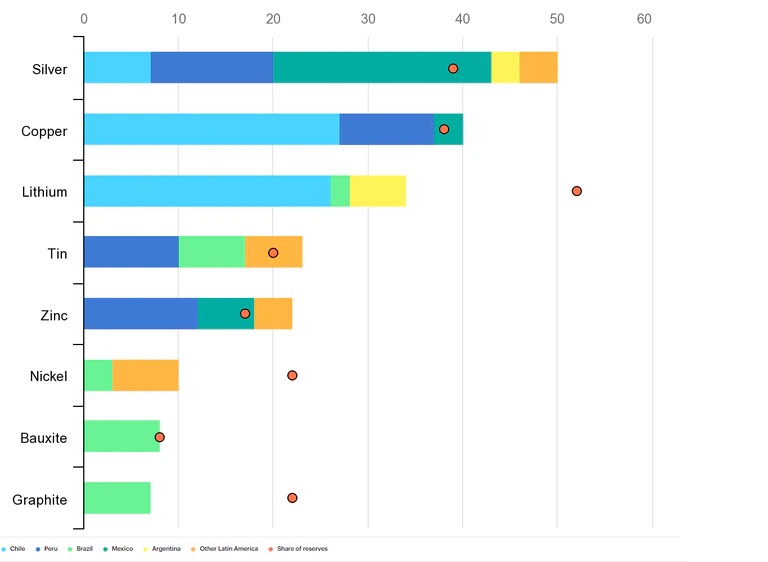
- Silver: Latin America produces 50% of the world’s silver (Mexico, 23%; Peru, 13%; Chile, 7%; Argentina, 3%; rest of Latin America 4%). The region has 39% of the world’s silver reserves.
- Copper: Latin America produces 40% of the world’s copper (Chile, 27%; Peru, 10%, Mexico, 3%). The region has 38% of the world’s copper reserves.
- Lithium: 34% of the lithium produced globally comes from Latin America (Chile, 26%; Argentina, 6%; Brazil, 2%). The region has 52% of the world’s lithium reserves.
- Tin: 23% of the world’s tin production is from Latin America (Peru, 10%; Brazil, 7%; rest of Latin America, 6%). The region has 20% of the world’s tin reserves.
- Zinc: Latin America produces 22% of the world’s zinc (Peru, 12%; Mexico, 6%; the rest of Latin America, 4%). The region accounts for 17% of the world’s zinc reserves.
- Nickel: Only 10% of the world’s nickel comes from Latin America, despite the fact that the region has 22% of the world’s nickel reserves. Brazil accounts for 3% of the world’s nickel production and the rest of the Latin American countries, as a whole, 7%.
- Bauxite: 8% of the world’s bauxite production is in Brazil, which is the only Latin American country that produces it. The volume of production coincides with the percentage of reserves.
- Graphite: Brazil also produces 7% of the world’s graphite, being the only country in the region that works this material. Latin America accounts for 22% of the world’s graphite reserves.
INDUSTRIALIZATION MIGRATION TO CHINA
A 2021 report by the Economic Commission for Latin America and the Caribbean (ECLAC) states that mine copper produced by Latin America increased from 24.1% of the world total in 1990 to 43.8% in 2020.
However, it warns that, at the same time, smelting and refining capacity fell from 21.9% to 11.2%, which means that most of the copper produced is now exported in concentrates.
The migration of smelting and refining capacity to China and other Asian countries brought consequences representing both vulnerabilities and opportunities for Latin American countries.
The study concludes that building new smelting and refining capacity in Latin America addresses these vulnerabilities and is economically and technologically feasible.
SOCIO-ENVIRONMENTAL CONFLICTS
The IEA itself recognizes that environmental standards are not only crucial to protect the environment but also to gain and maintain the support of local communities.
“Major catastrophes over the past decade have fueled anti-mining sentiment.”
“Prominent examples are the 2014 spill of 40,000 cubic meters of sulfuric acid over the Sonora River in Mexico, which affected the water supply of thousands of people, and the 2019 Brumadinho tailings dam disaster in Brazil, in which 270 people died,” the paper argues.
Although Latin American countries have established frameworks for environmental licensing and regulation, there is still room for improvement in implementation and enforcement, according to a recent report by the Inter-American Development Bank.
With information from Bloomberg
More: Brazil news in English, every day from The Rio Times.
This article was produced by The Rio Times’ automated AI newsroom. Editorial responsibility: Matthias Camenzind, Publisher and Editor-in-Chief. The Rio Times also runs Ask Rio Times, which answers from 100,000+ of our own articles, the daily Latin America Power Map, and prediction-market odds on elections and markets.. How we use AI · Report an error