The World Bank improves Mexico’s economic projection and worsens that of Argentina
On Tuesday (6), the World Bank delivered its new projections for the world economy, and its estimate for Latin America and the Caribbean showed a marginal improvement.
The multilateral organization expects the region’s aggregate Gross Domestic Product (GDP) to expand by 1.5% in 2023 after it had assigned 1.4% up to April.
There was a substantial change in the outlook within some countries.

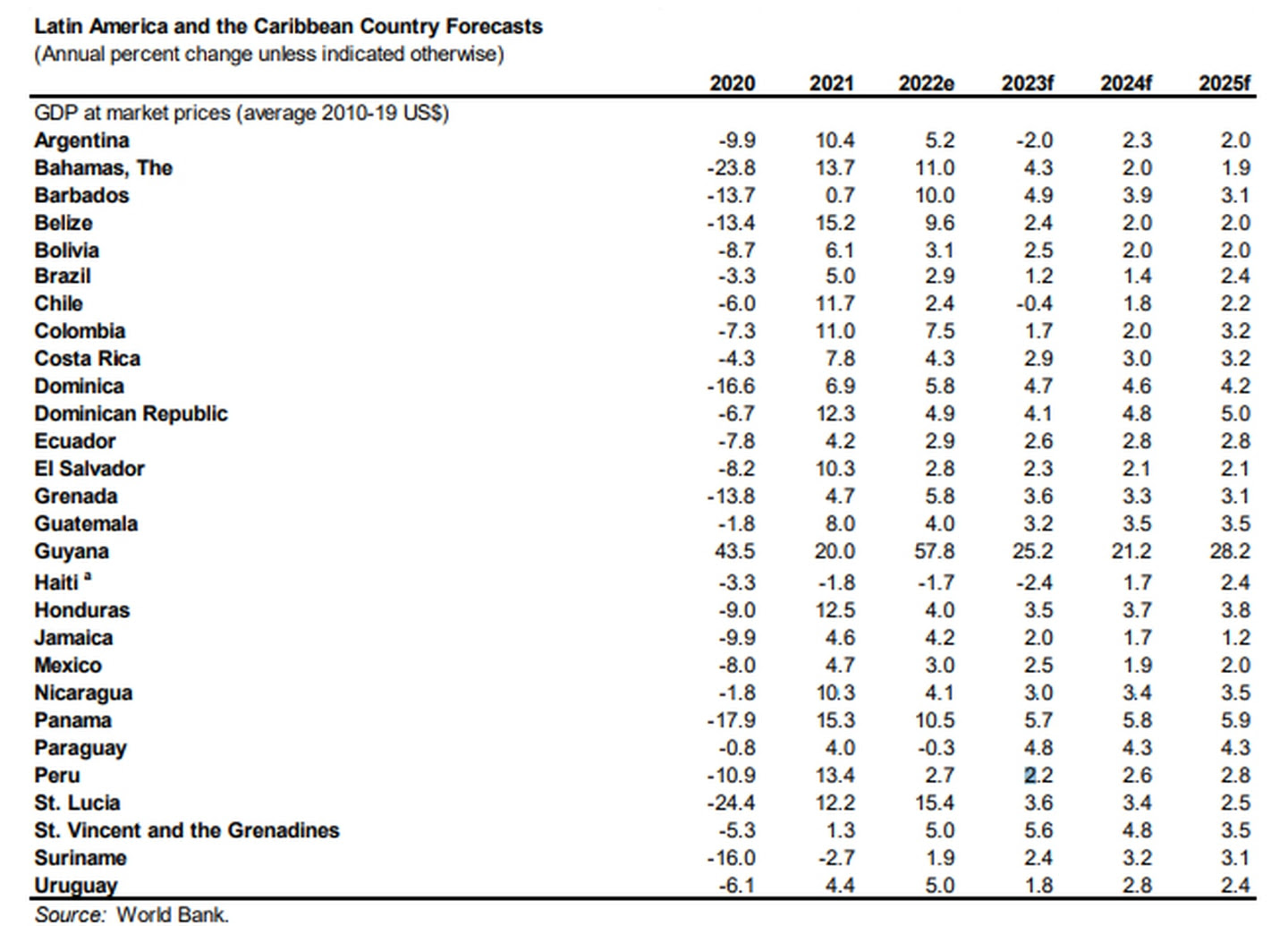
For example, the World Bank expects Argentina’s GDP to fall 2% this year when up to two months ago, it expected 0% growth.
Until the end of last year, the country was expected to have an economic growth of 2%.
In contrast, the World Bank’s projections were positive for the second regional economy, Mexico.
The country governed by Andrés Manuel López Obrador could grow 2.5% this year, according to the organization, when until April, it was projected an expansion of 1.5%.
Meanwhile, Brazil, the most important economy in Latin America, will grow 1.2% in 2023 (two months ago, the World Bank believed it would grow 0.8%).
The outlook is also improving in Chile, which until recently was expected to fall 0.7% in the year, and now this negative forecast has been cut to a 0.4% decline.
Likewise, there was a 0.6% percentage increase in expectations for the Colombian economy (in April, it was expected to expand by 1.1% in 2023, and now it is expected to expand by 1.7%).
THE COUNTRIES WITH THE HIGHEST GROWTH IN LATIN AMERICA
Except for Argentina and Chile, all Spanish-speaking countries will have economic growth in 2023, although uneven, according to the World Bank:
- Bolivia: 2.5%
- Costa Rica: 2.9%
- Dominican Republic: 4.1%
- Ecuador: 2.6%
- El Salvador: 2.3%
- Guatemala: 3.2%
- Honduras: 3.5%
- Nicaragua: 3%
- Panama: 5.7%
- Paraguay: 4.8%
- Peru: 2.2%
- Uruguay: 1.8%
THE WORLD BANK’S ANALYSIS
“Growth in Latin America and the Caribbean is projected to slow further in 2023, to 1.5%,” the entity detailed.
And it explained:
“Weak growth in advanced economies is expected to affect export demand, while restrictive monetary policies in those economies, together with persistently high domestic inflation, are likely to prevent any significant easing of financial conditions in the short term”.
On the other hand, the paper warns that the outlook faces several downside risks, including:
- Persistent inflation in advanced economies may require central banks to maintain tighter monetary policies than assumed in the baseline scenario.
- Latin American and Caribbean currencies could depreciate against those of advanced economies, which would increase debt servicing costs and further raise local inflation.
- There is a risk that China’s real estate sector could weaken further. This would affect metal prices, mainly copper and iron ore, representing a downside risk for Brazil, Chile, and Peru.
- Climate change continues to pose risks for the region. For example, droughts in Argentina or excessive rainfall in Colombia could once again increase the probability of extreme La Niña or El Niño events.
THE WORLD ECONOMY IS IN A “PRECARIOUS” STATE
According to the World Bank’s latest Economic Outlook report, the global economy is facing a significant slowdown in growth and is in a precarious situation.
The report highlights that the impact of sharp interest rate hikes is weighing down economic activity and amplifying vulnerabilities, particularly in lower-income countries.
As a result, the initial resilience seen in the early months of 2023 is expected to diminish, giving way to more persistent weakness.
Although the World Bank raised its forecast for global gross domestic product (GDP) this year to 2.1% from the previous 1.7% estimated in January, it revised its outlook for 2024 to 2.4% from 2.7%.
This adjustment reflects ongoing challenges stemming from the Covid-19 pandemic and Russia’s invasion of Ukraine, which continue to affect global economic conditions.
The report also highlights that risks to the outlook remain skewed to the downside, underscoring the uncertainty surrounding future economic developments.
With information from Bloomberg
News Latin America, English news Latin America, Latin America economy, World Bank
Key Facts
— Deep Dive
— For the complete picture, read our in-depth guide: Mexico Economy 2026: GDP, Peso, Nearshoring, Banxico and Trade
More: Latin America news in English, every day from The Rio Times.
Read More from The Rio Times