Sonatrach and Sinopec Put Helium on the Table in Beijing

ALGERIA · ENERGY
Key Facts
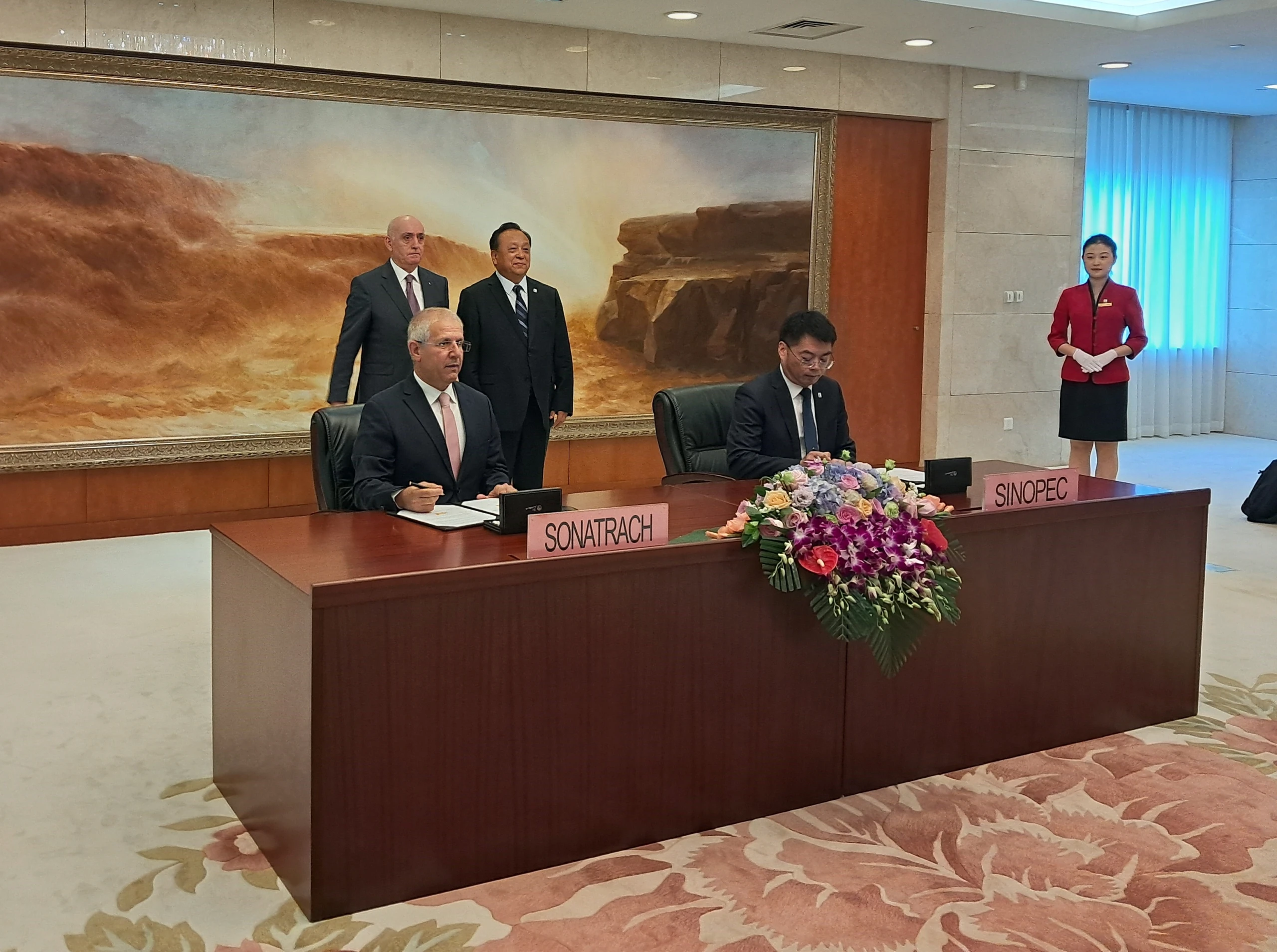
The signing: Sonatrach and Sinopec signed a memorandum of understanding in Beijing on Friday 28 August 2026. It was signed during a visit to China by Sonatrach’s chief executive, Nour Eddine Daoudi, with a senior delegation.
What it covers: The document examines cooperation in conventional and unconventional hydrocarbon projects, complex reservoir development, petrochemicals and helium.
The wider list: It also covers petroleum engineering, renewable energy and associated new technologies, and skills development.
The buried item: Helium is the unusual inclusion. It is a strategically scarce gas used in semiconductors, medical imaging and aerospace, and global supply is concentrated in very few countries.
It builds on 2024: Sonatrach says the memorandum follows an earlier agreement signed between the two companies in 2024, which identified opportunities and led to some concrete actions.
What was not disclosed: No value, no timetable and no project list were published. A memorandum of understanding is a statement of intent, not a contract.
The single source: The details come from a Sonatrach communique and Algerian press reporting of it. No independent confirmation of the terms has been published.
The Sonatrach Sinopec agreement signed in Beijing on 28 August covers unconventional hydrocarbons, complex reservoirs, petrochemicals and helium. It is a memorandum of understanding, with no value, timetable or project list disclosed.
What the Sonatrach Sinopec agreement says
The memorandum was signed on Friday 28 August during a visit to China by Sonatrach’s chief executive, Nour Eddine Daoudi, accompanied by a senior delegation. It sets out areas of common interest rather than committed work.
Those areas are conventional and unconventional hydrocarbon projects, complex reservoir development, petrochemicals and helium. Petroleum engineering, renewable energy, associated new technologies and skills development are also included.
Sonatrach says the document follows an earlier agreement between the two companies signed in 2024. That earlier work, on the company’s account, identified mutual opportunities and led to some concrete actions.
Helium is the line worth stopping on
Helium rarely appears in an oil and gas communique, which is what makes its inclusion notable. It is used in semiconductor manufacturing, medical imaging and aerospace, and there is no synthetic substitute.
Global supply is unusually concentrated. Helium is produced as a by-product of natural gas processing in a small number of countries, which makes any new source strategically interesting.
Algeria is already among the established producers, and its output has historically flowed to European buyers. A Chinese partnership in that segment would be a change of direction rather than a change of scale.
Unconventional gas is the harder ask
Algeria holds large shale resources on paper and has been trying to develop them for more than a decade. Progress has been slow, and earlier attempts drew significant domestic opposition in the south of the country.
Complex reservoir development, the other technical item on the list, is the polite description of fields that are expensive to produce. Both areas need capital and expertise more than they need acreage.
That is what a Chinese partner brings. It is also why memoranda of this kind recur without always producing wells.
Where this fits in the China-Algeria relationship
China has been Algeria’s largest trading partner for several years, and Chinese firms have a substantial presence in Algerian construction and infrastructure. Energy has been the slower part of the relationship.
Algeria has meanwhile been deepening its European gas ties, including a large supply agreement with Eni signed earlier this year. Both directions are being pursued at once.
That is a familiar pattern for a producer with options. It is also the reason to read a memorandum as positioning rather than commitment.
What Algeria wants from a Chinese partner
Algeria’s mature fields need investment to hold production, and its unconventional resources need technology it does not have in depth. Both are capital-intensive problems.
Chinese national oil companies have a long record of taking on technically awkward and politically complicated assets. That is the specific service on offer.
Sonatrach, for its part, is the largest energy company on the continent and does not need a partner for ordinary work. It signs these documents to widen its options.
The relationship therefore suits both sides on paper. Turning that into wells is the part neither company has yet described.
There is also a market question underneath the technical one. Algerian gas has been sold overwhelmingly into Europe, and a Chinese partnership does not by itself create a new buyer.
What it could create is a different set of contractors and financiers for the upstream. That is a quieter change than a new export route, and a more durable one.
How to read it
The essential caveat is that this is a memorandum of understanding. No value was announced, no timetable was set out, and no specific project was named.
The reporting rests on a Sonatrach communique carried by the Algerian press. No independent confirmation of the terms has been published, and Sinopec has not issued a detailed statement of its own.
The Beijing trip produced more than one document. A day later, on 29 August, Sonatrach signed a separate memorandum of understanding with Anton Oilfield Services Group, another Chinese firm, covering oilfield services.
The test will be whether anything follows within a defined period. Two memoranda in two years with no announced project is a pattern that means something in itself.
Frequently Asked Questions
What did Sonatrach and Sinopec sign?
A memorandum of understanding, signed in Beijing on 28 August 2026, covering conventional and unconventional hydrocarbons, complex reservoir development, petrochemicals and helium.
Why is helium significant?
It is used in semiconductors, medical imaging and aerospace, has no synthetic substitute, and global supply is concentrated in a small number of countries.
What else does the memorandum cover?
Petroleum engineering, renewable energy and associated new technologies, and skills development.
Is it a binding contract?
No. It is a memorandum of understanding, and no value, timetable or specific project was disclosed.
Have the two companies worked together before?
Sonatrach says the memorandum follows an earlier agreement signed between the two in 2024, which identified opportunities and led to some concrete actions.
Connected Coverage
More from our Northern Africa desk and the wider Africa: The New Scramble. Algeria signed a US$1.35bn gas supply pact with Eni earlier this year, and we track its diplomacy through the Egypt, Algeria and Tunisia push on Libya.
Sources
- sonatrach.com (official press release, 28 August 2026)
- energynews.pro (Anton Oilfield memorandum, 29 August 2026)
- euro-petrole.com (Sonatrach activity log)
This article was produced by The Rio Times’ automated newsroom system. How we use AI · Report an error · Editorial responsibility: Matthias Camenzind, Editor-in-Chief
Great Powers in Africa
- Who Backs Whom in Africa 2026: China, Russia, US, Gulf
- Africa: The New Scramble
- DP World and AD Ports Drive Gulf States Africa Investment as Saudi Deals Follow
- China Slashes Africa Lending 46% as Kenya and Angola Race to Refinance Old Debts