ALGERIA · NEIGHBOURHOOD
Key Facts
- —What it is Algeria shares land borders with Tunisia, Libya, Niger, Mali, Mauritania, Western Sahara and Morocco, and coordinates with Egypt on Libya.
- —Why it matters Algeria is Africa’s largest country by area and a major gas supplier to Europe, so its borders shape energy, security and migration across the region.
- —The numbers In 2024, Algeria’s merchandise exports were 6,605.8 billion Algerian dinars (about US$49 billion) and imports were 6,352.1 billion dinars (about US$47.5 billion), according to the Office National des Statistiques.
- —The catch Algeria severed diplomatic relations with Morocco in 2021 and the land border has remained closed for decades, blocking Maghreb-wide integration.
- —Who is who Algeria works most closely with Tunisia and coordinates on Libya with Egypt and Tunisia.
- —What it means for you A foreigner doing business or travelling in North Africa should read Algeria through its neighbours, because borders, pipelines and rivalries set the practical rules.
Algeria neighbours are not just lines on a map. They are energy routes, security buffers, trade corridors and the fault lines of the Maghreb’s oldest rivalry.
Algeria is Africa’s largest country by area, with a long Mediterranean coastline. This guide explains how its seven land neighbours, plus Egypt, shape Algerian policy, trade, energy and daily life as of 2026.
The neighbourhood map: who borders Algeria
Algeria’s official diplomatic description identifies its land neighbours as Tunisia, Libya, Niger, Mali, Mauritania, Western Sahara and Morocco. Egypt is not a direct neighbour, but it functions as an essential partner on Libya and Arab diplomacy.
The practical neighbourhood is broader than the border map. Tunisia is Algeria’s closest day-to-day partner in the Maghreb. Libya is a security priority and the subject of trilateral diplomacy with Tunisia and Egypt. Morocco is Algeria’s principal regional rival. Mauritania has become increasingly important for Atlantic access, trade and the Western Sahara balance. Mali and Niger connect Algeria to the Sahel, but instability there complicates relations.
Algeria’s southern borders are particularly consequential because they connect the Mediterranean economy to the Sahel. The country’s security doctrine traditionally prioritises territorial sovereignty, non-interference and the prevention of foreign military intervention near its borders.
| Neighbour or territory | Relationship to Algeria | Main strategic issue |
|---|---|---|
| Tunisia | Direct border | Trade, tourism, energy, security and migration |
| Libya | Direct border | Border security, armed conflict, political mediation and energy |
| Niger | Direct border | Sahel insecurity, migration, energy and transport corridors |
| Mali | Direct border | Armed groups, refugee flows and the breakdown of security cooperation |
| Mauritania | Direct border | Atlantic trade, road links and Western Sahara |
| Western Sahara | Border/territorial interface | Rivalry with Morocco and support for Sahrawi self-determination |
| Morocco | Direct border, closed frontier | Western Sahara, regional leadership and competing alliances |
| Egypt | No direct border | Libya diplomacy, Arab diplomacy and security coordination |

The central rivalry: Algeria and Morocco
The Algeria–Morocco relationship is the region’s most consequential strategic rivalry. The two countries share history, language, religion and economic complementarities, but competition over Western Sahara, regional leadership and external alliances has prevented normalisation.
Algeria severed diplomatic relations with Morocco in 2021, and the land border has remained closed for decades. The rivalry affects transport, energy, defence procurement and diplomatic alignments across the Maghreb.
Western Sahara is the core dispute. Algeria supports the Polisario Front and the principle of Sahrawi self-determination. Morocco claims sovereignty over the territory and promotes autonomy under Moroccan rule. In October 2025 the UN Security Council adopted Resolution 2797, which backs Morocco’s autonomy plan as a basis for negotiations. Algeria’s official position frames the issue through decolonisation and United Nations principles, while Morocco’s policy emphasises territorial integrity and its autonomy initiative.
The economic dimension of the rivalry
The Maghreb–Europe Gas Pipeline, which once carried Algerian gas through Morocco to Spain, stopped transiting Morocco after Algeria declined to renew the arrangement in 2021. Algeria instead increased the strategic importance of the Medgaz pipeline, which connects Algeria directly with Spain.
Morocco has pursued alternative energy and Atlantic strategies, including the proposed Nigeria–Morocco gas pipeline and stronger relations with Gulf states, the United States and Israel. The rivalry constrains Maghreb-wide integration because the two largest western Maghreb economies lack diplomatic relations and a functioning land crossing.
Algeria’s official account of Maghreb cooperation notes that it helped to establish the Arab Maghreb Union in 1989. It also identifies regional infrastructure, including roads, electricity connections, fibre-optic links and gas pipelines, as instruments of integration. Those projects have not overcome the political dispute.
Tunisia: Algeria’s closest practical partner
Relations with Tunisia are substantially warmer and more functional than Algeria’s relationship with Morocco. The countries signed a treaty of fraternity, good-neighbourliness and cooperation in 1970 and a further treaty of fraternity and concord in 1983.
The relationship rests on several pillars. Security cooperation matters because the shared border is vulnerable to smuggling, militant infiltration and instability spilling over from Libya. Algeria supplies gas and electricity to Tunisia and has provided support during periods of financial and energy stress. Algeria is also one of Tunisia’s most important sources of visitors, especially during the summer season.
Cross-border commerce is concentrated around food, fuel, manufactured goods and consumer products. Tunis and Algiers often share concerns about foreign intervention and instability in Libya. Tunisia’s importance to Algeria is partly geographic: it is the most accessible eastern Maghreb partner and a critical route for energy and people.
Libya: security, mediation and border management
Algeria’s border with Libya is long, remote and difficult to police. Instability in Libya creates risks involving weapons trafficking, armed groups, irregular migration and the movement of militants.
Algeria has generally supported Libya’s territorial unity, a Libyan-owned political process, the withdrawal of foreign forces and mercenaries, UN-supported elections and institutional reunification, and opposition to partition or prolonged foreign tutelage.
Algeria, Egypt and Tunisia form the Tripartite Neighbouring Countries Mechanism on Libya. A joint communiqué described the three states as those most directly affected by the Libyan crisis and reaffirmed support for a political settlement led by Libyans, with UN and regional support. Algeria’s Foreign Ministry has also reported that the three countries rejected foreign interference and called for the withdrawal of foreign forces and mercenaries.
This is both diplomacy and self-defence. Libya is not merely a foreign-policy issue for Algeria: it is a direct border-security problem. The eastern border is also connected to Algeria’s energy interests, since both countries are major hydrocarbon producers and members of the wider North African energy system.
Egypt, Mauritania and the Sahel frontier
Egypt: coordination rather than proximity
Egypt is not a direct neighbour, but it is an essential regional partner. Algeria and Egypt coordinate primarily over Libya, Arab diplomacy and African affairs. The relationship can also contain competition. Both countries seek influence in Libya and portray themselves as major Arab and African powers.
Egypt has historically maintained closer ties with some Libyan actors, while Algeria has generally stressed neutrality, non-intervention and a political settlement. The trilateral Algeria–Egypt–Tunisia format gives Algeria a way to work on Libya without relying exclusively on European or Gulf powers.
Mauritania and the Atlantic opening
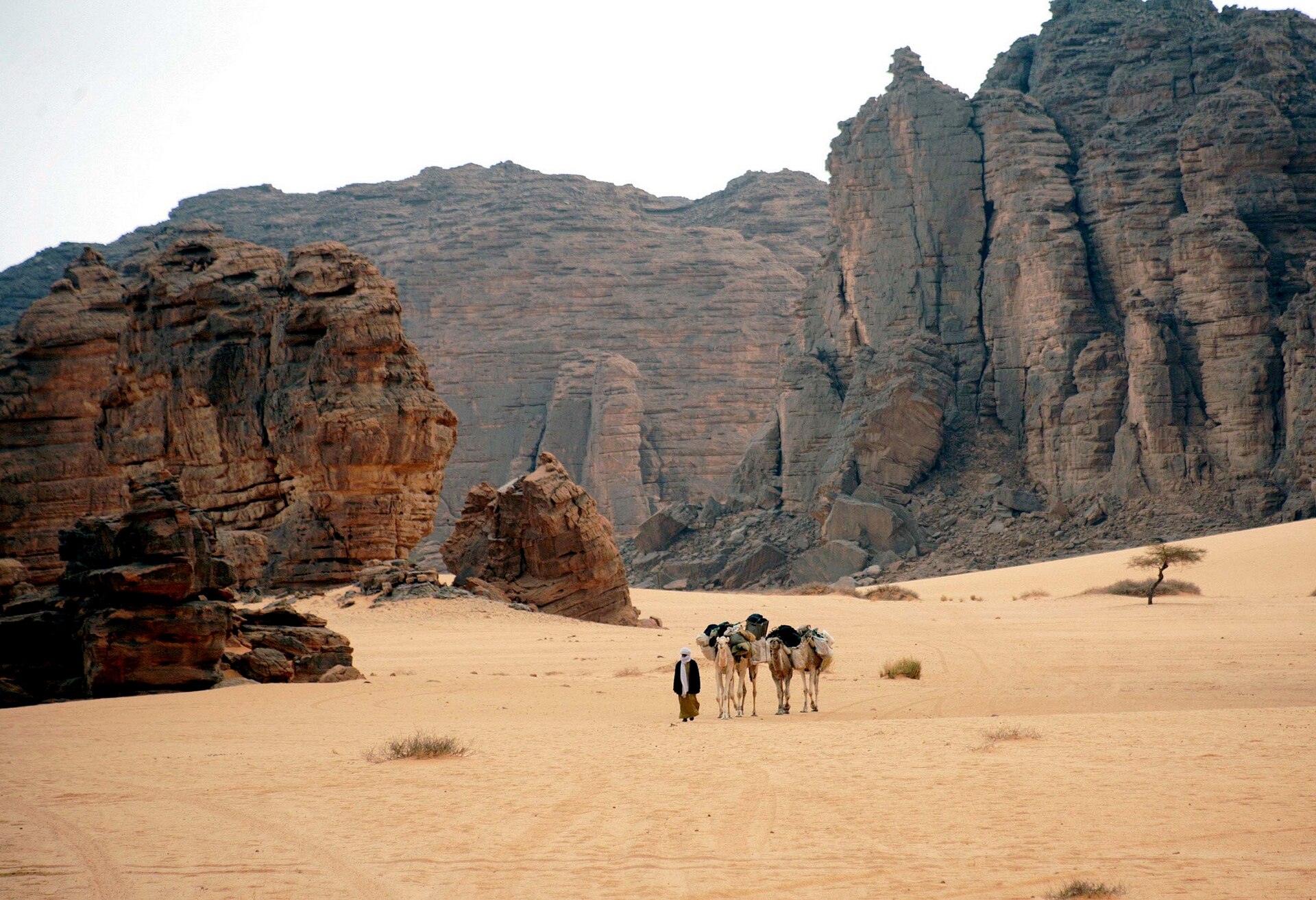
Mauritania has become more important as Algeria seeks stronger links with the Sahel and West Africa. The two countries are connected by the trans-Saharan and western Saharan security environment, and Mauritania provides access toward the Atlantic and the wider West African market.
The relationship involves road and border infrastructure, commercial links through the southern border, cooperation over security and desert-border management, coordination on Western Sahara, and efforts to connect Algerian production with markets farther south. Mauritania’s position is delicate. It seeks balanced relations with Algeria and Morocco while avoiding direct entanglement in their rivalry.
Mali and Niger: the Sahel frontier
Algeria’s southern neighbours, Mali and Niger, are central to its security policy. Both countries have experienced coups, armed conflict and the expansion or persistence of jihadist and criminal networks.
Algeria’s traditional approach has emphasised mediation and political dialogue rather than expeditionary military intervention. It played a major role in the 2015 Algiers peace process for Mali, although implementation later deteriorated. Relations deteriorated sharply in April 2025, when Algeria shot down a Malian drone that Algiers said had entered its airspace, and Mali, Niger and Burkina Faso recalled their ambassadors from Algiers.
Niger matters because it is a corridor for irregular migration toward North Africa, arms and contraband, militant movements, energy and transport projects, and Algeria’s engagement with the Sahel. The deterioration of regional security has narrowed Algeria’s room for manoeuvre. Its non-intervention doctrine remains important, but instability on its borders makes purely diplomatic solutions difficult.
Trade: substantial with Europe, limited inside the Maghreb
Algeria’s external trade remains dominated by hydrocarbons and European markets rather than by its immediate neighbours. The Office National des Statistiques reported that in 2024, merchandise exports were 6,605.8 billion Algerian dinars (about US$49 billion) and merchandise imports were 6,352.1 billion dinars (about US$47.5 billion), converted at the 2024 average of about 133.7 dinars per US$ (RT). The trade surplus fell to 253.7 billion dinars (about US$1.9 billion), and the export-to-import coverage ratio declined from 128.9% to 104%.
For the first half of 2025, ONS reported imports of 3,767.0 billion dinars (about US$28.4 billion), up 24.8% year-on-year, and exports of 3,055.6 billion dinars (about US$23.0 billion), down 8.5%, at an average of about 132.8 dinars per US$ (RT). That produced a trade deficit of 711.5 billion dinars (about US$5.4 billion) and an import-coverage ratio of 81.1%. These are the latest ONS figures reviewed for this guide, and later releases may differ.
These figures illustrate Algeria’s exposure to energy prices and import demand. They also show why regional integration is economically attractive: neighbouring markets could absorb more Algerian non-hydrocarbon products, while nearby suppliers could reduce logistical costs.
Yet intra-Maghreb trade remains far below its potential. The principal obstacles are closed or restricted land borders, political disputes, incompatible customs and regulatory systems, weak regional logistics, limited banking and payments integration, and security risks in the southern corridors.
Energy and infrastructure: where Algeria leads
Algeria leads North Africa in several forms of strategic infrastructure. It is a major gas supplier to Europe through TransMed, via Tunisia to Italy, and Medgaz, directly to Spain. The Morocco route is no longer operational for Algerian gas transit.
Algeria and Tunisia are connected through electricity interconnection infrastructure. Cross-border electricity trade and emergency support are strategically important because Tunisia is more exposed to supply constraints and fiscal pressure.
The Trans-Saharan Highway is one of Algeria’s flagship continental infrastructure projects. The road corridor runs from Algiers south through Niger toward Lagos in Nigeria. Its strategic logic is straightforward: connect Algeria’s Mediterranean ports with Niger and Nigeria, and reduce transport costs for landlocked Sahel markets. The state of the remaining sections and their timetable are not confirmed here.
What this means for foreigners, investors and expats
For a foreigner, Algeria’s neighbourhood shapes practical choices. The closed border with Morocco means you cannot simply drive or take a train between the two largest Maghreb economies. Travel and logistics often route through Tunisia or by air and sea.
For investors, the energy map matters most. Algeria’s gas now reaches Europe mainly through Tunisia and directly to Spain, not through Morocco. That changes transit economics and the political risk attached to pipeline routes. The Trans-Saharan Highway signals where Algeria wants future trade to flow, toward the Sahel and West Africa.
For expats and long-term residents, the neighbourhood affects security, migration and daily logistics. Southern borders with Mali and Niger are sensitive. The eastern border with Libya is a security priority. Tunisia remains the most practical regional partner for travel, trade and family connections.
What to watch
The main variable is whether Algeria and Morocco find any channel for de-escalation. As of early 2026, the latest period we could confirm, diplomatic relations remained severed and the border closed. The UN Security Council’s Resolution 2797 of October 2025 is the framework to watch. Any change would reshape Maghreb trade, energy and transport.
Libya is the second variable. The Tripartite Neighbouring Countries Mechanism with Egypt and Tunisia remains Algeria’s main diplomatic format. Elections, the withdrawal of foreign forces and the reunification of Libyan institutions would all affect Algeria’s eastern border.
The Sahel is the third variable. Security in Mali and Niger, and the durability of Algeria’s non-intervention doctrine, will determine whether the Trans-Saharan corridor becomes a trade route or remains a security frontier. Watch also whether Mauritania deepens its role as Algeria’s Atlantic outlet.
Related reading: More from Algeria, Algeria Explained, the economy and gas dependence and who is President Tebboune.
Frequently Asked Questions
Which countries border Algeria?
Algeria has land borders with Tunisia, Libya, Niger, Mali, Mauritania, Western Sahara and Morocco. Egypt is not a direct neighbour but coordinates closely with Algeria on Libya.
Why is the Algeria-Morocco border closed?
The land border has remained closed for decades, and Algeria severed diplomatic relations with Morocco in 2021. The core dispute is Western Sahara, where Algeria supports Sahrawi self-determination and Morocco claims sovereignty.
How does Algerian gas reach Europe?
Algerian gas reaches Europe mainly through TransMed via Tunisia to Italy and through Medgaz directly to Spain. The route through Morocco stopped operating after Algeria declined to renew the arrangement in 2021.
What is Algeria’s relationship with Tunisia?
Tunisia is Algeria’s closest practical partner in the Maghreb. The two countries cooperate on security, energy, trade and tourism, and they signed treaties of fraternity and cooperation in 1970 and 1983.
Why does Libya matter to Algeria?
Libya shares a long, remote border with Algeria. Instability there creates risks involving weapons trafficking, armed groups, irregular migration and militant movement, so Algeria works with Egypt and Tunisia through a trilateral mechanism.
What is the Trans-Saharan Highway?
The Trans-Saharan Highway is a road corridor running from Algiers through Niger to Lagos in Nigeria. It is meant to link Algeria’s Mediterranean ports with Sahel markets and lower transport costs for landlocked countries.
Sources: ons.dz, emblima.mfa.gov.dz, embjakarta.mfa.gov.dz, ons.dz, ons.dz, ons.dz, tsa-algerie.com, ons.dz. Retrieved 2 October 2026.
This article was produced by The Rio Times’ automated newsroom system. How we use AI · Report an error · Editorial responsibility: Matthias Camenzind, Editor-in-Chief
Read More from The Rio Times