Algeria’s Economy 2026: Gas Dependence, Deficits and the Slow Turn to Diversification
Key Facts
- —Hydrocarbon dependence: Oil and gas account for 92–93% of Algeria’s exports and roughly 40% of GDP, according to the IMF’s 2025 Article IV consultation.
- —External accounts: The current account is projected to swing to a deficit of about US$11.4 billion in 2026, after surpluses of US$19.1 billion (2022) and US$6.0 billion (2023).
- —Budget: President Abdelmadjid Tebboune signed a US$135 billion budget for 2026 in December 2025, extending the post-2020 spending expansion.
- —Energy diplomacy: 2026 brought a bigger gas deal with Germany’s VNG and a reinforced pipeline track with Spain via Medgaz.
The Hydrocarbon Engine — and Its Limits
Algeria enters the second half of the 2020s as Africa’s third-largest economy, with GDP projected at roughly US$285 billion in 2026 and growth of about 3.4% in 2025, or around US$6,095 per capita. The engine is unchanged: natural gas and oil. Hydrocarbons fund the state, the import bill and the generous subsidy system that underpins social peace — and they leave the country exposed to every swing in energy prices.
The IMF’s 2025 Article IV consultation laid out the arithmetic. The windfall years of 2022–2023, when Europe’s scramble to replace Russian gas filled Algerian coffers, are over. The current account is projected to widen to a deficit of about US$11.4 billion in 2026, and the Fund warns that the fiscal deficit remains elevated without strong policy action. Algerian economist Abderrahmane Mebtoul has estimated the 2025 budget gap at roughly US$61 billion — about 21% of GDP — an unofficial figure, but one that captures the scale of the revenue-expenditure mismatch.

A US$135 Billion Bet on Continuity
The government’s answer, for now, is spending. The 2026 budget, signed by Tebboune in December 2025, comes in at about US$135 billion — continuing the expansionist course set after 2020. Subsidies, public wages and infrastructure keep domestic demand alive, but they are funded by hydrocarbon revenue that depends on declining legacy fields and volatile prices.
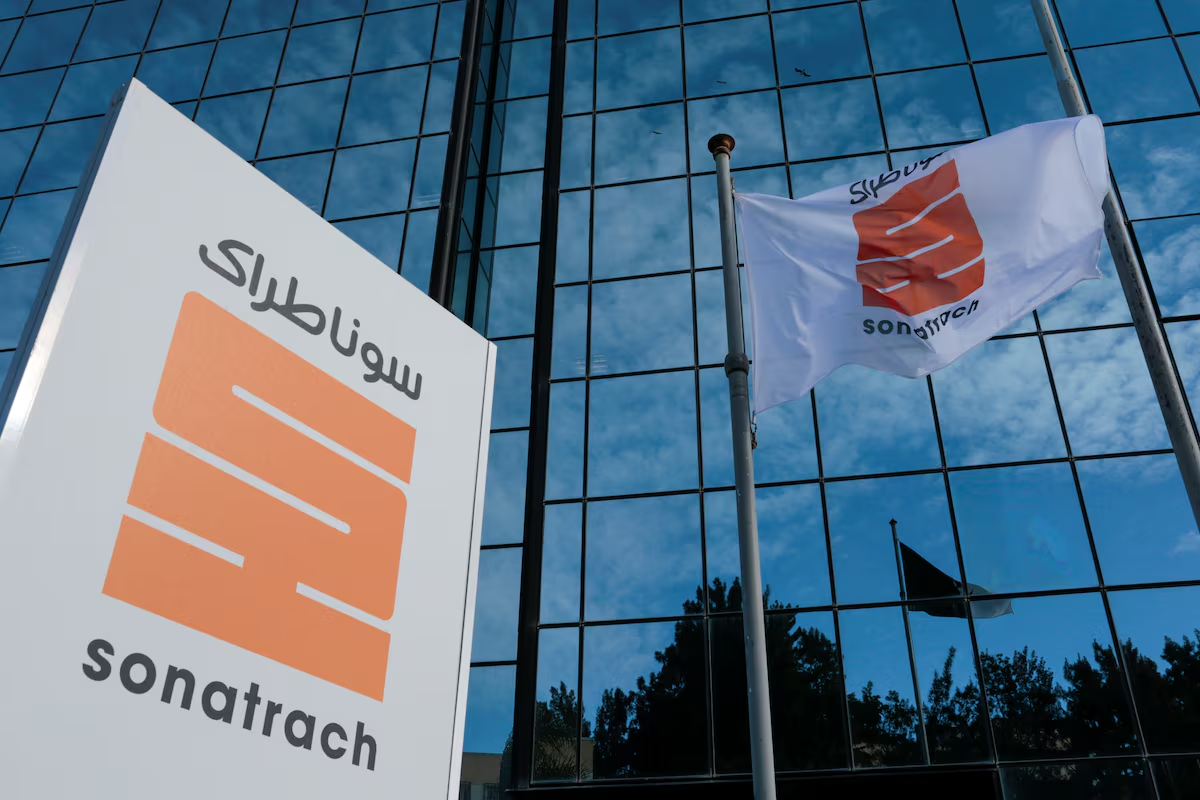
State energy giant Sonatrach is the regime’s counter-move: a US$40 billion investment program for 2023–2027 spanning exploration, refining and renewable integration. New output from the Hassi R’mel and Touat fields has expanded natural gas production, buying time for the rentier model even as planners talk about life after gas.
Europe Is Buying: Germany and Spain Deepen Gas Ties
Algeria’s strongest card in 2026 is geography. In July, during Tebboune’s official visit to Berlin, Sonatrach signed an agreement with Germany’s VNG that increases pipeline gas deliveries to Germany from January 2027 and adds cooperation on a future green hydrogen corridor — a signal that Europe’s second-largest gas supplier to the EU intends to stay relevant in the energy transition, not just the gas era.
The Spain track advanced in parallel. Prime Minister Pedro Sánchez’s July 2026 visit to Algiers reinforced the Medgaz pipeline arrangement — the direct subsea link that makes Algeria Spain’s top gas supplier — and scheduled the eighth high-level bilateral meeting for October 2026. Italian firms, meanwhile, are moving into Algerian agriculture and agri-mechanisation, a quieter but telling diversification of the relationship map.

The Diversification Question
Every Algerian government for two decades has promised to diversify away from hydrocarbons. The 2026 reality is mixed. Non-hydrocarbon exports remain marginal; the private sector operates in the shadow of the state; and periodic import-restriction drives — including a fraud inquiry into import requests this year — show how defensive the economic reflexes still are. Mining (notably iron ore at Gara Djebilet), phosphates, agriculture and renewables are the designated growth sectors, but none yet moves the macro needle.
The stakes are generational. Algeria’s median age is under 30, and the labor market cannot absorb new entrants without growth outside the state-energy complex. The gas rents of 2022–2023 financed a grace period; the deficits of 2026 are the bill. How Algiers sequences subsidy reform, private-sector opening and energy-transition investment — against a watchful security establishment — is the central economic story of North Africa’s largest country.
Frequently Asked Questions
How big is Algeria’s economy in 2026?
GDP is projected at roughly US$285 billion in 2026, with growth of about 3.4% in 2025 and GDP per capita around US$6,095 — making Algeria one of Africa’s three largest economies.
How dependent is Algeria on oil and gas?
Extremely: hydrocarbons account for 92–93% of exports and roughly 40% of GDP, according to the IMF’s 2025 Article IV consultation. The current account is projected to swing to an US$11.4 billion deficit in 2026 as energy windfalls fade.
Who buys Algerian gas?
Europe is the anchor market. Spain receives gas via the Medgaz subsea pipeline, Italy via the Transmed link, and a July 2026 agreement with Germany’s VNG increases pipeline deliveries to Germany from January 2027, with added cooperation on green hydrogen.
What is Sonatrach investing in?
Sonatrach, the state energy company, is running a US$40 billion investment program for 2023–2027 covering exploration, refining and renewable integration. New production from the Hassi R’mel and Touat fields has expanded gas output.
More North Africa coverage: Morocco news · Morocco votes on 23 September · Algeria’s import-fraud inquiry · Italian firms and Algeria’s farm push
This article was produced by The Rio Times’ automated newsroom system. How we use AI · Report an error
Read More from The Rio Times